
After a work injury, a careful clinical evaluation and a clear understanding of your claim process can help you plan your next steps. If pain or limited movement is making work and everyday tasks harder, finding a worker's comp chiropractor Arlington VA can feel complicated, especially when you’re unsure how treatment fits with employer or claim requirements. Before arranging care, review the instructions you’ve received and clarify any authorization questions through the appropriate claim channel.
This guide explains what to do after an injury, which claim and medical details to bring to a chiropractic evaluation, and how chiropractic care may fit into your treatment. At Vitalité Chiropractic in Arlington, Dr. W. Jean-Luc Sansfaute offers individualized care, including chiropractic adjustments, therapeutic modalities, and sports injury care. Use the sections below to prepare for a clinical conversation and understand which questions belong with your claims contact.
Key Takeaways
- A work-injury evaluation considers your symptoms, movement, and relevant health history to help determine whether chiropractic care may suit your needs.
- Virginia workers’ compensation procedures can vary by claim. Consult current Virginia Workers’ Compensation Commission guidance for process or treatment authorization questions.
- When comparing care, look for a thorough evaluation, clear communication, and an individualized approach. Chiropractic adjustments aren’t automatically appropriate for every injury.
- Prepare for an initial visit by organizing your claim details, injury history, symptoms, and questions. Bring your claim number and claims contact information when available and relevant.
- When considering a worker's comp chiropractor Arlington VA, learn about the clinician’s approach and experience. Vitalité Chiropractic is led by Dr. W. Jean-Luc Sansfaute, who has practiced since 2003.
What Does a Workers’ Comp Chiropractor Do for a Work Injury?
A workers’ comp chiropractor evaluates and treats musculoskeletal concerns after a workplace injury. The chiropractor provides healthcare, not workers’ compensation administration. A chiropractor can assess symptoms and discuss whether chiropractic care may be appropriate, but doesn’t decide whether a claim is approved, what an insurer will cover, or whether an employee can return to work. Those decisions belong to the relevant claims and employment processes.
Workers’ compensation generally provides benefits connected to work-related injuries. The clinical question is separate: what is affecting your function, and what care may fit? The Workers' compensation overview offers general background on the system, but it shouldn’t replace guidance about your individual claim or current Virginia procedures.
For someone searching for a worker's comp chiropractor Arlington VA, understanding this distinction helps set expectations. A clinical visit focuses on your health and function. Claim administration follows its own process, and a visit alone doesn’t determine coverage or claim status.
Which work-related symptoms may prompt a chiropractic evaluation?
Back, neck, and joint discomfort are examples of symptoms someone might discuss after a workplace incident or strain. Pain, stiffness, or reduced mobility can make ordinary activities harder, such as turning to check equipment, sitting through a shift, or getting comfortable at home. These examples aren’t a diagnosis or a list of conditions that qualify for benefits. If symptoms are severe, sudden, or getting worse, seek prompt medical attention rather than relying on a routine chiropractic evaluation.
What can an initial clinical assessment establish?
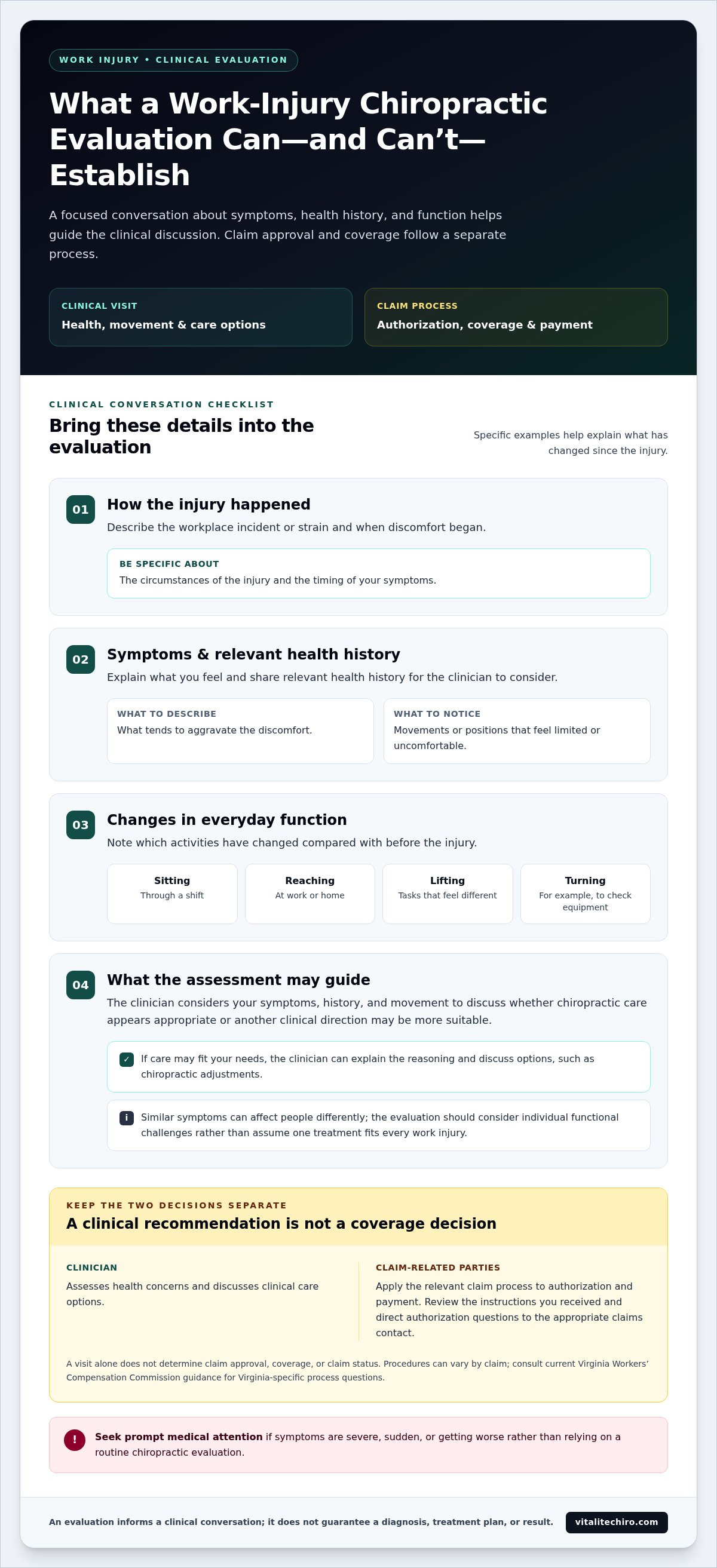
An initial assessment gives the clinician a chance to hear how the injury happened, understand your symptoms, review relevant health history, and consider movements or positions that are limited or uncomfortable. Be specific about when discomfort began, what tends to aggravate it, and which daily activities have changed. For example, note whether sitting, reaching, lifting, or turning feels different from before the injury.
Findings guide the clinical conversation, including whether chiropractic care appears appropriate or another clinical direction may be more suitable. An evaluation doesn’t guarantee a diagnosis, treatment plan, or result, and it doesn’t resolve claim questions. If care is appropriate, the clinician can explain the reasoning and discuss options such as chiropractic adjustments in light of your needs.
Similar complaints can affect people differently. A warehouse worker who has trouble bending and an office worker who feels discomfort during prolonged sitting may describe different functional challenges, even if both report back symptoms. A useful evaluation considers those differences rather than assuming one treatment fits every work injury. If a concern falls outside chiropractic care, the discussion can help clarify whether another clinical direction may be needed.
How Virginia Workers’ Compensation Can Affect Your Chiropractic Care
A work injury can lead to two related but separate conversations: what care may help address your symptoms, and how that care is handled under your workers’ compensation claim. The details depend on the claim, including any instructions you’ve received and treatment authorization that applies. Don’t assume every injured worker follows the same referral or approval pathway.
A chiropractor’s treatment recommendation is a clinical judgment. By itself, it doesn’t determine whether workers’ compensation will cover that care. A clinician can evaluate your condition and explain care options, while coverage and payment decisions follow the applicable claim process. A recommended service and an approved claim expense are not necessarily the same thing.
For current Virginia-specific procedural information, consult the Virginia Workers' Compensation Commission. Its guidance is a better starting point than assuming a process described for another state applies to your situation. If you’re searching for a worker's comp chiropractor Arlington VA, keep the distinction between clinical care and claim administration in mind.
Who makes decisions about claim coverage and authorization?
Depending on the circumstances, a claim may involve your employer, an insurer or claims administrator, and medical professionals involved in your care. Their roles differ: clinicians assess health concerns and make care recommendations, while claim-related parties apply the relevant process to authorization and payment. The people involved and the steps required can vary, so another worker’s experience may not match your case.
If you have a question about whether a visit or service is authorized, review the instructions you received and direct the claim question to the appropriate claims contact. For a disagreement, legal concern, or uncertainty about your rights, use qualified workers’ compensation resources or seek advice from a qualified legal professional. A chiropractor can discuss clinical findings, but isn’t the decision-maker for a claim dispute.
What should you clarify before treatment begins?
Before arranging care, review your claim status and any instructions about medical appointments. Keep relevant messages or documents together, and note who provided the instructions and when. If something is unclear, ask the appropriate claims contact to explain the process for your case. This can help you make an informed plan without assuming how payment will be handled.
Payment responsibility depends on claim-specific decisions and applicable rules. A clinical evaluation can help you understand your symptoms and possible care options, but it doesn’t promise coverage, claim approval, or a particular billing arrangement. Keep those questions separate as you prepare for a visit.
For clinical information about individualized chiropractic care, learn about chiropractic care at Vitalité. Direct claim and coverage questions to the appropriate workers’ compensation resource.
How to Compare Chiropractic Care Options After a Workplace Injury
After a work injury, compare more than the techniques a practice offers. Look for care that starts with a thoughtful evaluation, clear explanations, and a plan shaped around your symptoms and functional needs. You should understand what the clinician recommends, why it may fit, and how your response will inform the next conversation.
Chiropractic adjustments are one category of care, not an automatic fit for every injury. A clinician considers your history and examination findings before discussing whether adjustments or another approach may be appropriate. The CDC-hosted resource Chiropractic Care in Workers' Compensation provides context on chiropractic care within workers’ compensation systems; it doesn’t replace an individual clinical evaluation.
- Evaluation: Does the clinician ask how the injury happened, what symptoms you have, and which movements or tasks are difficult?
- Communication: Are findings and care options explained in language you understand, with time for your questions?
- Individualization: Does the discussion connect recommendations to your needs rather than assume the same technique suits everyone?
For more detail on how adjustments are described and performed, read Vitalité’s professional chiropractic adjustment guide. The goal isn’t to choose a technique before an assessment. It’s to understand the options well enough to have an informed conversation with your clinician.
Why should the treatment plan reflect the individual injury?
Work injuries can affect people differently, even when symptoms seem similar. A clinician can consider your injury history, current symptoms, examination findings, and the activities you’re working toward, such as sitting comfortably, reaching, or completing a task with less difficulty. Those factors help shape a plan around your situation. As symptoms and function change, the clinician may reassess and adapt the approach. No single technique should be presumed best for every workplace injury.
When might other chiropractic services be part of care?
After an evaluation, a clinician may consider options beyond adjustments. Vitalité offers sports injury care and therapeutic modalities. Whether either is relevant depends on your assessed needs and the clinical discussion. Decompression therapy or orthotics may also be considered when appropriate to an individual’s presentation. These services aren’t suitable for every injury, and no specific modality should be treated as a guaranteed route to recovery.
For related context on movement and rehabilitation, explore the sports performance chiropractic care guide. If you’re considering a worker's comp chiropractor Arlington VA, a practical next step is to arrange a visit with Vitalité and discuss your symptoms and functional concerns. The practice is led by Dr. W. Jean-Luc Sansfaute, who has practiced since 2003. You can request an appointment with Vitalité.
What to Prepare Before Seeing a Workers’ Comp Chiropractor in Arlington
A little preparation can help you explain what happened and make better use of your initial evaluation. You don’t need a perfect timeline or a complete file. Gather what you have, make a few notes, and keep claim paperwork separate from the clinical questions you want to discuss. This information helps the clinician understand your experience; it doesn’t determine claim coverage or guarantee a particular care plan.
Use this sequence to get ready:
- Gather relevant claim details. If available and relevant, bring your claim number, claims contact information, and any instructions you’ve received about medical care. Related claim documents or messages may also be useful. These details provide context, but don’t replace your clinical history or decide whether a service is covered.
- Write a brief injury history. Note when and how the workplace injury occurred, what you were doing, and when you first noticed symptoms. Include relevant prior care and changes since the injury. A short, factual timeline is easier to refer to during a conversation than trying to recall every detail on the spot.
- Describe symptoms and function. Record where you feel discomfort, stiffness, or limited movement, what tends to worsen or ease it, and which work or everyday activities have changed. For example, note whether reaching, sitting, lifting, or turning feels different. Include changes over time, even if they seem small.
- Prepare your questions. Decide what you most want to understand, such as what the assessment found, how the findings relate to your symptoms, or what a recommended care option is intended to address.
Which information can help make the evaluation more useful?
Bring relevant records or care instructions you already have, if available. You can also note medications or health history that may be relevant to the clinician’s assessment. The purpose is to give a clear picture of your circumstances, not to prove a claim or arrive with a self-diagnosis. If you’re unsure whether a detail matters, include it in your notes and let the clinician guide the discussion.
What questions should you bring to the appointment?
Ask the clinician to explain the evaluation findings in plain language and how they connect to your symptoms or movement limitations. If care is recommended, ask about its purpose, what the proposed course involves, and how your response will be reviewed. You can also share which activities you hope to manage more comfortably, without expecting a promised outcome or return-to-work date.
Keep claim questions separate. If you need to understand an authorization instruction, claim status, or payment responsibility, direct that question to the appropriate claims contact rather than assuming the clinical appointment settles it. If you’re preparing to see a worker's comp chiropractor Arlington VA, these notes can support a focused discussion while leaving coverage decisions to the applicable claim process. Request an appointment with Vitalité to discuss your chiropractic care needs.
Explore Individualized Chiropractic Care at Vitalité in Arlington
Choosing care after a workplace injury means finding a clinical conversation that starts with your concerns, not a preset treatment plan. Vitalité Chiropractic is an Arlington practice led by Dr. W. Jean-Luc Sansfaute, who has practiced since 2003. If you’re looking for a worker's comp chiropractor Arlington VA, learn about the practice’s approach and arrange a visit to discuss your symptoms and goals. A clinical appointment addresses your health needs; it doesn’t determine claim approval or coverage.
What does a person-centered care approach look like?
It begins with listening. Your description of the injury, current symptoms, movement limitations, and important activities can help shape the clinical evaluation. One person’s main concern may be discomfort during a particular work task; another may be focused on everyday movement outside work. Sharing what has changed helps the clinician understand how the issue affects your life.
Recommendations follow the evaluation rather than a one-size-fits-all protocol. Vitalité offers chiropractic adjustments, sports injury care, and therapeutic modalities. These are care options, not automatic recommendations for every patient or injury. A clinician considers your individual presentation before discussing whether a service may be appropriate and can explain the reasoning behind a proposed approach. As symptoms or function change, that conversation may evolve. You should feel comfortable asking questions and sharing concerns along the way.
This measured approach recognizes that each person’s needs are different. It also keeps expectations grounded: an evaluation and care discussion can clarify clinical options, but can’t promise a specific recovery, claim outcome, or return-to-work date.
How can Arlington patients take the next step?
To begin, request an appointment online or call Vitalité Chiropractic at (703) 879-5144. Same-day appointments are offered, though a particular appointment time isn’t guaranteed. When you make your request, have a brief description of your concerns ready so the practice understands what you’d like to discuss.
Bring relevant medical information or instructions you’ve received, and note the work or daily activities affected by your symptoms. If you have questions about claim status, authorization, or payment, keep them separate from clinical questions and direct them to the appropriate claims contact. This lets you focus your appointment on your health and care options while seeking claim guidance through the relevant channel.
Vitalité Chiropractic offers Arlington patients an individualized evaluation and a conversation about chiropractic care options. Request an appointment with Vitalité online, or call (703) 879-5144.
Take the Next Step at Your Own Pace
A work injury can make the next move feel uncertain, but you don’t need to resolve every question at once. Start with one practical step: organize the details you want to share with a clinician, note what you hope to understand, and direct claim questions to the appropriate claims contact. This can help you approach care with greater clarity while keeping clinical decisions separate from claim administration.
If you’re considering a worker's comp chiropractor Arlington VA, focus on starting a conversation about your individual needs. An appointment gives you space to describe how your symptoms affect your routine and learn which clinical options may be relevant. You can begin that discussion without assuming a particular treatment or outcome.
Vitalité Chiropractic welcomes Arlington patients seeking an individualized chiropractic evaluation. Request an appointment with Vitalité Chiropractic online to discuss your needs.
Frequently Asked Questions
Can I see a chiropractor for a work injury in Virginia?
A chiropractor may provide a clinical evaluation of musculoskeletal symptoms after a work injury, but whether a visit is authorized or covered is a separate, claim-specific question. If you’re considering a worker's comp chiropractor Arlington VA, follow the instructions you’ve received from the relevant claims contacts before arranging care. For procedural details, consult current Virginia Workers’ Compensation Commission guidance. An evaluation or recommendation doesn’t guarantee payment under your claim.
Does workers’ compensation cover chiropractic treatment in Virginia?
Coverage for chiropractic treatment can depend on the individual claim, applicable rules, and any treatment authorization requirements. A chiropractor’s clinical recommendation explains what care may be appropriate based on an evaluation; it doesn’t decide whether the claim will pay for it. Avoid assuming treatment is always covered or always excluded. For your specific situation, review current Virginia Workers’ Compensation Commission information and ask your claims administrator how coverage decisions apply.
What should I bring to a workers’ comp chiropractor appointment?
Bring available claim details, relevant care instructions, and the claims representative’s contact information. A concise timeline can help: note when the injury happened, when symptoms began, and what has changed. Describe symptoms in practical terms, such as difficulty reaching overhead or sitting through a shift, and list affected activities. If you don’t have paperwork, follow your claim instructions and ask the appropriate claims contact which documents are required.
Do I need a referral to see a chiropractor after a work injury in Virginia?
There isn’t a universal answer for every work-injury claim; referral and provider-selection procedures may depend on your circumstances and current Virginia requirements. Before scheduling care, review any instructions provided with your claim and clarify them with your claims representative. You can also verify current procedures through the Virginia Workers’ Compensation Commission. Don’t rely on a coworker’s experience as confirmation that the same steps apply to you.
What happens during a chiropractic evaluation for a workplace injury?
A chiropractic evaluation generally begins with questions about the injury and your symptoms, followed by an assessment relevant to the concern you describe. The clinician may discuss which movements or tasks feel limited and consider that information alongside your history. Recommendations depend on clinical findings and individual needs. The visit doesn’t guarantee a diagnosis, immediate treatment, or claim approval. Seek prompt medical attention for severe, sudden, or worsening symptoms.
Can I choose my own chiropractor for a workers’ compensation claim?
Your ability to choose a chiropractor can depend on the circumstances of your claim and applicable Virginia rules. Before arranging an appointment, review the provider instructions you’ve received and clarify any uncertainty with your claims representative. Current guidance from the Virginia Workers’ Compensation Commission can also help you understand the process. Don’t assume you can select any provider, or that you’re restricted to a particular option, without checking the requirements for your claim.
When should I seek urgent care instead of scheduling a chiropractor?
Seek prompt emergency or urgent medical assessment for severe, sudden, or rapidly worsening symptoms, or signs that could indicate a serious injury. An article can’t determine the cause of symptoms, so don’t wait for a routine chiropractic appointment if you’re concerned about immediate harm. Appointment scheduling isn’t a substitute for emergency care. If you’re in immediate danger, use local emergency services. Once urgent concerns are addressed, you can consider appropriate follow-up care.


