
What if your recovery plan focused not only on where you hurt, but on the movement you want to get back to? Pain or restricted motion can disrupt training, work, and everyday routines. Uncertainty about treatment or returning too soon can also make the next step feel unclear. A sports rehabilitation chiropractor can assess how an injury affects your movement and activity goals, then tailor care to your needs. Chiropractic care can involve more than adjustments, and the right approach depends on the person and the situation.
This article explains what an assessment can involve, how sports injury care can support recovery, and why a gradual return to activity matters. You’ll also learn which warning signs call for medical evaluation rather than routine sports care, so you can make informed decisions about your next steps. At Vitalité Chiropractic in Arlington, sports injury care and rehabilitation are led by Dr. W. Jean-Luc Sansfaute, who has practiced since 2003. Care is shaped around your individual activity goals and clinical assessment.
Key Takeaways
- A sports rehabilitation chiropractor considers your injury alongside your movement patterns and activity goals when shaping care.
- Your history, movement, and sport’s demands can help inform an individualized rehabilitation plan.
- Recovery goals can include returning to meaningful activities, not just addressing discomfort.
- Follow clinical guidance, increase activity gradually, and pay attention to symptoms and recovery between sessions as you progress.
- Vitalité Chiropractic provides sports injury care and rehabilitation in Arlington, led by Dr. W. Jean-Luc Sansfaute, who has practiced since 2003.
What Does a Sports Rehabilitation Chiropractor Do for an Injured Athlete?
An injury can interrupt more than a training plan. A sore ankle may make stairs uncomfortable, a stiff shoulder may affect work as well as sport, and uncertainty about what to do next can be frustrating. A sports rehabilitation chiropractor considers these effects in the context of your health, movement, and goals rather than assuming every athlete needs the same approach.
Sports rehabilitation chiropractic is individualized chiropractic care that assesses injury-related limitations and supports function, movement, and personal activity goals. It does not promise faster recovery or a guaranteed return to sport. Assessment findings and individual circumstances help determine whether chiropractic care is appropriate and which options fit your needs. If symptoms suggest that you need medical evaluation, routine sports care may not be the right first step.
How is sports rehabilitation different from an adjustment alone?
Rehabilitation can consider how comfortably and confidently you move, not only how much discomfort you feel. For example, a runner with knee pain may want to understand which movements are limited and how the issue affects running, walking, or daily tasks. The assessment puts those concerns in context. It doesn’t mean the painful area is automatically the only focus or that a particular treatment is always indicated.
An adjustment can be one component of chiropractic care, but it isn’t an automatic or complete plan for every injury. The appropriate approach depends on the assessment and the person. A broader overview of physical therapy can help explain how rehabilitation-related fields address movement and function, though it is a distinct profession. For more detail about adjustments, see this professional chiropractic adjustment guide.
Who might consider a sports rehabilitation chiropractor?
Recreational athletes, runners, and other active people may consider sports injury care when an injury or movement limitation interferes with an activity they value. Your goal might be returning to a usual running route, moving comfortably through a workout, or managing everyday movement while an injury is assessed. You don’t need to compete at an elite level for your activity goals to matter.
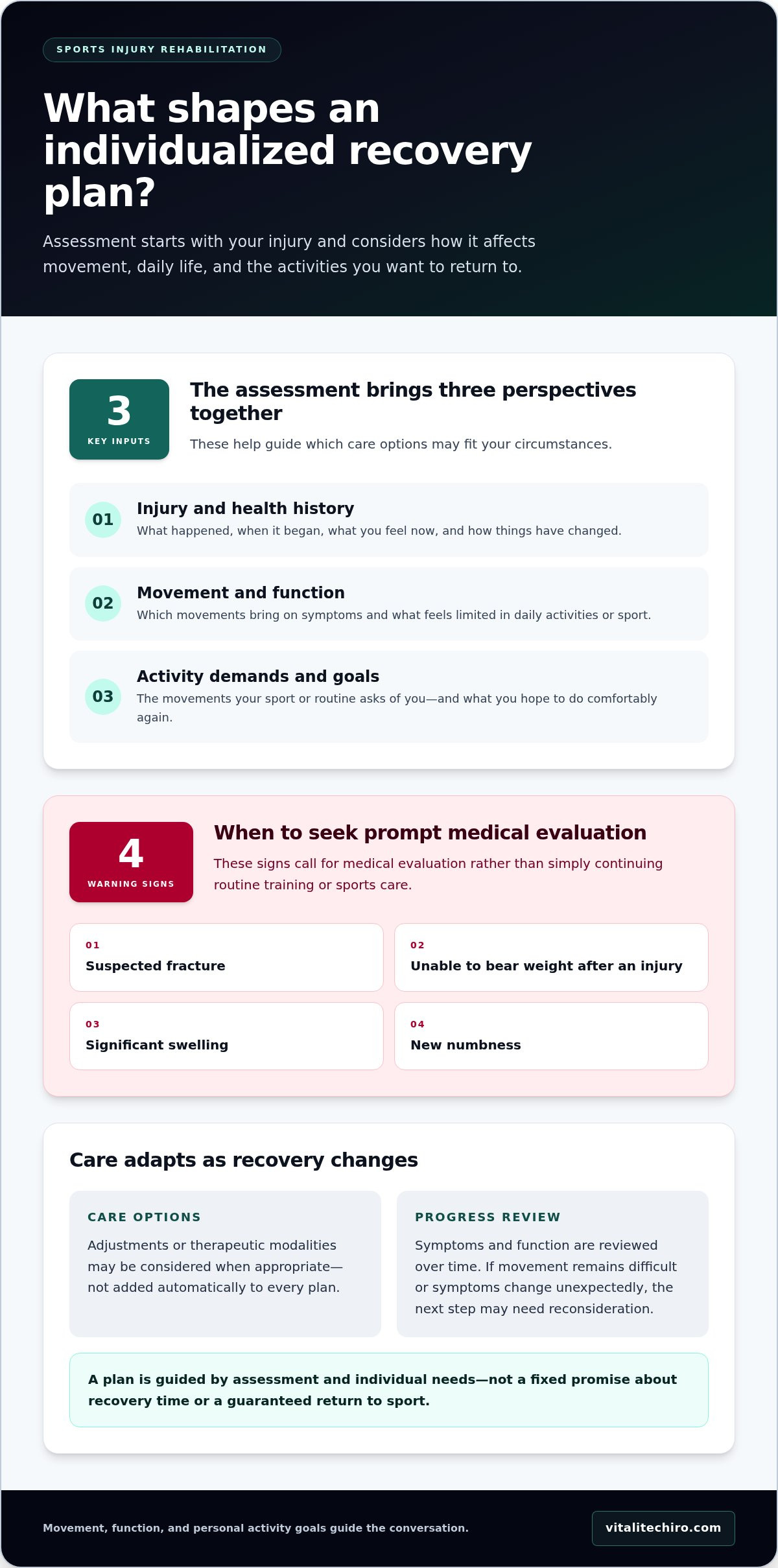
Whether chiropractic care is suitable depends on the injury, your health history, and clinical assessment. It isn’t necessary or appropriate for every athletic injury, and a responsible plan reflects that. A suspected fracture, inability to bear weight after an injury, significant swelling, or new numbness warrants prompt medical evaluation rather than simply continuing routine training or care. The aim is a considered next step, not pressure to push through symptoms.
At Vitalité Chiropractic in Arlington, sports injury care and rehabilitation are led by Dr. W. Jean-Luc Sansfaute, who has practiced since 2003. Care is tailored to your movement needs and activity goals, with assessment guiding the approach rather than assumptions about what every athlete needs.
How Does a Chiropractor Assess and Plan Sports Injury Rehabilitation?
A useful rehabilitation plan begins with questions, not assumptions. A sports rehabilitation chiropractor considers what happened, what you’re experiencing now, and what you need to do in daily life or sport. That context helps shape care around your circumstances instead of following a standard sequence of treatments.
What may happen during an initial sports injury assessment?
The first conversation can cover when the injury began, how it happened, which movements bring on symptoms, and whether anything has changed over time. Your health history and goals matter too. A runner hoping to resume easy outings has different activity demands from someone whose sport involves rapid changes of direction. Both goals deserve a clear discussion.
Movement and function can then be assessed as clinically appropriate. Depending on the concern, this could involve observing a relevant movement or considering how the affected area relates to the activity that aggravates it. Findings may also suggest that further medical evaluation is needed before routine chiropractic care proceeds.
Assessment findings, health history, and activity demands should guide the rehabilitation plan because they help determine which care options are appropriate for you. The University of Rochester Medical Center’s overview of sports injury rehabilitation also describes assessment and individualized planning as parts of the rehabilitation process.
How does an individualized plan adapt as you recover?
A plan isn’t a fixed promise about how long recovery will take. Progress is reviewed over time, with attention to changes in symptoms and function. If a movement remains difficult or symptoms respond differently than expected, the next step may need to be reconsidered. One appointment alone doesn’t establish readiness for every training demand.
When appropriate, care can include chiropractic adjustments or therapeutic modalities. These options are considered in light of assessment findings, rather than included automatically in every plan. The goal is to select care that fits your current needs and review whether the approach remains suitable as those needs change.
It helps to describe specific demands, not just name a sport. For instance, tell the practitioner whether your activity involves sustained running, lifting, or repeated twisting, and which everyday tasks are currently difficult. Clear examples connect the assessment with meaningful goals. For a broader discussion of activity and performance, Vitalité’s sports performance chiropractic care guide explores how care may relate to athletic demands.
Vitalité Chiropractic provides sports injury care and rehabilitation in Arlington, Virginia. Learn about Vitalité Chiropractic’s sports injury care and how an individualized assessment can inform your next steps.
Does Sports Rehabilitation Chiropractic Involve More Than Pain Relief?
It can. Depending on the assessment, sports rehabilitation may address discomfort as well as movement and the demands of a particular activity. A sports rehabilitation chiropractor can consider what you can do comfortably now and what you hope to resume. Care should be based on your individual findings, not a standard formula. No single approach suits every injury or athlete.
The distinctions below are useful, but these goals can overlap. A change in symptoms doesn’t automatically mean you’re ready for sport, and working on movement doesn’t replace evaluation of an injury that needs medical attention.
| Focus | What it may involve |
|---|---|
| Symptom relief | Addressing discomfort and considering how it affects daily movement. |
| Movement goals | Considering function in relevant movements, such as bending, reaching, or walking. |
| Sport-specific activity goals | Gradually working toward the movements and demands of an individual’s activity, as appropriate. |
These are different aims, not a promise that every plan will include each one. Chiropractic care can be one part of an approach. Rest or activity modification may be appropriate while symptoms and function are assessed. Rehabilitation exercises can be considered when suitable, while medical care may be needed to diagnose or manage injuries beyond routine chiropractic care. The American College of Sports Medicine offers broader information on sports medicine and exercise science, areas that help frame why activity goals and individual circumstances matter.
How is rehabilitation different from simply resting an injury?
Rest can be a sensible part of managing an injury, particularly when activity aggravates symptoms or an injury needs evaluation. It shouldn’t be portrayed as inherently harmful. At the same time, stopping all activity indefinitely isn’t a universal plan. Depending on the injury and clinical guidance, activity may be modified while symptoms and function are monitored. A return to sport should be gradual and responsive to individual progress, not driven by a predetermined schedule or pressure to keep up with training.
When might chiropractic care need to work alongside other medical care?
Some injuries require assessment or treatment beyond chiropractic care. A suspected fracture, a visible deformity after an injury, or symptoms that are severe, worsening, or accompanied by new weakness or numbness call for prompt medical evaluation. After a head injury, symptoms such as confusion or repeated vomiting also warrant urgent assessment. Don’t try to train through warning signs or use routine sports care as a substitute for urgent evaluation.
For less urgent concerns, an assessment can help determine whether chiropractic care is appropriate or whether further medical input should come first. The right next step depends on the injury and the person. A thoughtful plan respects those boundaries, adapts to the individual, and treats return to activity as a considered process rather than an automatic outcome.
How Can You Support a Safe Return to Sport During Rehabilitation?
Getting back to sport is a process, not a test of how much discomfort you can tolerate. Follow clinical guidance, increase activity gradually, and pay attention to how your body responds during and after each step. A sports rehabilitation chiropractor can help relate your symptoms and function to your activity goals, but readiness for unrestricted sport shouldn’t be judged by pain tolerance alone.
Training demands matter. A comfortable walk may not tell you how your body will respond to running, cutting, lifting, or repeated overhead movements. Progress should reflect the demands of your activity, your current function, and whether you recover between sessions. There’s no universal schedule for every injury.
Use this general checklist as you discuss progression with your clinician:
- Follow the activity guidance you’ve been given, and avoid advancing beyond it just because a session felt manageable.
- Increase activity in gradual steps rather than making a sudden jump in intensity, duration, or complexity.
- Notice how symptoms respond during activity, afterward, and by the next day.
- Consider whether everyday movement and the relevant sport movements feel manageable, not just whether pain has eased.
- Share changes with your clinician before deciding to push through or return to unrestricted participation.
What should you track as activity increases?
A brief note can make follow-up conversations more useful. Record the activity and how demanding it felt, any symptoms during or after it, and how you feel the next day. Include changes in movement or function, such as a task becoming easier or more difficult. These observations aren’t a way to diagnose a new injury. They’re practical details to share so your care can respond to what’s happening.
If your response differs from what you expected, pause before increasing demands and communicate the change. A flare in symptoms doesn’t by itself identify the cause, but it is useful information. Your clinician can help decide whether the plan needs review.
Which symptoms call for prompt medical attention?
Routine questions about activity progression can usually be raised at a follow-up. New or worsening symptoms deserve a more timely response. Seek prompt medical evaluation for rapidly worsening or severe pain, new weakness, significant numbness, or trouble coordinating movement. Sudden loss of bladder or bowel control, especially alongside back pain or leg weakness, requires emergency medical attention. Don’t wait for a routine appointment if symptoms are severe or rapidly changing.
A considered return means balancing your sport’s demands with symptoms, function, and recovery, while respecting the need for medical evaluation when warning signs arise. Arlington readers can learn about Vitalité’s sports injury care and its individualized approach to rehabilitation.
Where Can You Find Sports Injury Rehabilitation in Arlington, Virginia?
For Arlington residents looking for a sports rehabilitation chiropractor, Vitalité Chiropractic provides sports injury care and rehabilitation shaped around each patient’s needs and activity goals. Whether an injury affects recreational exercise, training, or everyday movement, care starts with understanding your situation rather than assuming one treatment fits everyone.
Care is led by Dr. W. Jean-Luc Sansfaute. Vitalité Chiropractic offers chiropractic adjustments, therapeutic modalities, and orthotics. These are options within the clinic’s care, not a set package or a guarantee that every service is appropriate for every injury. Suitability depends on an individual assessment and clinical judgment.
What can you expect from sports injury care at Vitalité Chiropractic?
Your injury history, current needs, and activity goals help shape the conversation. Consider how the issue began, what movements are difficult, and what you’d like to work toward, such as a comfortable return to a particular activity or greater ease with daily tasks. Sharing these details gives the practitioner context for assessing your situation and discussing appropriate care.
Your plan is individualized. Adjustments, therapeutic modalities, or orthotics can be considered as appropriate, but no particular technique, treatment duration, or outcome can be assumed in advance. The purpose is to connect care to your assessment findings and goals, with clinical judgment guiding what makes sense for you.
How do you take the next step in Arlington?
You can schedule online or call the office at (703) 879-5144. When arranging a visit, briefly describe the injury or movement limitation and the activity you hope to resume. It can also help to note when symptoms started and which everyday or sport-related movements affect you. These details give the conversation a practical starting point.
If you have already received an evaluation or have relevant health information, bring those details to the discussion. Be ready to explain what has changed and what you’re currently able to do. You don’t need to arrive with a diagnosis or a complete recovery plan. Sharing your experience and priorities can help the practitioner understand what matters to you.
Sports injury rehabilitation is a considered process, and the right next step depends on your circumstances. For support exploring care in Arlington, schedule a visit with Vitalité Chiropractic.
Take Your Next Step Toward Confident Movement
Recovery doesn’t have to mean guessing when to move or pushing yourself to keep pace with a training plan. A useful next step is to clarify what you want to return to, what currently feels limited, and what questions you’d like answered. Those priorities can make a conversation with a sports rehabilitation chiropractor more focused on your life and activity goals.
You don’t need to have every detail figured out before seeking guidance. Start with what you’ve noticed, be open about changes in your symptoms, and let an individualized assessment help shape the discussion. Progress can be approached with care, without treating a specific timeline or outcome as a given.
Ready to explore support for your recovery? Schedule a visit with Vitalité Chiropractic in Arlington.
Frequently Asked Questions
What does a sports rehabilitation chiropractor do?
A sports rehabilitation chiropractor evaluates how an injury affects movement and considers whether chiropractic care suits your situation. This can include discussing your activity, health history, and the motions that are difficult, then considering appropriate care options. For example, someone whose shoulder discomfort interferes with reaching overhead can describe both sport and everyday limitations. The goal is to make decisions based on individual findings, not assume that every athlete needs the same care.
Can a chiropractor help with a sports injury?
A chiropractor may provide care for some sports-related injuries, but whether it’s appropriate depends on the injury and assessment. A recreational athlete with a movement limitation, for instance, can discuss how it affects training and daily tasks during an evaluation. That conversation doesn’t guarantee chiropractic treatment is the right option. Some injuries need medical assessment or a different type of care, so don’t treat persistent or worsening symptoms as something to simply train through.
Is sports chiropractic care the same as physical therapy?
No. Chiropractic care and physical therapy are distinct healthcare disciplines, even though both may address movement-related concerns. A chiropractor’s care can include adjustments and other appropriate chiropractic services, while physical therapy has its own assessment and treatment approach. The right fit depends on your needs and the care indicated for your condition. If you’re receiving care from more than one discipline, share relevant guidance between providers so your activity plan stays coordinated.
How long does sports injury rehabilitation take?
There isn’t one reliable timeline for every sports injury. The type and extent of the injury, your health, your response to care, and the demands of your activity all matter. Returning to easy daily movement is different from resuming repeated sprints or contact play. Instead of relying on a generic recovery estimate, discuss how your symptoms and function are changing, and let those details inform decisions about progression.
Should I stop exercising while recovering from a sports injury?
Not necessarily, but you may need to modify activity until you understand what’s appropriate for your injury. Avoid pushing through movements that worsen symptoms, and follow the guidance you receive after assessment. For example, if a particular training activity aggravates discomfort, note what happened and discuss alternatives with your clinician rather than prescribing your own replacement routine. The safe level of activity varies, so advice should reflect your condition and response.
When should I see a doctor instead of a sports rehabilitation chiropractor?
Seek prompt medical evaluation for severe or rapidly worsening pain, new weakness or numbness, or concerning symptoms after a head injury, such as confusion or repeated vomiting. Sudden loss of bladder or bowel control, especially with back pain or leg weakness, needs emergency medical attention. These aren’t routine training setbacks to monitor on your own. For less urgent concerns, an assessment can help clarify whether chiropractic care is appropriate or further medical evaluation should come first.
Can I see a sports rehabilitation chiropractor in Arlington, Virginia?
Yes. Vitalité Chiropractic provides sports injury care and rehabilitation in Arlington, Virginia, led by Dr. W. Jean-Luc Sansfaute. If you’re arranging a visit, share what activity you want to return to and which movements currently feel limited. You can schedule online or call the office at (703) 879-5144. Care is guided by your individual needs and assessment, without a guaranteed recovery timeline or outcome.


