
“Is prenatal chiropractic safe?” is a question about care during pregnancy. It’s separate from whether chiropractic care is appropriate for a child, a decision that depends on the child’s needs and the care being considered. Parents deserve clear, careful information when online claims conflict, and a child’s care should never be treated as a smaller version of an adult’s.
Before considering any hands-on care, take the child’s age, development, health history, symptoms, and comfort into account. Evidence about chiropractic care for children has limits, so it’s important to distinguish what research can support from what remains uncertain.
This article explains what parents can responsibly conclude, what thoughtful assessment and communication involve, and when a child’s symptoms call for medical evaluation first. You’ll also find practical questions to bring to the conversation, so any decision is individualized and grounded in your child’s needs.
Key Takeaways
- There’s no one-size-fits-all safety guarantee. A child’s age, health history, symptoms, and proposed care all matter.
- Children aren’t small adults. Assessment and communication should account for a child’s development and comfort.
- Evidence about adults or prenatal care doesn’t automatically apply to children. “Is prenatal chiropractic safe?” is a different question about a different patient group.
- Describe the concern, review your child’s medical context, and involve their pediatrician when symptoms or uncertainty warrant it.
- Vitalité Chiropractic provides personalized, whole-person care in Arlington. Its prenatal services address a separate patient group and are not a substitute for pediatric care.
Is chiropractic safe for children? What parents can responsibly conclude
There isn’t a responsible, universal yes-or-no answer. Whether chiropractic care may be appropriate for a child depends on their age, health history, symptoms, developmental stage, and the specific care being considered. Be cautious of blanket promises of safety, as well as claims that every form of chiropractic care carries the same risk.
Evidence about chiropractic care in general doesn’t establish safety or benefit for children by itself. The field includes different approaches and has a complex history. Chiropractic offers general background, but it isn’t a substitute for child-specific clinical evidence or medical advice.
What does the evidence say about chiropractic care for children?
Some studies report outcomes after children receive chiropractic care, but an improvement reported after care doesn’t prove that the care caused it or that it will help other children. Research varies in design, sample size, the children and conditions studied, and the techniques used. Those differences make it difficult to draw one conclusion about all pediatric care.
Safety evidence also has limitations. Smaller studies may not detect uncommon harms, and findings about one technique or age group shouldn’t be generalized to another. Research can inform a discussion, but it can’t guarantee that an individual child will benefit or experience no adverse effects. Claims about treating non-musculoskeletal conditions deserve particular scrutiny. Chiropractic care should not replace appropriate pediatric assessment or treatment.
Age-appropriate care means considering a child’s development, health, symptoms, and comfort before deciding whether any care is suitable. It isn’t automatically appropriate for every child.
Why can’t one safety answer apply to every child?
Children’s needs change as they grow. A young child and an adolescent differ in development, communication, and ability to describe discomfort. Medical history matters too: a previous injury, ongoing condition, or new symptom may affect what assessment is needed before hands-on care is considered. Techniques and the body areas involved also vary, so they shouldn’t be treated as interchangeable.
An adult’s positive experience doesn’t establish how a child will respond. Children may communicate pain or distress differently, so caregivers’ observations and the child’s comfort deserve attention. Before a discussion about care, note what prompted your concern, when it began, what seems to worsen it, and how it affects daily activities. Ask for an explanation of the rationale, possible risks, alternatives, and uncertainties.
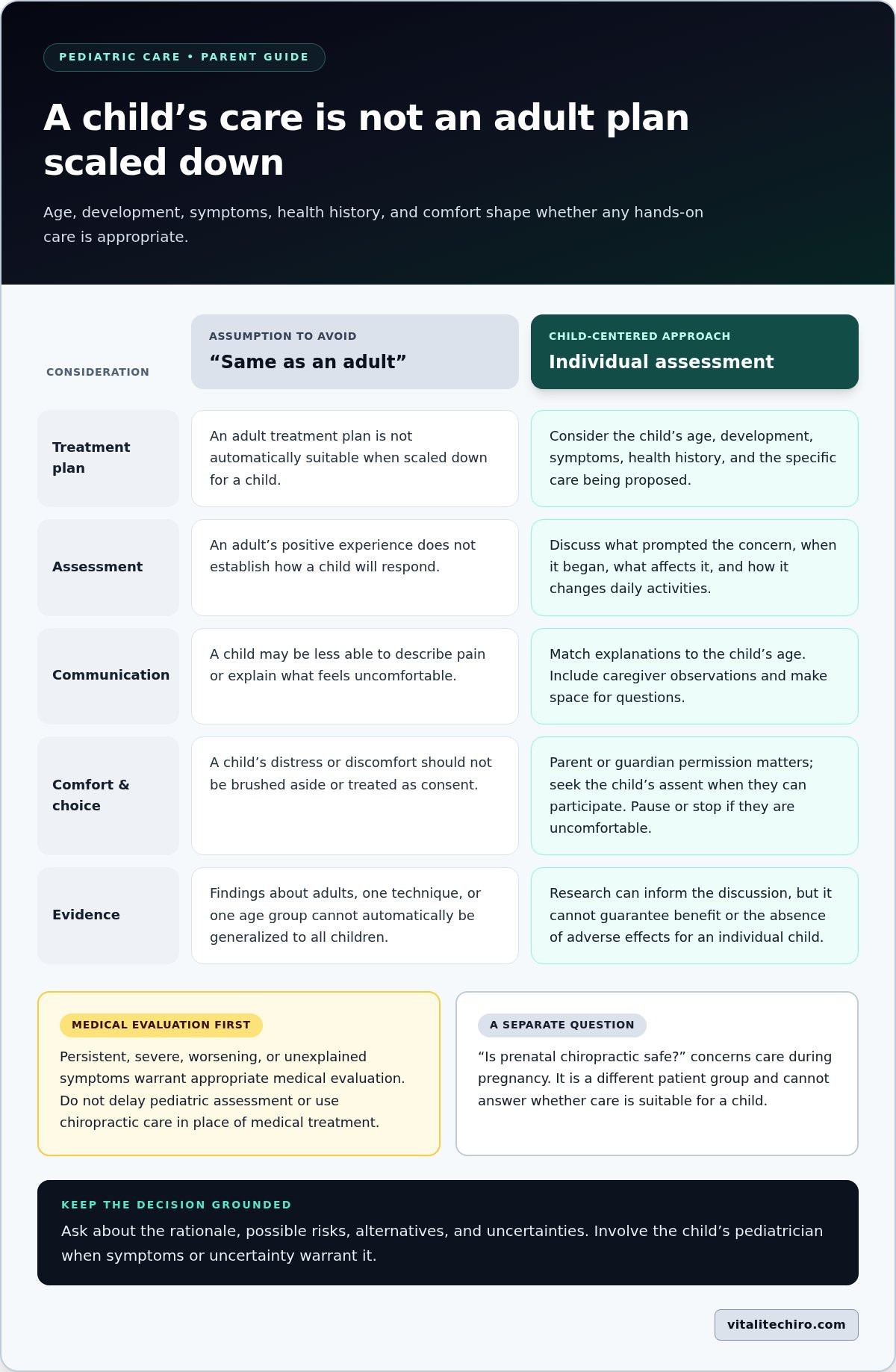
Persistent, severe, or unexplained symptoms warrant appropriate medical evaluation, particularly if the child’s condition is changing or causing significant concern. Don’t delay pediatric assessment to try chiropractic care or use it in place of medical treatment. The phrase “is prenatal chiropractic safe” concerns care during pregnancy, a separate population and question; it can’t answer whether care is suitable for a child. Decisions should reflect the child’s circumstances, with their healthcare team involved when symptoms or uncertainty warrant it.
How Pediatric Chiropractic Care Differs from Adult Care
A child’s care should begin with the child, not with an adult treatment plan scaled down. Age, development, symptoms, health history, and comfort all shape the discussion. A child may also be less able to describe pain or explain what feels uncomfortable, so caregivers’ observations and the child’s responses are important.
Adult treatment assumptions don’t transfer automatically to children. A child’s assessment and any proposed care should reflect their individual development, health, and comfort. The same approach won’t necessarily suit every child, and an adult’s experience can’t predict a child’s response.
What should a thoughtful assessment consider?
A meaningful assessment starts with questions: What prompted the visit? When did the symptoms begin? Have they changed, and what affects them? The practitioner should also understand relevant medical history, previous evaluation, and current care. Those details help clarify whether the concern is appropriate for a chiropractic discussion or needs pediatric medical assessment first.
Examination findings should inform the decision, not simply confirm a predetermined plan. If symptoms are persistent, worsening, unexplained, or accompanied by relevant health concerns, coordinating with the child’s pediatrician can help the family understand next steps. Review of Evidence and Safety of Pediatric Chiropractic Care discusses the evidence and safety questions in this area, reinforcing the importance of decisions based on a child’s circumstances rather than generalized assumptions.
How should the approach reflect a child’s age and comfort?
Children and caregivers should understand what is proposed and why before care begins. Explanations can match the child’s age: a younger child may need a simple, step-by-step explanation, while an older child may want more detail and a chance to ask questions. Parents or guardians should have room to discuss potential benefits, risks, alternatives, and uncertainty.
Permission from the parent or guardian matters, and the child’s assent should be sought when they can meaningfully participate. A child who is distressed or uncomfortable shouldn’t be pressured to continue. Families should feel able to pause, ask for clarification, or stop. If the child’s comfort changes or new information emerges, reassess the decision.
No single technique or approach fits every child. Individualized decision-making means taking the child’s response seriously rather than treating a method as automatically suitable. This is distinct from questions about pregnancy: “is prenatal chiropractic safe” concerns care during pregnancy, not assessment of a child.
At Vitalité Chiropractic in Arlington, Virginia, Dr. W. Jean-Luc Sansfaute has practiced since 2003, with an emphasis on personalized, whole-person care. Parents can learn about Vitalité Chiropractic as part of a broader conversation with their child’s healthcare team.
Which risks and misconceptions should parents weigh?
Parents don’t need to choose between assuming chiropractic care is harmless and fearing that every approach carries the same risk. A careful discussion acknowledges that adverse effects are possible and that the evidence has limits. Safety and Effectiveness of Chiropractic Care for Children discusses uncertainty around the quality of available data, a useful reminder to weigh confident claims against what research can actually establish.
A responsible risk discussion explains what is known, what remains uncertain, and what alternatives exist. It isn’t a blanket guarantee of safety. Technique, body area, age, health status, and reason for care all matter. Findings from adults or from one kind of care can’t automatically be applied to every child or approach.
What concerns should parents discuss before deciding?
Share relevant medical conditions, previous injuries, medications, and evaluations or treatment already underway. Explain what you’ve noticed, when it began, and whether it is changing. This information helps frame whether chiropractic care is appropriate to consider, whether more medical assessment is needed, or whether another option makes more sense.
Before agreeing to care, ask what the proposed approach is intended to address, why it’s being considered, what alternatives are available, and what uncertainties or potential adverse effects are relevant. The explanation should be specific to the child, not a generic assurance that a technique is safe for everyone. If the answers aren’t clear, take time to ask follow-up questions. If the child is uncomfortable or distressed, pause rather than press ahead.
When should a child receive medical evaluation first?
Urgent, severe, worsening, or unexplained symptoms call for timely medical assessment. Don’t try to determine the cause yourself or use chiropractic care as a reason to postpone evaluation. If a child is already receiving care for a health concern, discuss new symptoms with the clinician overseeing that care so decisions remain coordinated.
Chiropractic care does not replace emergency care, pediatric assessment, or specialist treatment. That distinction matters especially when symptoms are changing or a diagnosis is uncertain. A child’s healthcare team can help determine what evaluation is appropriate before other approaches are considered.
Searches such as “is prenatal chiropractic safe” concern care during pregnancy, not the risks or suitability of care for children. Different patient groups need separate evidence and individual assessment; one answer can’t serve as a safety guarantee for everyone. At Vitalité Chiropractic, care is personalized and whole-person. Parents can learn about Vitalité Chiropractic while keeping their child’s pediatric healthcare team involved in decisions about the child’s health.
How can parents make an informed decision about chiropractic care?
A clear process can help parents move from concern to a considered decision without feeling rushed. Start by defining what you’ve noticed and what you want to understand. Review the child’s medical context, discuss options, and make decisions with the appropriate healthcare professionals. If symptoms are severe, worsening, persistent, or unexplained, seek medical assessment rather than using chiropractic care to delay it.
- Clarify the concern. Describe the symptom or change in function, when it began, and how it affects the child’s usual activities.
- Review the medical context. Share relevant health history, previous evaluations, current treatment, and any changes since the concern appeared.
- Discuss options. Ask what the proposed care is intended to address, what outcome would be monitored, and what alternatives may be appropriate.
- Decide and follow up. Make room for the parent or guardian’s questions and the child’s comfort. Revisit the decision if circumstances change.
For general context on chiropractic adjustments, the professional chiropractic adjustment guide offers background on the subject. It can help orient a family, but it doesn’t determine whether care is suitable for a particular child.
What questions help parents understand a proposed plan?
Ask what specific concern the plan addresses and how progress would be judged in everyday terms, such as whether a symptom or activity limitation changes. Ask what discomfort might occur, what alternatives are available, and what would prompt the clinician to pause or reassess. Make sure the plan accounts for the child’s existing healthcare, and involve the pediatrician when the medical history, symptoms, or uncertainty make coordination appropriate.
Parents don’t need to agree to a plan they don’t understand. A useful conversation leaves room for questions, acknowledges uncertainty, and gives the child an age-appropriate chance to express comfort or concern. General searches such as “is prenatal chiropractic safe” address pregnancy, a different context; they can’t answer what is suitable for an individual child.
How should parents track comfort and follow-up?
Keep simple notes before and after a healthcare visit: what the child was experiencing, how it affected sleep or usual activities, and whether anything seemed to change afterward. This record can help you describe the timeline clearly, but a change after a visit doesn’t, by itself, establish what caused it.
Share new, worsening, or persistent concerns promptly with an appropriate clinician. Revisit the plan if the child’s comfort, symptoms, or health status changes. Families in Arlington can learn about Vitalité Chiropractic and its individualized approach to care.
How Vitalité Chiropractic approaches individualized care in Arlington
Vitalité Chiropractic is based in Arlington, Virginia, and is led by Dr. W. Jean-Luc Sansfaute, who has practiced since 2003. The practice provides personalized, whole-person care. For families weighing health decisions, that perspective starts with understanding the concern and the person behind it rather than assuming one approach is right for everyone.
This article focuses on questions parents may have about children. A patient-centered approach to those conversations means listening carefully, considering individual circumstances, explaining decisions clearly, and keeping pediatric medical care in its proper role. Chiropractic care should not replace a child’s pediatrician or delay assessment when symptoms need medical attention.
What does person-centered care mean for a family’s questions?
Parents know their child’s usual behavior and can often describe subtle changes in comfort or daily function. A respectful conversation makes room for those observations, the caregiver’s concerns, and the child’s comfort. It also allows time to clarify what is known, what remains uncertain, and what options may be appropriate to discuss with the child’s healthcare team.
Individualized care means considering the circumstances in front of you, not offering a standard promise or assuming an approach suitable for one person will suit another. A welcoming environment and multilingual support can help people communicate their questions and feel heard. Clear communication matters when a family is deciding whether to proceed, pause, or seek medical input first.
Keep pregnancy and childhood distinct. “Is prenatal chiropractic safe” raises questions about care during pregnancy, but it cannot establish whether chiropractic care is appropriate for a child. The patient’s health, needs, and clinical context differ. Evidence or recommendations for one group shouldn’t be transferred automatically to another.
Where can parents learn more about prenatal chiropractic care?
Readers with pregnancy-related questions can explore Vitalité Chiropractic’s prenatal chiropractic care benefits guide. Prenatal care is a separate topic and should be considered independently from decisions about a child’s health. If you’re weighing care for a child, continue to involve the child’s pediatrician whenever symptoms, medical history, or uncertainty warrant it.
For general information about the practice, its approach, and the care it provides, connect with Vitalité Chiropractic. That conversation can help you learn about the practice, but it doesn’t replace pediatric evaluation or establish that any particular care is right for your child.
Take your next step with clarity and confidence
Your child’s care decision doesn’t need to be rushed. Write down what you’ve noticed and what you still need clarified, then bring those concerns to the child’s healthcare team. A thoughtful next step may be gathering more information, seeking medical assessment, or deciding that a proposed approach isn’t right for your family at this time.
“Is prenatal chiropractic safe” concerns care during pregnancy, not whether chiropractic care is appropriate for a child. Keeping those questions separate helps you focus on your child’s health needs and make decisions with the right context.
Vitalité Chiropractic provides prenatal chiropractic care in Arlington, Virginia. For information about the practice and its personalized approach, learn about Vitalité Chiropractic and connect with the Arlington team.
Trust your questions, take the time you need, and keep your child’s well-being at the center of every decision.
Frequently Asked Questions
Is chiropractic care safe for children?
It can’t be described as universally safe for every child; suitability depends on the child and the care proposed. Ask for a clear explanation of potential benefits, risks, and uncertainties before deciding. “Is prenatal chiropractic safe” refers to care during pregnancy, a different question that doesn’t establish safety for children. If a child’s symptoms are concerning or unexplained, seek medical evaluation rather than relying on chiropractic care alone.
At what age can a child see a chiropractor?
There isn’t a single age that makes chiropractic care automatically appropriate. A newborn, a school-age child, and a teenager have different developmental needs and may require different clinical considerations. Age alone can’t determine suitability; the reason for care, medical history, and assessment matter too. Before arranging a visit for a young child, discuss the concern with their pediatrician and ask whether evaluation by a chiropractor is appropriate in that specific situation.
Can chiropractic treatment hurt a child?
Discomfort or other adverse effects are possible, and no responsible answer can promise that a child won’t experience them. Ask what sensations might occur during or after the proposed care and what to do if your child reports pain or seems unsettled. Children may show discomfort through behavior as well as words. If you notice a concerning change after a visit, contact an appropriate clinician for guidance rather than assuming its cause.
Should I talk to my child’s pediatrician before chiropractic care?
Discussing it with the pediatrician is a sensible step, especially if your child has a medical condition, takes medication, has had a recent injury, or is already being evaluated. Share the specific concern and ask whether further assessment should come first. A pediatrician can help put the child’s symptoms and existing care in context. This conversation supports coordinated decision-making; it doesn’t require you to commit to any particular treatment.
What should parents expect during a child’s chiropractic assessment?
Expect questions about why you’re seeking care, when the concern began, and how it affects your child. Bring a concise history of relevant conditions, medications, previous evaluations, and current treatment. The practitioner should explain the purpose of any examination and what the findings may mean before discussing next steps. You can ask to pause at any point, and your child should have room to express discomfort or ask questions.
Can chiropractic care replace a pediatrician’s treatment?
No. Chiropractic care shouldn’t replace pediatric assessment, prescribed treatment, or follow-up for a diagnosed condition. If your child is under a pediatrician’s care, keep that clinician informed about any complementary approach you’re considering. Don’t delay medical attention for urgent, worsening, or persistent symptoms. When different care plans are involved, clear communication helps prevent confusion about who is monitoring a symptom and what changes should prompt further evaluation.
How can I find a chiropractor for children in Arlington, Virginia?
In Arlington, begin by discussing your child’s needs with their pediatrician and asking whether chiropractic care is appropriate to consider. If you explore it, focus your conversation on the practitioner’s experience with children, the proposed approach, and how they’ll communicate with you and your child. Vitalité Chiropractic is an Arlington practice centered on personalized care; learn about the practice while keeping your child’s pediatric healthcare team involved in the decision.


