
For common back or neck pain without a traumatic injury, chiropractic care may be a starting point. Suspected fractures, severe injuries, or structural damage call for orthopedic evaluation. Knowing when to see a chiropractor vs an orthopedist depends on the problem’s severity and the care it may require. Progressive weakness or loss of bladder or bowel control needs immediate medical care.
It’s understandable to wonder whether both specialists treat the same conditions. They may, but their training and approaches differ: chiropractors focus on nonsurgical musculoskeletal care, while orthopedists are medical doctors who assess complex injuries and may consider medication, injections, or surgery.
This guide compares their education and roles, explains how injury severity can shape your next step, and describes when the two specialists may work together. You’ll have a clearer way to match your symptoms to appropriate care, without assuming every ache needs the same approach.
Key Takeaways
- Chiropractors focus on nonsurgical musculoskeletal care, while orthopedists can evaluate complex injuries and consider medical or surgical treatments.
- Use injury severity to guide your next step: suspected fractures or significant trauma call for orthopedic evaluation; progressive weakness or loss of bladder or bowel control requires immediate medical care.
- Both specialists may contribute to a coordinated plan, including support for movement and function after orthopedic treatment.
- Understanding each specialist’s distinct education and training can help you choose care that fits your symptoms and needs.
What’s the Difference Between an Orthopedic Doctor and a Chiropractor?
Both specialists address musculoskeletal problems, but their training and treatment options differ. The American College of Physicians recommends conservative, non-invasive treatments before injections or surgery for back pain.
Conditions Treated by Orthopedic Doctors
Orthopedic doctors are medical physicians who assess conditions affecting bones, joints, muscles, ligaments, and tendons. They commonly treat fractures, advanced arthritis, torn ligaments, tendon injuries, and complex spinal disorders. An orthopedic surgeon can evaluate structural damage and may use imaging, medication, injections, rehabilitation, or surgery. Orthopedic care is important when an injury may require medical or surgical treatment.
Conditions Treated by Chiropractors
Chiropractors focus on nonsurgical care for issues such as back pain, neck pain, sciatica, joint stiffness, and posture-related headaches. Care may include spinal adjustments, hands-on techniques, and rehabilitative exercises to support movement. Chiropractic care generally focuses on nonsurgical approaches rather than medication or surgery. About half of chiropractic patients experience mild, short-lived soreness after spinal manipulation, a possible side effect to consider when weighing care options.
Conditions Treated by Both Specialists
Both specialists may see people with low back pain, herniated discs, degenerative disc disease, sciatica, osteoarthritis, or scoliosis. Their approaches can differ even when conditions overlap: chiropractors provide conservative, nonsurgical care, while orthopedists assess structural problems and consider medical or surgical treatments. Costs depend on the services involved; orthopedic imaging or procedures can add charges. Medicare covers chiropractic spinal manipulation for low back pain, while coverage for orthopedic visits depends on the plan.
Treatment Approaches and Conservative Care
Orthopedic doctors may recommend physical therapy, pain management, injections, or surgery, depending on the condition. For back pain, the American College of Physicians recommends starting with conservative, non-invasive options before injections or surgery. A treatment plan may begin with exercise or hands-on care, then consider more invasive options if needed. Chiropractic care is nonsurgical, while an orthopedist can evaluate a broader range of medical interventions.
| Option | Common concerns | Typical approach |
|---|---|---|
| Orthopedic doctor | Fractures, torn ligaments, advanced arthritis | Imaging, medication, injections, rehabilitation, or surgery |
| Chiropractor | Back or neck pain, sciatica, stiffness | Spinal adjustments and other nonsurgical care |
Choose based on whether your symptoms suggest a structural injury that needs medical evaluation or a problem suited to conservative musculoskeletal care.
Can a chiropractor and an orthopedist work together?
Yes. For common mechanical back or neck pain, U.S. clinical guidance recommends starting with non-drug, non-surgical options, such as exercise and hands-on care. An orthopedic assessment may still be part of the plan when symptoms or findings call for medical evaluation.
Chiropractors may address muscle tension, spasms, restricted movement, and tension-related headaches with hands-on techniques and adjustments. Orthopedic physicians assess injuries involving bones, joints, ligaments, and tendons, including fractures and sports injuries such as torn ligaments. If a sports injury causes structural damage or may need surgery, orthopedic evaluation can help determine the appropriate next step.
Coordination works best when each specialist understands the other’s role. A practical sequence is to share relevant examination findings, imaging results, and treatment goals, then agree on which symptoms each practitioner will address. For example, an orthopedist may assess a knee injury, while chiropractic care or rehabilitation supports movement and function during recovery when appropriate. Orthopedic care remains central when an injury requires surgical assessment.
Care may continue across treatment stages. After orthopedic surgery, rehabilitation and chiropractic care may help restore movement and function as part of a broader recovery plan. In a U.S. military population, adding chiropractic care to usual medical care improved outcomes at six weeks. That finding describes the population studied, not a guaranteed result for every person.
A primary care doctor can help guide you toward a chiropractor or orthopedist based on your symptoms and needs. They can also help coordinate a referral when specialist evaluation is appropriate. If common muscle tension or restricted movement is your concern, conservative chiropractic care may be one part of a broader care plan.
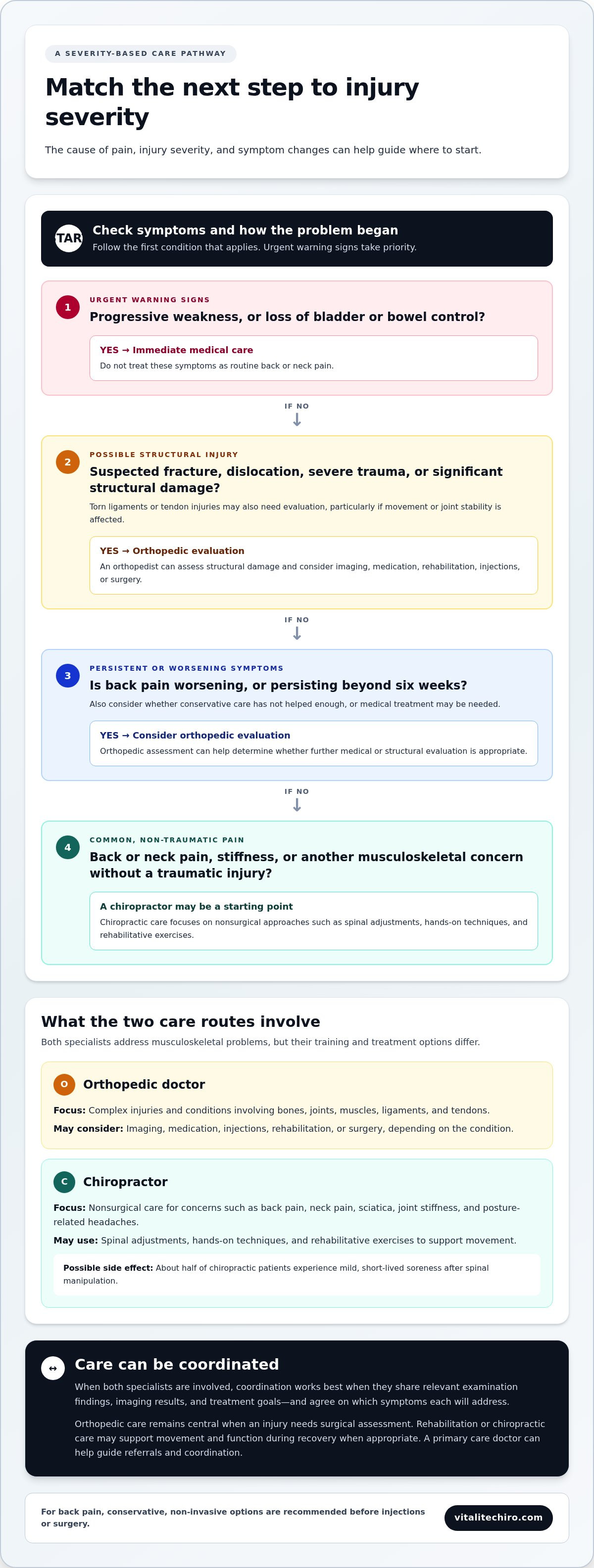
Choosing a specialist based on injury severity
Severity, cause, and changes in symptoms help determine the appropriate first step. A sudden injury with structural damage differs from mild pain or stiffness that responds to conservative care.
Choosing an Orthopedic Doctor
An orthopedic doctor is appropriate for suspected fractures, dislocations, severe trauma, or injuries that may need advanced imaging or surgery. Torn ligaments and tendon injuries may also require orthopedic evaluation, especially when movement or joint stability is affected. Consider this route when conservative care hasn’t helped enough, pain worsens, or injections or surgery may be considered.
For back pain, orthopedic evaluation is appropriate when symptoms persist beyond six weeks or worsen. Severe sciatica lasting longer than two to three months, or sciatica accompanied by weakness, also calls for orthopedic assessment. Progressive weakness, a dragging foot, groin numbness, or loss of bladder or bowel control requires immediate medical care.
Choosing a Spine Doctor or Chiropractor
A spine doctor can evaluate complex spinal disorders and consider options such as medication, injections, physical therapy, or surgery. A chiropractor may be a starting point for common back or neck pain without traumatic injury, posture-related symptoms, mild pain, or restricted mobility. Chiropractic care is nonsurgical and doesn’t include surgery or medication prescriptions.
For sciatica, orthopedic guidelines recommend six to twelve weeks of conservative care unless severe neurological deficits are present. Don’t let that timeframe delay urgent care if serious symptoms appear. Deciding when to see a chiropractor vs an orthopedist means weighing injury severity, structural concerns, symptom progression, and whether conservative treatment has improved function.
Use this decision guide: choose orthopedic evaluation first for fractures, dislocations, severe trauma, or possible surgical needs. Choose chiropractic care for non-traumatic pain or mobility concerns suited to nonsurgical treatment. If pain worsens, persists beyond six weeks, or comes with weakness, seek orthopedic assessment; urgent neurological warning signs require immediate medical care.
Chiropractor and orthopedist education and training
Education helps explain why chiropractors and orthopedic doctors take different approaches. In the United States, both complete advanced professional training, but their degrees and clinical focus prepare them for distinct roles in musculoskeletal care.
A chiropractor earns a Doctor of Chiropractic (D.C.) degree after undergraduate education and chiropractic college. Training includes a four-year chiropractic program and at least 4,200 hours at a chiropractic college. The curriculum centers on spinal health, joints, and nonsurgical care. Chiropractors use this preparation to assess movement concerns and provide conservative treatment, but they don’t prescribe medication or perform surgery.
Orthopedic doctors earn a Doctor of Medicine (M.D.) or Doctor of Osteopathic Medicine (D.O.) degree. Medical school typically takes four years, followed by a five-year orthopedic residency. M.D. graduates take the United States Medical Licensing Examination; D.O. graduates take the Comprehensive Osteopathic Medical Licensing Examination. Residency prepares doctors to evaluate structural conditions and consider medical, rehabilitative, or surgical treatment.
These paths clarify what patients can expect. A chiropractor’s education emphasizes spinal function and nonsurgical techniques, while an orthopedist’s medical training includes a broader ability to assess injuries and prescribe medication. Both can evaluate musculoskeletal concerns, but the right specialist depends on whether symptoms call for conservative care or advanced medical assessment. A degree alone doesn’t determine which treatment will provide relief; the patient’s symptoms and needs matter.
For persistent pain without signs of severe injury, conservative chiropractic care may be a suitable starting point. An orthopedic doctor is better placed to assess suspected structural damage or a possible need for invasive procedures. If you’re considering nonsurgical care, schedule chiropractic adjustments to discuss your symptoms and care options.
Vitalité Chiropractic: Chiropractic Adjustments
Vitalité Chiropractic in Arlington offers chiropractic adjustments for people seeking nonsurgical care for musculoskeletal discomfort or restricted movement. The clinic also provides Decompression Therapy, Sports Injury Care, and Prenatal Chiropractic Care for needs suited to those services. If an injury is severe, a fracture is suspected, or symptoms suggest structural damage, orthopedic evaluation is the more appropriate next step.
For ongoing back or neck discomfort, sports-related concerns, or pregnancy-related chiropractic needs, care can be tailored to why you’re seeking support. The goal is to help you understand your options and choose a suitable next step for your symptoms.
Contact Vitalité Chiropractic or visit vitalitechiro.com to discuss chiropractic care.
Take the Next Step Toward the Care That Fits
Deciding when to see a chiropractor vs an orthopedist is one part of moving forward; the next is identifying what you want care to help you do. Consider which movements, work tasks, or daily activities feel difficult, and share those details when discussing care. Clear goals can focus the conversation on appropriate options and whether conservative chiropractic care fits your needs.
Vitalité Chiropractic offers Chiropractic Adjustments, Decompression Therapy, and Sports Injury Care. These services may be relevant when you’re exploring nonsurgical support for discomfort, mobility concerns, or a sports-related issue. If your symptoms point to a severe injury or need for surgical assessment, orthopedic care is the appropriate direction. For guidance on chiropractic options, contact Vitalité Chiropractic. A thoughtful next step can help you move toward care with greater clarity and confidence.
Frequently Asked Questions
Chiropractor or Orthopedic for Neck Pain?
For neck discomfort linked to posture or muscle tension, chiropractic care may be a suitable option; an orthopedic doctor evaluates structural injury or complex symptoms. For example, neck stiffness after long periods at a desk differs from pain following a collision. A clinical trial found spinal manipulation improved neck pain more than medication after 12 weeks, with outcomes similar to exercise therapy at one year.
What Is an Orthopedic Spine Specialist?
An orthopedic spine specialist is a medical doctor focused on conditions affecting the spine. These physicians have an M.D. or D.O. degree and orthopedic training, and assess concerns such as spinal deformities, disc disorders, and severe arthritis. Depending on the findings, they may discuss activity changes, medication, injections, physical therapy, or surgery with the patient.
Which One Is Right for You?
Deciding when to see a chiropractor vs an orthopedist starts with matching your concern to the care needed. Consider how symptoms began, whether movement is limited, and whether pain is improving or worsening. For example, posture-related stiffness points toward conservative evaluation, while a suspected structural injury calls for orthopedic assessment. Your treatment goals also matter, such as returning to sport or managing persistent discomfort.
When Should You See an Orthopedist Instead of a Chiropractor for Back or Neck Pain?
Choose orthopedic evaluation when back or neck pain follows significant trauma, suggests structural damage, or may require injections or surgery. Assessment is also appropriate when symptoms worsen or fail to improve with conservative care. For persistent back pain, note how it changes with movement and daily activity. That information can help the specialist assess the problem and consider suitable next steps.
What Symptoms Require Urgent Medical Care Rather Than Chiropractic Treatment?
Progressive weakness, a dragging foot, numbness in the groin, or loss of bladder or bowel control requires immediate medical care. These symptoms can signal a serious neurological problem, so don’t wait for a routine chiropractic appointment. Severe trauma or a suspected fracture also needs prompt medical evaluation. Share when symptoms began and how quickly they changed.
What Tests and Treatments Do Orthopedists Use for Musculoskeletal Pain?
Orthopedists begin with a physical examination and may use X-rays, MRI, or CT scans to assess suspected injuries or structural problems. Treatment depends on the findings and can include medication, physical therapy, injections, or surgery. For low back pain without warning signs, routine MRI imaging is not advised because it rarely changes treatment and may show normal age-related changes.


