
A routine lift, a long shift on your feet, or hours at a desk can suddenly become difficult when back pain sets in. If you’re treating work-related back injuries, it’s understandable to feel unsure about what to do next, especially when sitting, standing, lifting, or commuting makes symptoms worse. A practical recovery plan should account for both your symptoms and the demands of your job.
This guide explains what to do after a back injury at work, which symptoms need urgent attention, and how a clinician may assess your condition. You’ll learn how to compare care options, why treatment should be individualized, and how to document the injury and communicate about your work duties and functional limits.
Recovery isn’t about pushing through pain or returning to every task at once. It’s about making informed decisions and building a safe, practical path back to activity. The steps below cover your first response, ongoing care, and a gradual return to work.
Key Takeaways
- Learn why workplace back pain can follow a sudden incident or build gradually, and which symptoms call for prompt attention.
- See how a clinician may assess your symptoms, movement, strength, sensation, and work demands to guide next steps.
- Understand how treating work-related back injuries can involve individualized care options, including rehabilitation and chiropractic adjustments when appropriate.
- Use practical steps to report and document an injury, then describe your functional limits when discussing work duties.
- Explore how Vitalité Chiropractic in Arlington tailors evaluation and care to your symptoms, examination, and recovery goals.
What Causes Work-Related Back Injuries, and When Should You Take Them Seriously?
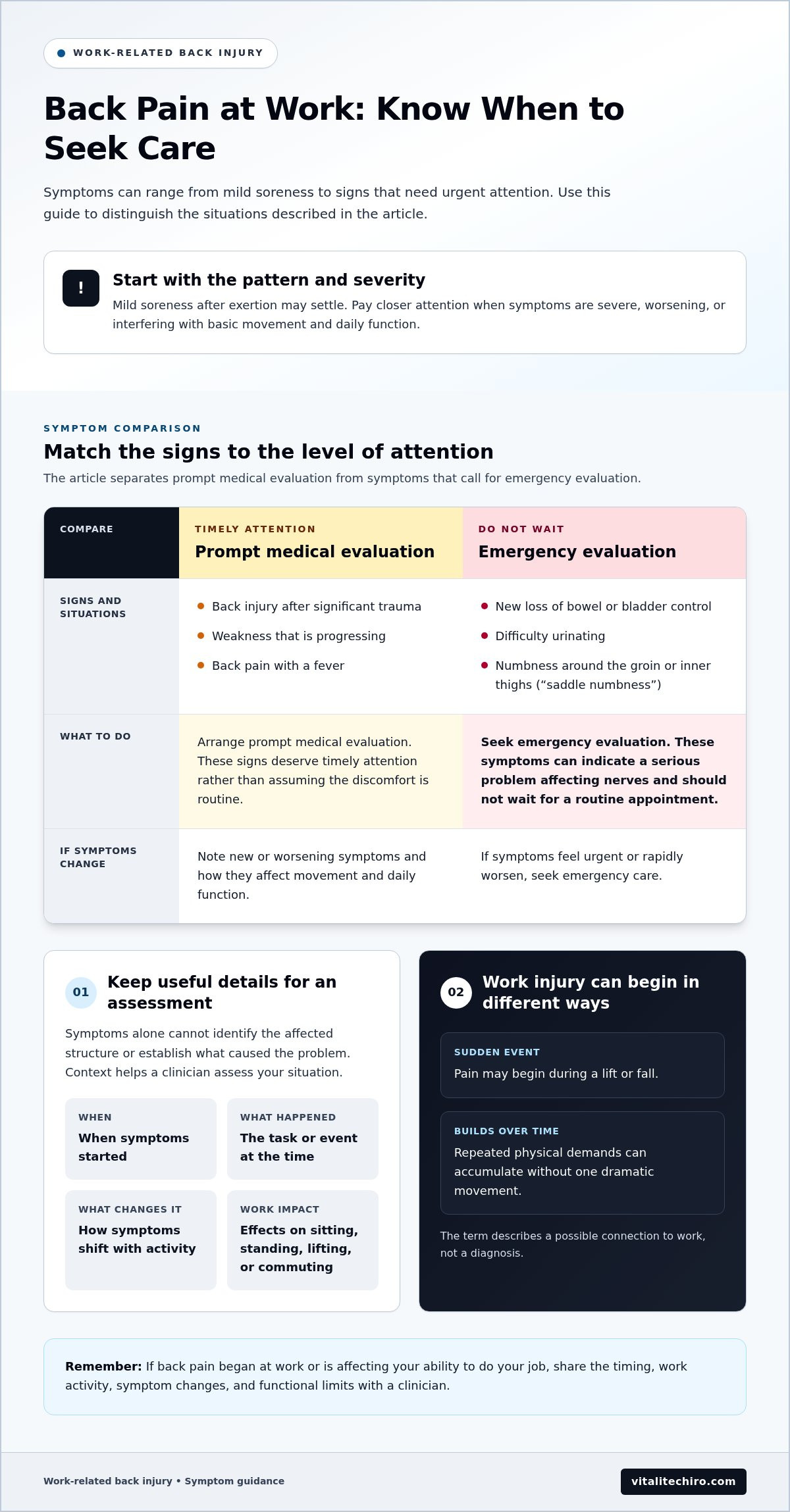
A work-related back injury is pain or tissue injury associated with a job task or workplace event. It may begin suddenly, such as during a lift or fall, or develop gradually as physical demands accumulate. The term describes a possible connection to work, not a diagnosis. Symptoms alone can’t identify which structure is affected or establish what caused the problem; a clinician considers your history and examination.
Work-related injuries can take different forms, as outlined in this general overview of occupational injury. For back symptoms, both the task and the pattern of discomfort matter. A clear incident isn’t always present, as several workplace demands may contribute over time.
Which workplace activities can contribute to back pain?
A sudden event can strain the back. For example, pain may begin while lifting a heavy box, helping reposition a patient, or slipping on a wet floor. Repeated loading can also contribute: frequent bending, twisting, carrying, or pushing may build physical demand across a shift, even when no single movement seems dramatic.
Job demands vary. A desk worker may sit for long periods, especially at a workstation that encourages a fixed or awkward posture. A service worker may repeatedly reach, restock, or stand with few chances to change position. Healthcare tasks can involve bending or assisting with patient movement, while physical jobs may require lifting, carrying, or operating equipment. Repetition, posture, load, and opportunities to vary tasks or take recovery breaks all help describe the demands on your back. They don’t prove a specific injury, but they’re useful details to share during an assessment.
Which symptoms call for prompt or urgent medical attention?
Mild soreness after exertion may settle, but pay attention to symptoms that are severe, worsening, or interfering with basic movement and daily function. Arrange prompt medical evaluation after significant trauma, if weakness is progressing, or if back pain occurs with a fever. These signs deserve timely attention rather than an assumption that the discomfort is routine.
Seek emergency evaluation for new loss of bowel or bladder control, difficulty urinating, or numbness around the groin or inner thighs (saddle numbness). These symptoms can indicate a serious problem affecting nerves and shouldn’t wait for a routine appointment. If symptoms feel urgent or rapidly worsen, seek emergency care.
No article can diagnose an individual injury. If back pain began at work or is affecting your ability to do your job, note when it started, what you were doing, and how it changes with activity. This context can help a clinician assess your situation and determine appropriate next steps for treating work-related back injuries.
How Is a Work-Related Back Injury Evaluated in Arlington?
A useful evaluation starts with your account of what happened, then considers how your back and body are functioning. The clinician may ask when symptoms began, whether there was a specific workplace event, which tasks you were doing, and how the discomfort has changed. Relevant health history matters too, since previous back problems or other conditions can affect how symptoms are understood.
The examination is guided by your symptoms and comfort. It may include observing posture and movement, checking how bending or other motions feel, and assessing strength, sensation, and function. These findings can help the clinician consider whether muscles, joints, discs, or nerves may be involved. No single symptom or test finding necessarily identifies the injured structure or proves the cause.
Evaluation should guide treatment selection, not follow it: your history, examination findings, work demands, and any concerning signs help determine which care options are appropriate and whether further assessment is needed. This individualized approach supports safer decisions about treating work-related back injuries instead of applying the same plan to everyone.
What information should you share at an appointment?
Specific details make the discussion more useful. Note when symptoms started and whether they followed a particular task or event. Describe the work activities, positions, or movements that make the pain worse or ease it, and explain how it affects tasks such as sitting through a shift, standing, lifting, or commuting.
Also mention past back problems, current medications, and changes in everyday function. If symptoms vary during the workday, describe when that happens. These details help connect your experience with examination findings and your job’s physical demands.
When might imaging or another medical evaluation be considered?
Imaging isn’t automatic for every back injury. A clinician considers the overall symptoms and examination findings when deciding whether imaging or another medical evaluation may be useful. The decision depends on what the assessment suggests, including whether symptoms are changing, function is affected, or findings raise concern. Additional or urgent medical assessment may be appropriate when the situation calls for it.
Share any new or worsening symptoms and ask how they affect the next step in your care. For example, a clinician may recommend further assessment before selecting hands-on care if the findings suggest a need to clarify what is contributing to your symptoms. For background on how adjustments are approached, explore the complete guide to professional chiropractic adjustments.
At Vitalité Chiropractic in Arlington, Dr. W. Jean-Luc Sansfaute brings experience dating to 2003 to individualized evaluations that consider symptoms, examination findings, and work demands. If you’re considering chiropractic care as part of your next steps, learn about chiropractic care in Arlington.
Which Treatments May Help a Work-Related Back Injury?
There isn’t one treatment plan for every workplace back injury. The right approach depends on the assessment findings, your symptoms and goals, the physical demands of your job, and how you respond as care progresses. A plan may focus on restoring movement, easing activity-related strain, or determining whether additional medical evaluation is needed. Options can be adjusted over time rather than treated as a fixed menu.
The comparison below describes the general purpose of several approaches, not a ranking. Suitability depends on the individual.
| Approach | Potential purpose | How suitability is considered |
|---|---|---|
| Active rehabilitation | Support movement, strength, and everyday function through appropriate exercises. | Exercises are selected and progressed in light of symptoms and tolerance. |
| Manual care | Use clinician-applied techniques as part of an individualized care plan. | The examination helps determine whether a technique is appropriate. |
| Activity guidance | Adapt tasks and activity levels while maintaining appropriate movement. | Guidance reflects functional limits and the demands of work and daily life. |
| Decompression therapy | Provide a modality a clinician may consider for selected presentations. | It isn’t a universal treatment; assessment helps determine whether it fits. |
| Medical referral or further evaluation | Address symptoms or findings that call for additional assessment. | The overall clinical picture guides whether another evaluation is appropriate. |
How do rehabilitation and manual care differ?
Rehabilitation emphasizes active participation. Suitable exercises can help build movement, strength, and function for daily tasks and work demands. Manual care involves techniques applied by a clinician and selected according to the person’s presentation. These approaches can complement one another when clinically appropriate, but neither should be assumed to fit every injury. For related movement and rehabilitation context, explore sports performance chiropractic care.
Chiropractic adjustments are one form of manual care. They should be considered only after an appropriate assessment, not chosen solely because back pain followed a workplace event. When treating work-related back injuries, clinicians can consider examination findings, preferences, functional needs, and response over time when deciding whether adjustments belong in an individualized plan.
When might decompression or referral be considered?
Decompression therapy may be considered in selected cases, but it isn’t suitable or necessary for every work-related back injury. A clinician considers the assessment and the person’s symptoms before including it. If symptoms change, progress is limited, or findings raise concerns, additional medical evaluation or referral may be appropriate. The aim is to match the next step to the situation, not promise a particular result.
At Vitalité Chiropractic in Arlington, care is tailored to your symptoms, examination, and work demands. Explore individualized chiropractic care in Arlington to learn how chiropractic and rehabilitation approaches may fit your recovery needs.
How Can You Manage Recovery and Work Duties Safely?
Recovery involves more than attending appointments. Clear communication and thoughtful planning can help you and your workplace understand what you can do comfortably while symptoms are being assessed and treated. Use this practical sequence as a starting point, adapting it to your situation and workplace procedures:
- Report the event or symptoms through your workplace’s reporting process, even if discomfort developed gradually rather than during one obvious incident.
- Keep a record of when symptoms began, what you were doing, how they change, and any related communications or care.
- Arrange an evaluation and share your work tasks, symptoms, and functional concerns with the clinician.
- Follow the care plan and communicate changes in your capacity or symptoms to the clinician and appropriate workplace contact.
What should you document and communicate after an injury?
Write down when symptoms began or became noticeable, the work activity involved, and whether symptoms change during or after particular tasks. Keep relevant workplace communications and follow your job’s reporting procedures. Accurate notes can help you recall details later; they don’t determine a claim outcome.
Be specific with your clinician about what your work requires and what feels difficult. Describe functional limits plainly, such as trouble remaining seated, bending repeatedly, carrying items, or standing through a shift. Don’t minimize symptoms or guess at a diagnosis. Explain what you can do, what aggravates symptoms, and how your capacity changes over the day.
How can you plan a gradual return to work?
Discuss your current abilities and job duties with your clinician, then communicate relevant guidance to your employer or the appropriate workplace contact. If a task is difficult, describe the movement or demand that causes trouble rather than requesting a restriction you haven’t discussed clinically. You can ask whether temporary task adjustments are possible, such as changing the mix of duties or how a task is performed, without assuming a particular modification is right for you.
Progress should reflect your symptoms, function, and clinical guidance, not a fixed calendar. Track how you respond during and after work. If symptoms significantly worsen or your ability to function declines, tell your clinician and discuss whether the plan or duties need reassessment. Treating work-related back injuries safely means keeping the conversation open as your needs evolve.
Workplace reporting and compensation processes can depend on current requirements. Virginia rules and guidance may change, so consult the Virginia Workers’ Compensation Commission for up-to-date information about procedures and requirements. This article offers general recovery information, not legal advice, and can’t determine whether a particular claim qualifies for benefits.
At Vitalité Chiropractic in Arlington, an individualized evaluation considers your symptoms, examination, and work demands. Schedule an evaluation to discuss your recovery needs.
How Can Vitalité Chiropractic Support Your Recovery in Arlington?
A work-related back injury can affect more than one part of your day. Sitting through a shift, lifting, standing, or commuting may all feel different while symptoms are present. At Vitalité Chiropractic in Arlington, Dr. W. Jean-Luc Sansfaute brings experience dating to 2003 to individualized evaluations that take your symptoms, examination findings, and work demands into account.
Care options include chiropractic adjustments, decompression therapy, therapeutic modalities, and rehabilitation. These services serve different purposes, and recommendations depend on your presentation and functional goals. An evaluation and conversation help clarify which approaches may be appropriate, what they involve, and how your response can inform next steps. There’s no single plan for everyone treating work-related back injuries.
What can you expect from an individualized care discussion?
You’ll have the opportunity to describe the tasks involved in your job and how symptoms affect daily activities. Be specific: explain which movements or positions are difficult, what you’re currently able to do, and whether your work duties have changed because of the injury. These details give the clinician useful context alongside the examination.
After assessment, the clinician can discuss relevant care options and how they relate to your concerns. If workplace or claim paperwork provides context about duties or restrictions, bring it to the conversation so your care team understands the information you’ve received. The discussion focuses on your health and care, not legal advice or a promise about a claim’s outcome.
Vitalité’s Arlington practice brings together chiropractic techniques, decompression therapy, and rehabilitation. For a broader, whole-person perspective on chiropractic care, you can also explore holistic chiropractic care in Arlington.
How do you take the next step in Arlington?
If you’re uncertain where to begin, start with a conversation about what you’re experiencing and what your work requires. Same-day appointments and online scheduling are available at Vitalité Chiropractic. You can schedule online or call (703) 879-5144 to arrange an evaluation. Share urgent or concerning symptoms promptly with an appropriate medical professional rather than waiting for a routine appointment.
Bring a brief record of your symptoms, the tasks that are difficult, and any relevant paperwork. You don’t need to arrive with a diagnosis or a complete recovery plan. An individualized evaluation can help you understand which chiropractic and rehabilitation options may fit your situation and what questions to consider as you plan your next steps.
When you’re ready, schedule a personalized chiropractic evaluation. Vitalité Chiropractic can listen to your concerns and discuss care with your needs in mind, without promising a specific timeline, claim decision, or outcome.
Take a Thoughtful Next Step Toward Recovery
Returning to activity after a work-related back injury doesn’t mean you have to figure everything out at once. Start by identifying what you need from care: which movements feel limited, what your job asks of your body, and what you’d like to do more comfortably. Those priorities can shape a practical conversation about options and progress.
Treating work-related back injuries is a personal process. Your needs may shift as symptoms and function change, so share what you notice and revisit the plan with your clinician rather than measuring recovery against someone else’s experience. Steady, informed decisions can help you move forward with greater confidence.
If you’re ready to discuss your situation, Vitalité Chiropractic can help you explore individualized care in Arlington. Schedule a personalized chiropractic evaluation and take a considered first step toward your recovery goals.
With guidance and a plan shaped around your needs, you can approach what comes next with greater clarity.
Frequently Asked Questions
Can back pain from a workplace injury begin hours or days after the incident?
Yes, back pain may become noticeable hours or even days after a workplace incident. You might finish a shift without much discomfort, then feel stiffness or pain later. Record when symptoms first appeared, what happened at work, and how the discomfort changes with movement or rest. Delayed pain doesn’t rule out a work connection. Arrange an appropriate clinical evaluation, especially if symptoms worsen or interfere with normal activities.
How long does it take to recover from a work-related back injury?
Recovery time varies, so there isn’t one reliable timeline for everyone. The type and extent of an injury, your overall health, job duties, and response to care can all affect progress. Someone with flexible tasks may face different physical demands from someone whose job requires repeated lifting. When treating work-related back injuries, use changes in comfort and function, along with clinical guidance, to inform decisions rather than comparing your progress with another person’s.
Is imaging required for every work-related back injury?
No, imaging isn’t required for every back injury. A clinician considers your history, examination, and any findings that raise concern before deciding whether imaging or another assessment is appropriate. The need may differ depending on whether symptoms are improving, limiting movement, or accompanied by other concerning changes. If imaging is recommended, ask what question it is intended to clarify and how the result could influence the next step in your care.
Does workers’ compensation cover chiropractic care in Virginia?
Coverage for chiropractic care depends on current Virginia workers’ compensation rules and the circumstances of the individual claim. Don’t assume that a particular service or visit is automatically covered, or that treatment guarantees claim approval. For current information about Virginia requirements and processes, consult the Virginia Workers’ Compensation Commission. Keep treatment and claim questions distinct: a clinician can discuss care, while the Commission’s official guidance can help clarify the workers’ compensation process.
Can I continue working while recovering from a back injury?
Possibly, but work capacity depends on your symptoms, functional abilities, and the tasks your job requires. A role involving prolonged sitting may pose different challenges from one involving repeated bending or carrying. Discuss specific duties with your clinician, including what feels manageable and what causes difficulty. Share relevant guidance with the appropriate workplace contact, and revisit the conversation if your symptoms or ability to perform tasks changes.
What should I do if my employer disputes whether my back injury is work-related?
Keep your account factual and organized. Preserve relevant messages, note when symptoms began, and record work tasks or events you believe are connected without altering details to fit a particular conclusion. Continue seeking appropriate care for your health. For questions about your rights or how to respond to a dispute, consult current official Virginia Workers’ Compensation Commission information or a qualified legal professional. No article can determine how an individual claim will be resolved.
Can a work-related back injury cause pain, numbness, or tingling down the leg?
Yes, pain, numbness, or tingling that travels down a leg can occur with back problems, but these symptoms can have different causes and don’t identify a specific injured structure on their own. Describe where the sensation travels, when it occurs, and whether it affects walking or other activities. Arrange a clinical assessment, particularly if symptoms are worsening or accompanied by weakness. Progressive weakness warrants prompt medical evaluation.


