
What if the first sign of good chiropractic care isn’t an adjustment, but a provider who listens? If you’re searching for an LGBTQ friendly chiropractor Arlington VA, concerns about being misgendered, facing assumptions, or explaining personal boundaries can make it harder to feel at ease. Those concerns deserve to be taken seriously. At Vitalité Chiropractic, inclusive care means approaching each person as an individual and making room for a respectful conversation about comfort, health concerns, and goals.
Chiropractic care should be tailored to what matters to you, not based on assumptions about your identity or needs. This article explains what considerate communication can look like, how services such as chiropractic adjustments, decompression therapy, and therapeutic modalities may fit into individualized care, and what to expect when arranging care in Arlington. You’ll also find practical ways to share preferences and questions so the conversation is more comfortable and relevant to you.
Key Takeaways
- Inclusive chiropractic care pairs respectful communication with a thorough clinical assessment, without making assumptions about identity or health goals.
- Your symptoms, health history, comfort, and daily activities can help shape a discussion about individualized care.
- Notice how a chiropractor communicates, ask questions, and share your goals and preferences to help determine whether the care feels comfortable.
- Preparing a few notes about symptoms, relevant history, and questions can help you make the most of an appointment.
- Vitalité Chiropractic is an LGBTQ friendly chiropractor Arlington VA, offering inclusive services and multilingual support with Dr. W. Jean-Luc Sansfaute, who has practiced since 2003.
What Does an LGBTQ-Friendly Chiropractor in Arlington, VA, Mean?
An LGBTQ-friendly chiropractor respects each patient’s identity, preferences, and individual health goals. That means avoiding assumptions about someone’s body, relationships, or reasons for seeking care, and making space for the patient to explain what matters to them. The term describes an approach to communication and care, not a particular treatment.
Clinical expertise remains essential. A chiropractor needs to understand your symptoms, relevant health history, and movement concerns to assess your needs and discuss appropriate care. Affirming communication supports that process: it keeps the conversation focused on your health, rather than requiring you to correct assumptions or explain parts of your identity that aren’t relevant.
Feeling heard can matter when describing pain, limited mobility, or discomfort during an examination or treatment discussion. LGBTQ+ people are not a single group with identical healthcare needs, but some may value a provider who understands that experiences and health considerations can vary. The broad overview of LGBTQ+ health disparities offers context for why respectful, individualized care matters across healthcare settings.
For someone searching for an LGBTQ friendly chiropractor Arlington VA, local convenience is one practical consideration. A practice near home, work, or familiar daily routes may make appointments easier to fit into a routine. Just as important is finding a setting where you can discuss symptoms and comfort at a pace that feels manageable.
What can affirming chiropractic care look like in practice?
It can begin with listening, using respectful language, and explaining an assessment or treatment discussion clearly. You should have room to share relevant preferences, ask questions, and describe what feels comfortable. The conversation should center on symptoms, movement, personal goals, and individual circumstances, not assumptions based on identity.
For example, you might describe when back discomfort occurs during the day, which movements feel restricted, or what you’d like to do more comfortably. The chiropractor can use those details as part of a clinical discussion and explain possible next steps. Care should be individualized, rather than based on a presumed LGBTQ+ experience or a one-size-fits-all protocol.
Why does feeling respected matter during a healthcare visit?
Respectful communication can make an appointment feel more collaborative. You can focus on describing what’s happening and understanding the discussion, rather than managing assumptions. It also gives you room to raise a concern about language, explanation, or comfort. You can share information that’s relevant to your care without feeling that you need to justify your identity.
Some personal details may be relevant to a particular health concern; others may not be. You can ask why a question matters and share what you’re comfortable discussing. A considerate provider keeps the conversation connected to your symptoms and care needs. That balance helps establish a clearer foundation for discussing options and deciding what feels appropriate for you.
How Does an Inclusive Chiropractor Tailor Care to Your Needs?
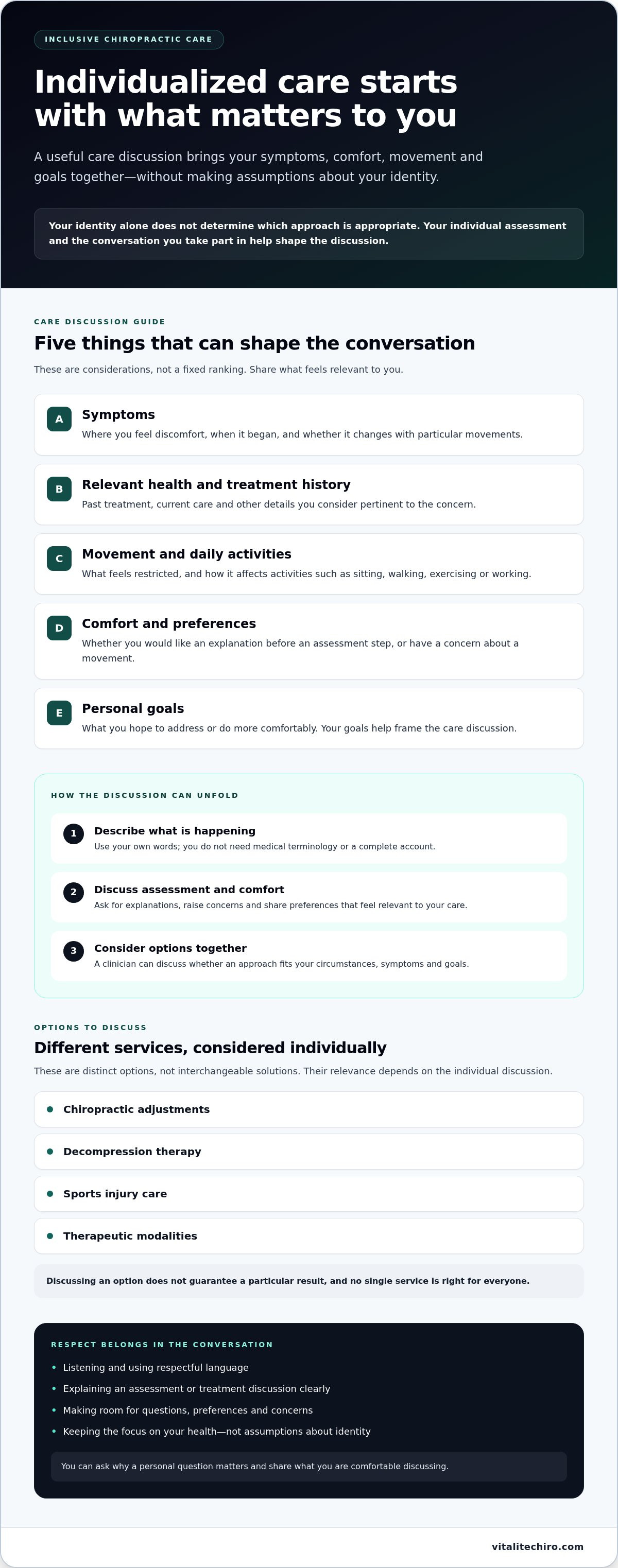
Individualized care starts with understanding what you’re experiencing, what you’d like to do more comfortably, and what matters during an appointment. A clinical discussion may consider your symptoms, relevant health history, movement, comfort, and personal goals. Your identity alone doesn’t determine which approach is appropriate. The plan should be guided by your individual assessment and a conversation you can take part in.
For someone looking for an LGBTQ friendly chiropractor Arlington VA, this balance matters: respectful communication creates room to discuss care, while clinical judgment helps guide the evaluation. You can ask for explanations as the discussion unfolds. For general information about LGBTQI+ health and access to services, the HHS Resources for LGBTQI+ Health provide broader context.
What information can help shape a chiropractic care discussion?
A few practical details can make it easier to describe your concern. Consider where you feel discomfort, when it began, whether it changes with particular movements, and how it affects daily activities such as sitting, walking, exercising, or working. You can also mention relevant treatment history, current care, and what you hope to address. Share what feels pertinent; identity itself doesn’t dictate a treatment plan.
Comfort is useful information, too. If you prefer an explanation before a step in the assessment or have a concern about movement, say so. You don’t need to arrive with a complete account or medical terminology. A clear description in your own words gives the clinician a starting point for follow-up questions and for considering what may be relevant to your care.
How can treatment options relate to different patient goals?
After considering your concerns and assessment, a clinician can discuss whether an approach fits your circumstances. Chiropractic adjustments, decompression therapy, sports injury care, and therapeutic modalities are distinct options, not interchangeable solutions. Their relevance depends on the individual discussion, including your symptoms and goals. No single service is right for everyone, and discussing an option doesn’t guarantee a particular result.
For instance, you may want to talk about movement limitations after an activity, while someone else may be focused on discomfort during routine tasks. Those goals help frame the conversation; they don’t determine treatment on their own. Ask what an option involves and how it relates to your assessment. For a closer look at adjustments, see this guide to professional chiropractic adjustments.
At Vitalité Chiropractic in Arlington, care is discussed around your individual concerns and preferences. If you’re considering a local appointment, explore Vitalité Chiropractic as a starting point for learning about the practice.
How Can You Assess Whether a Chiropractor Feels Like the Right Fit?
You deserve respectful communication without having to justify your identity. Assessing whether care feels right isn’t a test you have to administer or a judgment about someone’s character. It’s a way to stay involved in decisions about your health and notice whether the conversation gives you room to ask questions, explain your needs, and understand what’s being discussed.
As you consider an LGBTQ friendly chiropractor Arlington VA, use a simple framework during your interactions: notice the communication, ask questions, share your goals, and discuss comfort. At Vitalité Chiropractic, inclusive care is grounded in respectful, individualized communication alongside clinical assessment. Use your own needs to guide what you share and what you ask.
- Notice communication: Is the conversation clear and respectful?
- Ask questions: Do you understand what’s being discussed?
- Share goals: Have you explained what you want help addressing?
- Discuss comfort: Can you state a preference or concern?
This isn’t about expecting a perfect script. It’s about having a chance to participate in a clinical conversation that stays focused on your concerns and preferences.
What questions can help you discuss comfort and treatment?
Practical questions can make a care discussion clearer. You might ask, “Can you explain what this step involves?” or “How would this relate to my goal of moving more comfortably?” If you prefer a different pace or more explanation, say so. Asking for clarification is appropriate whenever a term, recommendation, or next step isn’t clear.
Keep the conversation connected to your goals. For example, explain that you want to understand how a proposed option relates to your symptoms before discussing it further. The aim isn’t to challenge clinical expertise; it’s to understand the reasoning and share information that may help shape an individualized discussion.
What if you feel nervous about sharing personal information?
You can focus on details relevant to your symptoms, health history, and care goals. You don’t have to disclose your sexual orientation or gender identity to receive respectful treatment. If a personal question feels unclear, you can ask how it relates to your care, then decide what you’re comfortable sharing.
Simple language is enough to express a boundary: “I’d prefer to keep the conversation focused on my symptoms,” or “Please explain what you’re doing before we continue.” You can also say, “I’m not sure how to answer that. Can you clarify why it’s relevant?” These phrases help communicate a preference without requiring you to offer a longer explanation.
At Vitalité Chiropractic, the goal is to make care individualized and the conversation respectful. Bring your questions, share what feels relevant, and take part in discussing options at a pace that supports your comfort.
How Can You Prepare for an Inclusive Chiropractic Appointment in Arlington?
A little preparation can help you make the most of an appointment without turning it into homework. For anyone seeking an LGBTQ friendly chiropractor Arlington VA, preparation can also make it easier to communicate what helps you feel comfortable. Focus on details that support a useful clinical conversation, and leave room for questions to come up naturally.
Before your visit, jot down a few notes:
- Symptoms: Where you feel discomfort, when it began, and what seems to affect it.
- Daily impact: Activities or movements that feel difficult, limited, or uncomfortable.
- Relevant history: Previous care or health information related to your current concern.
- Goals and questions: What you’d like to address and what you want to understand about possible care.
These notes are prompts, not a script. Describe your experience in your own words and add details during the appointment. The aim is to connect your concerns with the clinical discussion, not to arrive with a diagnosis or a predetermined treatment plan.
What should you bring or make a note of beforehand?
Think about patterns rather than trying to document every sensation. For example, you might note that stiffness is more noticeable after sitting or that a particular movement feels restricted. Include relevant treatment history and a practical goal, such as making a daily activity more comfortable. If you have questions about an option or what to expect, write them down so they’re easy to raise.
There’s no need to prepare information that doesn’t relate to your care. A short, focused note can be more useful than a long account, and it’s fine to refer to it during the conversation.
How can you communicate preferences clearly?
Preferences can be simple and specific. You might say, “I go by this name,” “I use these pronouns,” or “Please explain each step before we continue.” If a movement or position may affect your comfort, mention that before the relevant part of the assessment. You can also ask for clarification at any point. Share only what feels useful to you; disclosure of identity isn’t a requirement for respectful care.
A whole-person approach also considers how physical concerns fit into daily life and personal goals. Vitalité Chiropractic’s perspective on whole-body chiropractic care offers more context on that broader care philosophy.
Keep your preparation manageable. A few notes, a question or two, and a clear preference can help you take an active role in the conversation. To arrange an appointment with Vitalité Chiropractic in Arlington, schedule online.
Where Can You Find LGBTQ-Friendly Chiropractic Care in Arlington, VA?
Finding an LGBTQ friendly chiropractor Arlington VA can mean looking for a local practice where clinical care and respectful communication go together. Vitalité Chiropractic serves patients in Arlington and provides inclusive services and multilingual support. The aim is to make space for a clear conversation about your concerns and goals, while keeping care grounded in your individual needs.
The practice is led by Dr. W. Jean-Luc Sansfaute, who has practiced since 2003. Experience is one part of the picture; your symptoms, health history, comfort, and preferences also matter when discussing care. Bring questions and explain what you hope to address, then take part in considering which options may be relevant to your circumstances.
What care does Vitalité Chiropractic provide in Arlington?
Vitalité offers several chiropractic services and related options. Each serves a different role in care, and no one service is automatically suitable for every patient. A clinical discussion helps connect your needs and goals with relevant options.
- Chiropractic adjustments are one option for patients discussing chiropractic care.
- Decompression therapy may be discussed as part of an individualized care conversation.
- Sports injury care relates to concerns connected with sports and physical activity.
- Prenatal chiropractic care is available for patients seeking chiropractic care during pregnancy.
- Orthotics and therapeutic modalities are additional offerings that may be relevant to individual needs.
These services aren’t a checklist or a promise of a particular result. The appropriate discussion depends on your clinical needs and what you want to work toward. Ask how an option relates to your concerns and raise any preferences that would help you feel comfortable discussing care.
How can you take the next step with Vitalité?
Patients can schedule online or call the office at (703) 879-5144. Same-day appointments are offered. When arranging your visit, share the main concern you’d like to discuss or save those details for the appointment. You don’t need to have every question answered beforehand.
A comfortable care conversation can begin with a simple goal, such as discussing pain, movement, or an activity you’d like to manage more comfortably. You’re welcome to ask for clear explanations and share relevant preferences as the discussion unfolds. Your identity doesn’t need to be justified for your concerns to be heard.
If Vitalité Chiropractic feels like a helpful fit for your needs in Arlington, schedule an appointment online or call the office to arrange a visit.
Take the Next Step Toward Care That Feels Right
Choosing an LGBTQ friendly chiropractor Arlington VA can be a meaningful step toward addressing your physical health in a setting where you can speak openly and take part in decisions. You don’t need to have every detail figured out before beginning. A concern, a question, or a simple goal is enough to start a conversation about what care could look like for you.
As you move forward, ask for explanations, communicate what helps you feel comfortable, and take time to understand the options discussed. Your preferences belong in the conversation, and care should be considered in light of your individual needs.
If you’re ready to explore chiropractic care with Vitalité Chiropractic, schedule an appointment. Starting with one conversation can help you take a clear step toward care that respects you.
Frequently Asked Questions
Is Vitalité Chiropractic LGBTQ-friendly in Arlington, VA?
Yes. Vitalité Chiropractic provides inclusive services for the LGBTQ+ community in Arlington, with care centered on individual needs and respectful communication. Begin by describing the concern you want addressed and what would help you feel comfortable during the discussion. The practice approaches care individually rather than assuming every patient wants or needs the same experience.
Do I have to disclose my gender identity or sexual orientation to a chiropractor?
No. You don’t have to share your sexual orientation or gender identity simply to receive chiropractic care. You can focus on details relevant to your concern, such as when discomfort started or which movements affect it. If a personal detail feels relevant to your symptoms or comfort, you can decide how much to share. You can also ask why a question is connected to your care.
Can I ask a chiropractor to use my name and pronouns?
Yes. You can tell the chiropractor the name and pronouns you use, along with any communication preference that would make conversation easier. For example, you might say, “I go by Alex and use they/them pronouns.” You can share this when scheduling or during your visit, whichever feels more comfortable. A direct request makes your preference clear without requiring you to explain your identity.
Can LGBTQ+ people receive chiropractic care for back or neck pain?
Yes, back or neck concerns can be discussed with a chiropractor, and LGBTQ+ identity alone doesn’t determine whether a treatment is appropriate. The discussion should take into account your symptoms and clinical assessment. At Vitalité Chiropractic, chiropractic adjustments and other therapies are among the care options. For example, describe which movements aggravate your neck discomfort and ask what approaches may fit your individual needs.
What should I expect when discussing treatment with an inclusive chiropractor?
Expect to talk about your concern, how it affects daily activities, and what you hope to address. You can ask what a suggested option involves, request a clearer explanation, or raise a comfort concern before decisions are made. For instance, if you’re unsure how a treatment relates to a specific activity, ask the clinician to explain the connection. The discussion and care plan will depend on your situation.
How can I schedule an appointment with an LGBTQ-friendly chiropractor in Arlington?
You can schedule with Vitalité Chiropractic online or call (703) 879-5144. Same-day appointments are offered. Before the visit, you may want to note the symptoms you’d like to discuss and any questions that would help you understand your care. You can also mention communication preferences if you wish. Keep the conversation focused on what feels relevant, and bring up questions as they occur to you.


