
More rest doesn’t always mean faster healing. If an injury has sidelined you, it’s understandable to worry about losing fitness, feel frustrated by generic “rest and ice” advice, or wonder why the same pain keeps returning. Effective athlete injury recovery takes more than waiting. It calls for a plan that considers your symptoms, movement, and the demands of your sport as your body heals.
The goal isn’t to rush back and risk another setback. It’s to build an individualized path that supports recovery, maintains appropriate activity, and helps restore confidence in your body. Dr. W. Jean-Luc Sansfaute provides sports injury care at Vitalité Chiropractic in Arlington, considering the whole athlete rather than focusing only on the sore spot.
In this guide, you’ll learn what a safe recovery timeline can involve, how gradual loading can help you stay active without overdoing it, and how movement and stability relate to a return to sport. You’ll also find practical ways to monitor symptoms and rebuild toward activity, so recovery is more than simply getting back to where you started.
Key Takeaways
- Learn why athlete injury recovery often benefits from guided, gradual movement rather than prolonged inactivity.
- Explore how the nervous system, spinal function, and movement patterns may inform an individualized recovery plan.
- Understand how chiropractic adjustments, therapeutic modalities, and decompression therapy may be used in sports injury care.
- Preview a five-step approach, from initial assessment to managing symptoms and rebuilding toward activity.
- See how Dr. W. Jean-Luc Sansfaute and Vitalité Chiropractic’s welcoming, multilingual care support Arlington athletes.
Why Traditional Rest Isn't Enough for Modern Athlete Injury Recovery
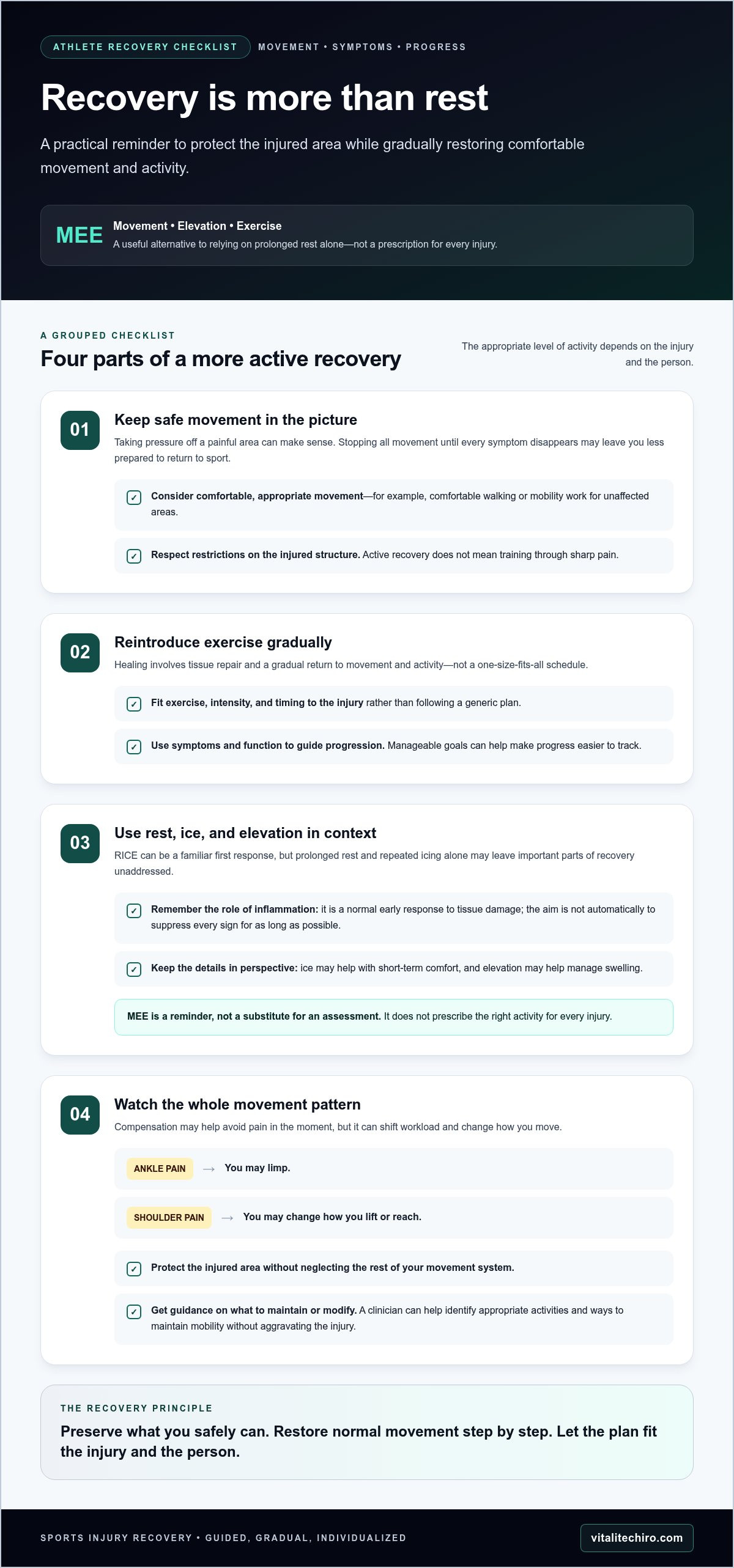
After an injury, taking pressure off the painful area can be sensible. But stopping all movement until every symptom disappears may leave you less prepared to return to sport. Athlete injury recovery involves tissue repair and a gradual return to movement and activity. The right level of activity depends on the injury and the person, so recovery should be guided rather than reduced to “push through” or “do nothing.”
This is where athletes can fall into the Rest Trap. Extended inactivity may reduce strength, joint mobility, and coordination, while healing tissue may benefit from carefully graded loading. Active recovery doesn’t mean training through sharp pain. It means maintaining safe movement, such as comfortable walking or mobility work for unaffected areas, while respecting restrictions on the injured structure. A structured plan can also ease the uncertainty of being sidelined by giving you manageable goals and ways to track progress.
Recovery is broader than the injured body part alone. This overview of sports injuries and recovery also highlights rehabilitation and mental health as part of the picture. Appropriate activity can help maintain general conditioning, but the exercise, intensity, and timing should fit the injury rather than follow a one-size-fits-all schedule.
The Downside of the RICE Method
Rest, Ice, Compression, and Elevation can be a familiar first response, but relying on prolonged rest and repeated icing as the entire plan can leave important parts of recovery unaddressed. Inflammation is a normal early response to tissue damage. That doesn’t mean every injury should be left untreated, or that ice is never useful for short-term comfort. It does mean the aim shouldn’t automatically be to suppress every sign of inflammation for as long as possible.
A practical alternative to remember is MEE: Movement, Elevation, Exercise. Use comfortable, appropriate movement and gradually reintroduce exercise as symptoms and function allow. Elevation may help manage swelling. MEE isn’t a substitute for an assessment or a prescription for every injury. It’s a reminder that recovery can include safe activity, not just passive waiting.
Identifying the “Secondary Injury” Risk
When an ankle hurts, you may limp. When a shoulder is painful, you may change how you lift or reach. These adjustments can shift workload to other muscles and joints, creating new discomfort while the original injury is still healing. Compensation can help you avoid pain in the moment, but it may also change your movement patterns.
Protect the injured area without neglecting the rest of your movement system. A clinician can help identify which activities are appropriate, which need modification, and how to maintain mobility without aggravating the injury. The goal is steady progress: preserve what you safely can, restore normal movement step by step, and avoid turning a local problem into a wider pattern of limitation.
The Science of Neuromusculoskeletal Recovery
Healing involves more than the injured tissue alone. The brain and spinal cord receive information from muscles, joints, and skin, then help coordinate sensation and movement. After an injury, pain and swelling can affect how movement feels and is controlled. A once-familiar action may feel uncertain. Understanding that connection helps explain why athlete injury recovery often includes restoring comfortable movement and coordination, not just waiting for soreness to fade.
It’s also important to be precise about what spinal care can and can’t do. Spinal alignment is not a switch that turns healing on, and there’s no established evidence that a joint restriction sends literal “static” to an injury or blocks tissue repair. Chiropractic adjustments may change sensory input and help some people move more comfortably, but they don’t guarantee faster healing or directly control inflammation. Recovery depends on the injury, overall health, and appropriate progression of activity.
Nerve Interference and Healing Speed
The autonomic nervous system helps regulate involuntary functions, including aspects of blood vessel tone. But it would be an oversimplification to claim that adjusting the spine speeds inflammatory resolution by dilating blood vessels at an injury site. A more useful aim is to assess movement, symptoms, and function, then choose care that supports activity within the person’s tolerance. For an overview of adjustment techniques and considerations, see the complete guide to professional chiropractic adjustments.
During care, pay attention to practical changes: Is turning, reaching, or walking more comfortable? Can you perform a controlled movement with less guarding? Those responses can help guide the next step, although symptom relief alone doesn’t prove that tissue is fully healed. A gradual return to sport still calls for appropriate strength, mobility, and task-specific readiness.
Proprioception: Retraining Your Body’s GPS
Proprioception is the body’s sense of where a joint is and how it’s moving without needing to look at it. After an ankle or knee sprain, pain, swelling, and changes to joint and muscle input can make balance and coordination feel less reliable. An athlete might feel hesitant standing on the affected leg or changing direction, even as discomfort settles.
Manual therapy, including chiropractic adjustments, may provide sensory input that supports comfortable movement for some people. It doesn’t automatically “reset” joint sensors or replace active rehabilitation. Pair hands-on care with progressive stability practice suited to your injury, such as controlled weight shifts or single-leg balance when appropriate. A clinician can adjust the challenge as your control improves.
Think of the goal as rebuilding trust through repeatable movement, not forcing a quick test. If pain, instability, or unusual symptoms persist or worsen, pause the activity and seek an assessment. Athletes looking for an individualized perspective on movement and chiropractic care can explore sports injury care in Arlington.
Comparing Advanced Recovery Modalities for Athletes
No single modality suits every injury or athlete. The value of care comes from matching the approach to the problem and combining it with a sensible plan for restoring function. Chiropractic adjustments may address joint mobility, while therapeutic modalities can support comfort and movement during recovery. These approaches may complement one another, but neither replaces an assessment or guarantees a particular outcome.
The needs of a runner with foot or knee symptoms can differ from those of a lifter managing back discomfort. A whole-athlete perspective considers where pain occurs, how the body moves under sport-specific demands, and whether mechanics elsewhere may be adding stress. That context makes athlete injury recovery more targeted than choosing a treatment based on symptoms alone.
Spinal Decompression for the High-Impact Athlete
Contact sports and heavy lifting place substantial loads on the spine, but a disc problem can’t be diagnosed from an athlete’s sport or symptoms alone. Decompression therapy uses controlled traction intended to reduce pressure on spinal structures. The approach is sometimes described as creating negative pressure within a disc, but results vary, and it shouldn’t be presented as reliably drawing nutrients into the disc or repairing it. An individualized assessment helps determine whether it fits the athlete’s needs.
For a closer look at how this approach is used in care, see spinal decompression therapy. The aim is to support function and comfort as part of a broader care plan, not to promise a specific result.
Custom Orthotics: The Foundation of Performance
Foot mechanics influence how forces travel through the ankles, knees, hips, and lower back. If a runner’s foot repeatedly rolls inward or a lifter’s stance feels uneven, the way they load the body may affect movement higher up the kinetic chain. Custom orthotics can provide individualized support, but they’re one part of a plan that may also address strength, mobility, footwear, and training habits.
Ready-made inserts offer general shapes and support. They may not address an individual athlete’s specific foot mechanics or gait demands. That doesn’t make every off-the-shelf insert unsuitable, but persistent symptoms or sport-specific issues may call for a closer look at fit and function. Learn more about custom orthotics and support.
Choosing Care Around Your Sport
A runner may need attention to repetitive impact and foot stability, while a lifter may benefit from assessing spinal comfort and the positions used under load. Diversified chiropractic techniques allow care to be adapted to the person and their presentation, rather than applying the same approach to every athlete. Therapeutic modalities may complement hands-on care when appropriate, with progress guided by symptoms and changes in function.
Consider how the issue affects your actual sport: Can you tolerate a gradual return to running, lifting, or changing direction without symptoms escalating? A plan should account for those demands and adjust as you regain capacity. Athletes seeking sports injury care can explore care at Vitalité Chiropractic.
A 5-Step Protocol for Faster Athlete Injury Recovery
A useful recovery plan gives you a sequence, not a guessed return date. Athlete injury recovery should adapt to the injury, your symptoms, and the demands of your sport. These steps provide a framework; an assessment helps determine what is appropriate for you.
Phase 1: The First 48 Hours
Early assessment can identify movement limits, pain patterns, and neurological signs that an X-ray alone may not explain. It can also help you protect the injured area without unnecessarily changing how you move elsewhere. Vitalité Chiropractic offers same-day appointments for pain and wellness needs, including sports injury care. Avoid using medication to mask symptoms so you can train. Discuss medication choices, including NSAIDs, with a qualified health professional, especially if you have other health conditions or take other medications.
- Assess the injury and screen function. Describe how the injury happened, what movements trigger symptoms, and whether you notice numbness, tingling, weakness, or loss of coordination. Imaging such as an X-ray can help identify certain problems, but it doesn’t assess every soft-tissue injury or explain all movement changes. A thorough evaluation considers symptoms and function together.
- Manage symptoms and protect movement. In the early phase, modify activities that aggravate pain while maintaining comfortable movement where appropriate. A clinician can advise on symptom management and assess whether spinal or joint mobility is relevant to your presentation. The aim isn’t to force alignment or eliminate every sensation. It’s to support safe function and avoid letting protective habits become persistent movement patterns.
- Restore range of motion. As symptoms allow, manual therapy and diversified chiropractic techniques may be used to address mobility restrictions and help you move more comfortably. Progress should be based on your response, not a fixed schedule. For example, an athlete returning to an overhead lift may first work on comfortable shoulder and upper-back motion before adding load.
- Rebuild strength and proprioception. Add progressive strengthening and balance or coordination work suited to the injured area. An ankle injury may call for controlled balance practice, while a knee injury may require carefully progressed leg strength. Increase the challenge only when you can maintain good control without a marked increase in symptoms during or after the activity.
- Rehearse your sport and maintain progress. Gradually reintroduce the movements your sport requires, such as jogging, changing direction, or lifting with the relevant technique. Start with controlled drills before returning to full intensity. Ongoing mobility, strength, and movement work can help maintain capacity and make it easier to notice a flare-up before it disrupts training.
Phase 2: The Transition to Movement
The Pain-Free Range is the span of motion you can perform without pain, and it can serve as a boundary for early exercises. Therapeutic modalities, including ultrasound or electrical stimulation, may be used to support comfort as movement progresses. They don’t replace active rehabilitation. Increase intensity in small steps when movement remains controlled and symptoms don’t significantly worsen during the activity or afterward.
For an individualized assessment and sports injury care in Arlington, schedule an appointment with Vitalité Chiropractic.
Personalized Sports Injury Care in Arlington, VA
An injury can affect more than your ability to train. It may disrupt your routine, confidence, and connection to the sport you enjoy. At Vitalité Chiropractic in Arlington, Dr. W. Jean-Luc Sansfaute brings more than 20 years of clinical experience to sports injury care, with an approach that considers the athlete as a whole, not just the painful area.
That means looking at how symptoms affect daily movement and sport-specific goals, then considering relevant factors such as mobility, stability, and mechanics. A runner’s concerns may differ from a lifter’s, and a recovery plan should reflect those individual demands. Chiropractic adjustments, therapeutic modalities, decompression therapy, and custom orthotics may be considered as part of care when appropriate. Explore sports performance chiropractic care in Arlington to learn more about this whole-athlete perspective.
Why Arlington Athletes Choose Vitalité
Care should feel respectful as well as clinically thoughtful. Vitalité Chiropractic welcomes athletes of diverse backgrounds, including LGBTQ+ patients, in an inclusive environment. Multilingual support in French and Spanish can also help patients communicate their concerns and understand their care more comfortably.
For busy professionals and athletes, online scheduling offers a convenient way to arrange a visit around training and other commitments. Dr. Sansfaute has practiced since 2003 and uses diversified chiropractic techniques in his work with athletes. His approach is individualized: rather than assuming every injury needs the same intervention, he considers the person, their symptoms, and what they hope to return to doing.
Your Journey Back to the Field Starts Here
Your first sports-focused visit is a chance to explain what happened, which movements are limited, and what you need to do in your sport. The assessment may include reviewing your health history and symptoms, discussing your goals, and evaluating relevant movement and function. From there, you can discuss an appropriate care plan and what signs will help guide progress. You can also raise questions and concerns, including worries about recurring injuries or losing fitness.
If you already work with other healthcare professionals, share relevant recommendations or records so your care can take that context into account. Coordination with other providers can support a more connected recovery when appropriate and authorized. The focus remains on clear communication and care suited to your needs.
Progress isn’t always a straight line, but a thoughtful plan can help you move forward with greater clarity. If pain or limited movement is keeping you from the activities you value, schedule a sports injury evaluation with Vitalité Chiropractic and take a considered next step toward returning to your sport.
Take Your Next Step Toward Confident Performance
Your return to sport isn’t just a finish line. It’s an opportunity to understand how your body responds and prepare thoughtfully for the demands ahead. Notice how your movement changes as you progress, and bring questions about training goals, recurring symptoms, or anything that feels uncertain into your next conversation about care.
A personalized plan can turn uncertainty into a practical next step. At Vitalité Chiropractic in Arlington, Dr. W. Jean-Luc Sansfaute brings more than 20 years of experience to athlete injury recovery, with care shaped around the individual. Same-day appointments are available, and the clinic offers multilingual, LGBTQ+ inclusive care.
Schedule your athlete injury recovery consultation at Vitalité Chiropractic to discuss your symptoms, goals, and a considered path back to the activities you value.
Frequently Asked Questions
How soon after a sports injury should I see a chiropractor?
Arrange an assessment promptly if pain, swelling, limited movement, or difficulty bearing weight isn’t settling or is affecting normal activity. Early evaluation can help clarify which movements to modify and whether chiropractic sports injury care is appropriate. Seek urgent medical attention for severe pain, a visible deformity, major loss of function, or new numbness or weakness. Don’t try to train through symptoms that are worsening.
Can chiropractic care help with non-spinal injuries like tennis elbow or runner's knee?
Yes, a chiropractic sports injury assessment can consider non-spinal musculoskeletal complaints such as tennis elbow or runner’s knee. The focus may include how the affected area moves and responds to sport-specific tasks, rather than treating the spine alone. Care is tailored to the assessment and may include appropriate manual techniques or therapeutic modalities. Persistent symptoms warrant an individualized evaluation, since similar pain can have different causes.
Is athlete injury recovery faster with chiropractic adjustments compared to rest alone?
There’s no reliable promise that adjustments make athlete injury recovery faster than rest, and the comparison depends on the injury and what “rest” means. Chiropractic care may help some people move more comfortably, but an adjustment alone doesn’t establish tissue healing or readiness to compete. Discuss measurable goals, such as improved function in a relevant daily task, and use those alongside professional guidance to judge progress.
What is the difference between a sports chiropractor and a physical therapist?
A sports chiropractor typically focuses on musculoskeletal assessment and may use chiropractic adjustments and other manual approaches. A physical therapist commonly emphasizes rehabilitation through exercise, movement training, and functional progression. Their methods can overlap, and an individual practitioner’s scope and approach vary. For an athlete, the key question is how the care plan addresses the specific injury, sport demands, and safe return to activity, not just the provider’s title.
Will I need to stop training completely while undergoing chiropractic care?
Not necessarily. Whether you can continue training depends on the injury, symptoms, and movements involved. You may need to pause an activity that aggravates the problem while maintaining other training that can be done safely. For example, a runner with foot pain might temporarily avoid running but discuss upper-body strength work or another comfortable activity with their clinician. Stop and reassess if symptoms intensify or new symptoms appear.
How do custom orthotics help prevent future athletic injuries?
Custom orthotics may provide support tailored to an athlete’s foot mechanics and activity demands. They can be one part of managing recurring discomfort or addressing how the foot loads during movement, but they can’t guarantee injury prevention. Follow the fitting and use guidance provided, introduce them as directed, and pay attention to comfort during training. Persistent rubbing, pressure, or worsening pain deserves reassessment.
Does insurance typically cover sports injury chiropractic care in Arlington?
Coverage varies by insurance plan, the specific service, and your benefits, so there isn’t one answer for every Arlington athlete. Before scheduling, review your plan’s chiropractic coverage, deductible, copayment or coinsurance, visit limits, and any referral or prior-authorization requirements. Ask your insurer how it classifies the care you’re considering and whether orthotics have separate coverage rules. Keep a record of the information and representative’s guidance.
What should I bring to my first sports injury consultation?
Bring a photo ID, insurance information if you plan to use benefits, and any relevant imaging reports or medical notes you already have. Write down when the injury began, what movements worsen it, and what you hope to return to doing. Wear comfortable clothing that allows the affected area to be assessed, and bring the athletic shoes or equipment you use if they relate to the problem.


