
What if an adjustment is a starting point, not a posture you have to hold perfectly? If you’re wondering how to maintain spinal alignment after adjustment, it helps to know that an adjustment doesn’t permanently lock your spine into place. Your body keeps adapting as you sit, move, exercise, and rest. Everyday habits can support comfortable movement without requiring constant self-correction.
It’s understandable to worry that a long stretch at a desk or a workout might undo your progress. In practice, spinal alignment isn’t about staying rigid or maintaining flawless posture. It’s about supporting comfortable movement and finding positions your body tolerates well. What feels manageable can vary from person to person and from day to day.
This guide explains what an adjustment can and can’t do, then offers practical ways to build movement breaks, comfortable work and rest habits, and clinician-recommended exercises into your routine. You’ll also learn when persistent or changing symptoms may call for a professional reassessment, so you can respond with care rather than guesswork.
Key Takeaways
- Spinal alignment describes how your body moves and functions, not one perfect position you must hold.
- An adjustment doesn’t guarantee permanent alignment. Individual factors influence how your body feels and moves over time.
- Learn how to maintain spinal alignment after adjustment with flexible habits, such as changing positions and moving regularly, adapted to your needs.
- Use a simple routine to notice how you feel, return to usual movement, and track relevant patterns without treating it as a substitute for personalized clinical guidance.
- Persistent, recurring, or changing symptoms are a reason to discuss individualized follow-up with a clinician.
What Does Spinal Alignment Mean After an Adjustment?
Wanting the progress you feel after an appointment to last is understandable. It can help to think of spinal alignment as a general description of how the spine and surrounding tissues relate and move, rather than a single ideal position everyone must hold. Your posture naturally changes as you sit, walk, bend, and rest.
Medically reviewed definition: Spinal alignment describes the relationship and positioning of the spine’s structures in a given posture or during movement. It isn’t a guarantee of one perfect position, and an adjustment doesn’t lock vertebrae permanently in place.
What does an adjustment change?
A chiropractic adjustment is a clinician-applied technique intended to address findings from an individual assessment. A spinal adjustment may be part of care focused on movement or symptoms, but the response differs from person to person. Some people notice a short-term change in comfort or ease of movement; others notice little immediate difference.
Those experiences matter, but they don’t establish that the spine has been permanently repositioned or structurally corrected. A movement feeling different after an appointment reflects a change in symptoms or function at that moment, not proof that vertebrae have been set into a lasting position. For more on what the technique involves, see the complete guide to professional chiropractic adjustments.
Why can comfort and movement vary afterward?
Your body responds to more than an adjustment. The activity you return to, the positions you spend time in, sleep quality, stress, and individual health factors can all influence how comfortable or mobile you feel. You might feel looser when getting up from a chair, for example, then notice stiffness after sitting for a long time. That variation doesn’t necessarily mean anything has shifted out of place.
Likewise, temporary relief doesn’t confirm lasting spinal repositioning. Comfort can change from hour to hour as your body responds to movement and daily demands. A more useful question than whether you can hold perfect posture is whether your movement and symptoms are trending in a direction that supports your daily activities.
That distinction gives you a practical starting point for how to maintain spinal alignment after adjustment. Rather than trying to keep every vertebra in a fixed position, pay attention to how you move and feel over time. Notice which activities feel comfortable, when symptoms return, and whether a particular limitation repeatedly affects your routine. These observations can make a follow-up conversation more specific.
Does an Adjustment Permanently Hold the Spine in Alignment?
No. An adjustment doesn’t guarantee that your spine will remain in a particular position, and there isn’t one posture or alignment your body must preserve throughout the day. Movement is normal. A realistic goal is to support comfortable function and notice changes that affect your daily activities, rather than trying to keep your spine “in place” through constant correction.
Evidence-reviewed: A change in symptoms or movement after an adjustment does not, by itself, demonstrate permanent structural change in the spine.
This distinction can ease the pressure to find one perfect posture or a single habit that prevents every future ache. Self-care can support general comfort and mobility, but no routine can promise discomfort won’t return. How to maintain spinal alignment after adjustment is best approached as an individualized process, not a way to lock in a lasting result.
What can influence how you feel after care?
Comfort may vary as your usual activities and demands change. You might notice different sensations after sitting in one position for a long time, having a more active day, experiencing a change in workload, or sleeping poorly. Recovery and personal health factors may also be relevant. These are possibilities to consider, not proof that a specific activity caused a symptom or that your spine has shifted.
Look for patterns without trying to diagnose yourself. If discomfort tends to arise during a particular task, note what you were doing and how it affected your movement. A brief record can help you describe the issue during follow-up without drawing conclusions from one episode.
What should you expect from a realistic maintenance plan?
A useful plan should fit your life and focus on practical goals, such as moving more comfortably or taking part in everyday activities. Recommendations may depend on your symptoms, examination findings, activity demands, and personal circumstances. Your needs may differ from someone else’s, even if you have similar routines or concerns.
Personalized care should respond to how you’re doing and what you need to do, rather than promising permanent correction or prescribing the same schedule for everyone. A discussion of chiropractic care and physical therapy for spinal alignment can also provide context on how different approaches may support musculoskeletal concerns.
If recurring discomfort or movement limits are making daily tasks harder, an individualized reassessment can help clarify what support may be appropriate. Vitalité Chiropractic provides personalized chiropractic care in Arlington, where you can learn more about arranging care.
Which Daily Habits Can Support Comfortable Movement?
There isn’t one posture you need to hold all day to protect your spine. A more workable approach is to vary positions, move regularly, and choose activity and recovery habits that suit your body and routine. These habits can support comfortable movement, but they aren’t a guarantee against future discomfort or a substitute for individualized guidance.
Evidence-reviewed principle: For many people, changing positions and incorporating regular movement into the day is more practical than trying to maintain one fixed posture.
| Habit | Practical example | Individual adaptation |
|---|---|---|
| Movement breaks | Stand, walk briefly, or shift position during a long stretch of sitting. | Choose a movement and pace that feel manageable for your comfort and mobility. |
| Comfortable positioning | Adjust your chair or work surface so you can sit without straining to reach or hold yourself rigidly. | Use positions that feel supportive, and change them as needed rather than chasing a perfect setup. |
| Gradual activity | Return to familiar walks, household tasks, or exercise in a way that feels tolerable. | Adapt the effort and progression to your symptoms and any clinician guidance. |
| Recovery | Make space for a consistent sleep routine and a manageable daily workload. | Consider what helps you rest and recover, recognizing that needs differ. |
How can movement breaks fit into a typical day?
Breaks don’t need to become a formal exercise program. If you’ve been seated through several meetings, stand during a phone call, walk to refill your water, or shift to another comfortable position before returning to work. A reminder between tasks can make movement easier to remember. Treat these as options, not a required schedule. Choose what fits your abilities and day.
Notice how you respond. If an activity brings on new or worsening symptoms, reduce or pause it and seek guidance from a qualified clinician, especially if the change persists or affects daily function. Don’t force a stretch or movement simply because it’s commonly recommended.
How do recovery and activity choices work together?
Rest and movement can complement each other. Returning gradually to familiar activity, while following personalized clinical advice, can help you gauge what feels manageable without making a sudden jump in workload. If a usual activity feels demanding, for example, modify its pace or duration rather than abandoning movement altogether. Sleep routines and realistic demands on your time are also useful parts of general recovery, though they won’t affect everyone in the same way.
If you’re active and working through movement limitations, sports performance chiropractic care offers related context on rehabilitation and activity. Together, these flexible choices provide a practical starting point for how to maintain spinal alignment after adjustment, with comfort and function guiding your decisions rather than rigid rules.
How Can You Build a Simple Routine After an Adjustment?
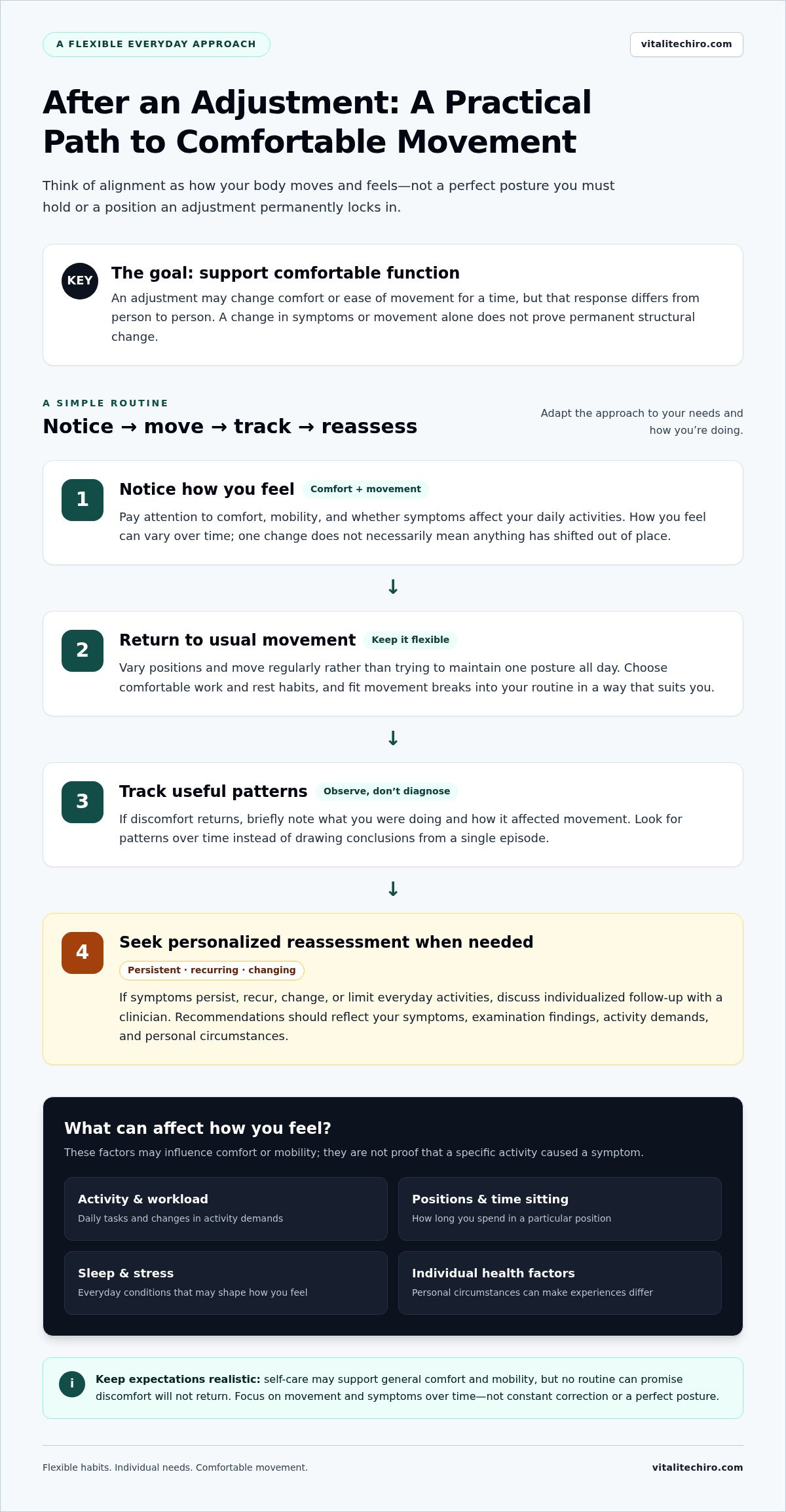
A useful post-adjustment routine doesn’t need to be complicated or rigid. Think of it as a way to check in with your body, continue ordinary movement as tolerated, and notice whether anything changes. This sequence can help you make thoughtful choices between appointments, but it isn’t a substitute for personalized clinical advice or instructions from your treating clinician.
What can you do during the first part of your day?
Start by noticing how you feel without testing your body repeatedly. Is getting dressed, walking around your home, or preparing breakfast comfortable? Choose ordinary movement that feels manageable, and follow any specific guidance your clinician has given you. You don’t need to perform a special stretch or hold a particular posture to “keep” an adjustment in place. Forcing a movement to chase alignment may add strain rather than offer useful information.
As you move through the day, use a flexible sequence:
- Check comfort: Notice whether everyday movement feels familiar, easier, or more limited than you expect.
- Resume usual activity: Continue familiar tasks at a comfortable level, guided by any individualized instructions.
- Take a break or modify: If a position or task becomes uncomfortable, change position, pause, or scale the activity down.
- Look for patterns: If a limitation keeps returning, make a brief note instead of assuming you know its cause.
If a particular movement noticeably worsens your symptoms, don’t push through it just to complete the routine. Reduce the effort or pause that activity, and seek clinical guidance if the change continues or concerns you. There isn’t one universal exercise plan or restriction that suits everyone.
How can you track patterns without over-monitoring?
Notes are most useful when they answer a practical question. If a recurring limitation is affecting your day, briefly record the activity, what changed, and whether it interfered with a goal such as sitting through a meeting or taking a comfortable walk. You don’t need to monitor every sensation or log every movement. The purpose is to communicate clearly, not to diagnose a spinal problem or search for meaning in every fluctuation.
Use those observations to guide a conversation with your clinician, especially if symptoms persist, change, or interfere with daily activities. A reassessment can consider your experience alongside examination findings and personal circumstances, rather than relying on a generic routine. This is a grounded way to approach how to maintain spinal alignment after adjustment: focus on manageable movement, relevant changes, and advice tailored to you.
If you’d like support building a routine around your needs, learn about personalized chiropractic care with Vitalité Chiropractic in Arlington.
When Should You Seek Personalized Follow-Up in Arlington?
Changes in comfort can come and go, but you don’t have to guess your way through symptoms that persist or keep returning. Consider discussing them with a clinician if they’re changing, limiting movement, or interfering with work, sleep, exercise, or other everyday activities. A follow-up can put those changes in context and help determine what next steps may be appropriate for your situation.
Pay attention to function as well as discomfort. Note if a familiar task has become harder, a movement limitation repeatedly interrupts your routine, or your symptoms are following a different pattern than before. These observations don’t diagnose a problem. They give your clinician useful context for deciding whether your care should be reassessed.
What should you share at a follow-up appointment?
Clear, concise details can make a conversation more useful. Describe what has changed, which activities feel limited, and what seems to ease or aggravate your discomfort. If you’ve noticed a recurring pattern, bring a few brief notes rather than trying to track every sensation. It can also help to identify a practical goal, such as returning to a particular activity or completing a daily task more comfortably.
Your clinician can consider these observations alongside your examination findings and personal circumstances. Be open about what matters in your day, including changes in activity or workload. That information helps guide individualized care instead of assuming the same plan fits everyone with similar symptoms.
How can personalized care support your next steps?
At Vitalité Chiropractic in Arlington, care is tailored to the individual. Chiropractic adjustments and rehabilitation may be considered in light of your concerns, movement limitations, and clinical findings. Dr. W. Jean-Luc Sansfaute has practiced since 2003, bringing experience to conversations about your needs and goals. The purpose of reassessment is to make thoughtful decisions about care, not to promise a specific result or prescribe one visit schedule for everyone.
A whole-body approach to lasting wellness can offer broader context for considering how daily demands and personal goals fit into care. If recurring movement limits are making your routine harder, a personalized conversation can help clarify possible next steps and whether adjustments or rehabilitation are appropriate to discuss.
Understanding how to maintain spinal alignment after adjustment includes knowing when self-management may not be enough. If symptoms persist, recur, change, or interfere with activities that matter to you, consider arranging an individualized follow-up. You can schedule personalized chiropractic care in Arlington online or call the practice at (703) 879-5144.
Take the Next Step Toward Confident Movement
Your routine doesn’t need to be perfect to be useful. The goal is to make choices that support the activities you value, notice when your needs change, and seek guidance when movement becomes harder. That perspective can take the pressure off trying to hold your body in one position and help you focus on what feels practical in daily life.
If you’re still considering how to maintain spinal alignment after adjustment, bring your questions and the movements that matter most to you into a personalized conversation. You can discuss your priorities and explore care that fits your circumstances, without expecting a universal plan or guaranteed result.
Schedule personalized chiropractic care with Vitalité Chiropractic in Arlington online or by calling the office at (703) 879-5144. A thoughtful next step can help you approach movement with greater clarity and confidence.
Frequently Asked Questions
Is it normal to feel sore after a chiropractic adjustment?
Mild soreness or temporary stiffness can occur after an adjustment, but it isn’t inevitable and shouldn’t be dismissed if it feels severe or keeps worsening. For mild tenderness, ease into your usual routine and avoid movements that aggravate it. Note when it started and whether it changes. Contact your clinician if it persists, intensifies, or comes with symptoms that concern you.
Can I exercise on the same day as a chiropractic adjustment?
You may be able to exercise the same day if the activity feels comfortable and your clinician hasn’t advised otherwise. Consider choosing an easier version of a familiar activity rather than testing a new maximum effort. A relaxed walk, for example, may feel more manageable than heavy lifting or intense intervals. If symptoms increase during or after exercise, stop or scale back and seek individualized guidance.
Does a popping sound mean an adjustment worked?
No. A popping or clicking sound doesn’t show that an adjustment worked. Such sounds can occur with joint movement and aren’t a reliable measure of treatment effect or spinal position. An adjustment may be performed without an audible pop, and sound alone can’t tell you whether your comfort or function has changed. Pay attention to how you feel and move, and discuss concerns with your clinician.
Should I drink extra water after a chiropractic adjustment?
You generally don’t need extra water specifically because you had an adjustment, and water shouldn’t be thought of as flushing toxins released by treatment. Drink according to thirst and your usual needs. If a clinician has advised you to limit fluids because of a health condition, follow that guidance rather than increasing your intake. Hydration supports ordinary body functions, but it doesn’t ensure an adjustment’s effects will last.
Can I drive or return to work after an adjustment?
You can generally return to driving or work if you feel alert, comfortable, and able to move safely. Before driving, consider whether you can turn to see traffic and react without significant pain or restriction. If you feel lightheaded, unusually uncomfortable, or less able to control the vehicle, don’t drive until it’s safe. At work, modify tasks that aggravate symptoms and follow your clinician’s instructions.
When should I seek medical attention after an adjustment?
Seek urgent medical attention for severe or rapidly worsening symptoms, new weakness, significant numbness, loss of bladder or bowel control, or difficulty walking. Sudden severe headache, vision or speech changes, fainting, or marked dizziness after an adjustment also need immediate assessment. These symptoms aren’t routine soreness. If you’re unsure about a new symptom, contact a medical professional promptly; for possible emergency symptoms, call local emergency services.
Does sleeping position affect how I feel after an adjustment?
Sleep position may affect comfort, but there’s no single position that determines how to maintain spinal alignment after adjustment. Try a comfortable position and notice whether your pillow or mattress setup leaves you waking more stiff or sore. A small change, such as adjusting pillow height or using support between your knees when side-sleeping, may help. If discomfort repeatedly disrupts sleep, discuss it with your clinician in Arlington.


