
Flat feet alone don’t mean you need orthotics. If you’re asking, “Do I need orthotics for flat feet?” the answer depends more on symptoms and function: ongoing foot, ankle, or knee pain may respond to added support, while mild discomfort without mobility problems may be manageable with supportive shoes. For adults, evidence isn’t definitive. A systematic review found a lack of evidence supporting orthotics as a treatment for flat feet, although they may help with some related problems.
It makes sense to look for support when flat feet affect your comfort or movement. But orthotics aren’t a cure-all, and custom devices aren’t right for everyone. To answer “Do I need orthotics for flat feet?”, consider what hurts, when symptoms occur, and how they affect daily activities. This article explains what orthotics do, compares over-the-counter inserts with custom devices, and reviews the evidence for adults. You’ll also learn when symptoms may call for evaluation and how footwear and other conservative care can guide your next step.
Key Takeaways
- Arch support, heel cushioning, and stability serve different purposes; the right balance depends on how your feet feel and function.
- Over-the-counter inserts can be a starting point for mild symptoms, while persistent discomfort may call for a more tailored approach.
- Evidence for orthotics in adults with flat feet is limited, though they may help with certain related pain and function problems.
- Ongoing pain, fatigue, or instability despite supportive shoes can signal that it’s time to consider further evaluation.
What Are Orthotics for Flat Feet?
Orthotics are shoe inserts designed to support the foot, cushion the heel, or influence foot mechanics while walking. In the United States, insurance coverage varies by plan, so there is no single rule that applies to everyone.
Arch Support, Cushioning, and Stability
Arch support helps distribute pressure across the foot, while heel cushioning softens impact. Stability features can help limit unwanted movement. These functions may matter when flat feet contribute to discomfort during standing or walking.
Functional orthotics use semi-rigid materials, such as plastic, carbon fiber, or graphite, to help control foot movement. Accommodative orthotics use softer, flexible materials that mold to the feet and provide cushioning. A useful insole balances support and comfort: overly firm arch support can create pressure points and increase discomfort.
A thin, flat insert may add a layer between the foot and shoe without providing much arch support or stability. If walking without support brings on foot pain, an insert with arch support and heel cushioning may feel different from a simple foam liner. Shin splints can also make it worth considering how footwear feels during activity, but an insert should not cause new pressure or pain.
Supportive Footwear and Arch Support
Supportive footwear combines a firm sole with a shape that holds the foot comfortably; an insole adds support inside the shoe. This distinction matters because an insert fits within the shoe and cannot make every shoe supportive.
For mild discomfort, shoes with good arch support and a firm sole may be enough. Stability shoes can add midfoot support for mild to moderate overpronation. Running shoes, dress shoes, and work boots have different interior shapes, so one orthotic profile may not fit every pair equally well.
Check how the shoe and insole feel together while standing and walking. Your heel should feel cushioned, your arch supported without a sharp pressure point, and your foot stable in the shoe. If walking brings on pain instead of comfortable support, the fit or level of arch support may not suit your foot mechanics.
Over-the-counter inserts and custom orthotics
For a flexible flat foot with occasional discomfort, over-the-counter inserts can be a practical starting point. They add support and cushioning, but their shape and fit are not tailored to your arches. Comfort matters: an insert that presses sharply into the plantar arch can create pressure points instead of easing symptoms.
Custom orthotics may be considered when flat feet are severe or pain is chronic. A specialist examines the foot and ankle, considers how symptoms affect standing and walking, and assesses what fit is needed. If symptoms persist or worsen with an over-the-counter device, a custom option may be recommended. Neither type corrects the underlying foot or ankle condition; orthotics are used to manage symptoms.
Custom devices are made to match an individual’s foot shape. They may be fabricated using a plaster mold, a foam-box impression, or computerized foot analysis that creates a three-dimensional image. This tailored process distinguishes custom orthotics from mass-produced insoles, but more customization does not automatically mean better comfort for every flat foot.
Costs vary depending on whether inserts are over-the-counter or custom-made, as well as on materials and fitting. Custom-device pricing is provided after a quote request.
Adults and children should seek medical evaluation when pain, fatigue, or instability continues despite supportive shoes. Persistent discomfort that interferes with walking also deserves attention, particularly if an over-the-counter insert does not ease symptoms.
New inserts may take time to adjust to. Start by wearing them for short periods, then gradually increase wear time; some people need the first few weeks of consistent use to notice benefits. If arch pressure or foot pain increases, don’t force longer wear. Reassess the comfort and fit, since overly firm support can worsen discomfort rather than help.
Evidence for orthotics in adults with flat feet
For adults, the evidence does not support a blanket recommendation for orthotics to treat flat feet. A systematic review found a lack of evidence in available studies supporting orthotics as a treatment for adult flat feet. That signals uncertainty, not proof that inserts never help. It also means arch shape alone cannot tell you whether you will benefit.
Some specific problems may respond differently. Orthotics may reduce pain and improve function for plantar heel pain, including plantar fasciitis, and early posterior tibial tendon dysfunction. This tendon helps support the arch, so symptoms involving it differ from having flat feet without discomfort. Extra support may help manage those symptoms, rather than change the underlying foot structure.
Custom orthotics are not automatically necessary for a rigid flat foot. Some people with rigid feet may be better served by bracing or another treatment plan. A podiatrist can assess the foot and ankle, identify the condition, and consider how pain or function affects daily activities. The key is the diagnosed problem, not simply whether an arch appears low.
Available studies indicate that inserts for flat feet do not cause harm. Still, a device that presses too firmly against the arch can create pressure points and increase discomfort. Tolerability matters when deciding whether extra support is useful. New or worsening pressure while wearing an insert is a reason to reassess its fit and level of support.
For a practical decision, separate flat-foot structure from symptoms. An adult without pain or activity limits has a different concern from someone with plantar heel pain or early tendon dysfunction. Consider whether standing, walking, or everyday tasks remain uncomfortable, and whether an insert changes that experience. Orthotics can help manage symptoms, but the evidence does not establish them as a universal treatment for adult flat feet.
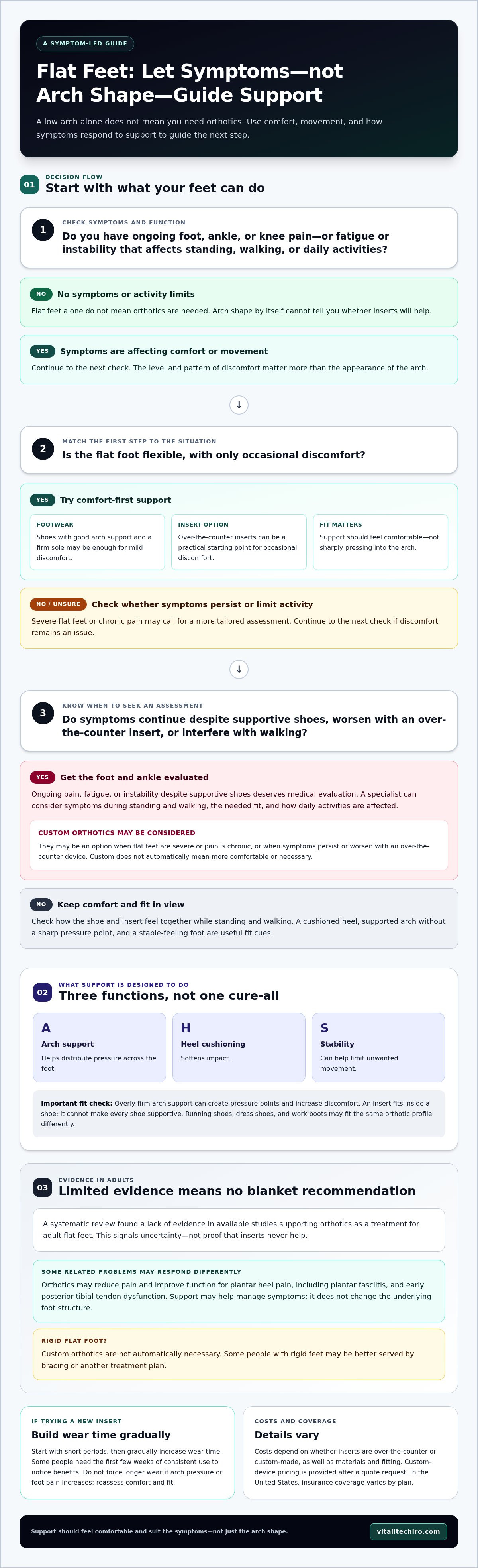
What symptoms indicate flat feet need medical evaluation?
Flat feet alone don’t establish a need for medical evaluation. A more useful signal is how your feet function: ongoing pain, fatigue, or instability despite supportive shoes warrants attention. For example, ankle aches after standing for a long time matter more than a low arch without discomfort.
Notice what happens during ordinary activities. Pain that builds while walking, tired feet that limit standing, or a sense of instability can affect daily function. If supportive footwear hasn’t eased these problems, an evaluation can help determine whether flat feet relate to your symptoms and what conservative care may help.
The shape of your arch offers context, but it isn’t a diagnosis. With flexible flat feet, an arch appears when sitting or when the feet are unsupported, then disappears while standing. Rigid flat feet have no visible arch in either position, and the foot feels stiff with limited mobility. These differences help describe what you notice during everyday movement.
Age also matters. Babies are born with flat feet, and arches often develop naturally as children grow. Some people never develop a defined arch. For a child, consider whether foot discomfort or limited movement accompanies the flat-foot shape, rather than treating appearance alone as proof of a problem.
Before an appointment, note which activities bring on symptoms, such as standing through a work shift or walking in supportive shoes. Record whether pain, fatigue, or instability changes with footwear or rest. These concrete details help explain how the problem affects function, beyond simply describing your arch as low.
If pain, fatigue, or instability persists despite supportive shoes, arrange an evaluation to discuss the cause and suitable care. Orthotics may be one option for managing symptoms, while other conservative approaches can also be considered based on the specific foot and ankle problem.
Vitalité Chiropractic: Chiropractic Adjustments
Vitalité Chiropractic offers orthotics for people considering added support for flat-foot symptoms. If discomfort continues or affects walking, a conversation about your symptoms and daily activities can help clarify whether orthotics are relevant to your care. Chiropractic Adjustments are also available as a separate offering; they should not be presented as a replacement for orthotics or as a guaranteed solution for flat feet. Consider discussing what brings on your discomfort, how it affects movement, and what support you’ve already tried. This gives the conversation a practical focus without assuming that every low arch needs treatment. For a patient-centered discussion of your options, contact Vitalité Chiropractic.
Choose a next step that fits your needs
Let comfort and everyday function guide your decision, rather than arch shape alone. If you’re still weighing whether you need orthotics for flat feet, consider what you want to change: walking with less discomfort, managing symptoms during activity, or finding support that suits your routine. Those priorities can make a conversation about care more focused.
Vitalité Chiropractic offers orthotics and Chiropractic Adjustments in Arlington, Virginia. The practice also provides Decompression Therapy and Sports Injury Care for different needs. These services are not interchangeable, so a useful discussion starts with your symptoms, activities, and goals. Share what you’ve noticed with the team to explore which options align with your situation.
Contact Vitalité Chiropractic to discuss your concerns and possible next steps. You deserve care that considers your individual needs and supports confident movement forward.
Frequently Asked Questions
What are the potential benefits of orthotics?
Orthotics may reduce pain and improve function for some problems linked to flat feet, including plantar heel pain and early posterior tibial tendon dysfunction. Their practical benefit is symptom management, such as making time on your feet more comfortable. They don’t change the underlying foot structure. Judge an insert by whether it supports the activity that causes difficulty, not by appearance alone.
But Don’t Feet Need Support?
Feet need to manage body weight and movement, but that doesn’t mean everyone needs an insert. Natural arches and foot mechanics vary, and support can come from footwear as well as orthotics. Think of support as a way to make standing or walking more comfortable when symptoms call for it, not as a requirement for every foot. A low arch without pain or functional difficulty doesn’t automatically need correction.
Do Orthotics Really Work?
Orthotics may help some people, but evidence doesn’t establish them as a universal treatment for flat feet in adults. A systematic review found a lack of evidence supporting orthotics for adult flat feet overall. That doesn’t rule out symptom relief for specific problems, such as plantar heel pain. Their usefulness depends on the condition being addressed and whether the device feels comfortable during the activities that matter to you.
How long do I have to wear orthotics?
There isn’t one wear schedule for every orthotic or purpose. Start with short periods, then gradually increase wear time while paying attention to comfort during everyday activities. For example, introduce a new pair during a shorter walk before wearing it through a full day on your feet. The right routine depends on your symptoms, the device, and how comfortably it fits in your shoes.
How long do orthotics last?
Orthotics don’t have one universal replacement interval. Their useful life depends on the materials, how often they’re worn, and the demands placed on them. Check whether the device still sits securely in the shoe and feels supportive during ordinary walking. Visible damage, compressed cushioning, or a changed fit can affect comfort and support. If you notice these changes, have the device assessed rather than relying on its age alone.
So why do I have pain if I don’t have cushion or lose orthotics?
Insufficient cushioning can make walking uncomfortable, while a loose orthotic can shift inside the shoe and cause rubbing or uneven pressure. Pain can also come from the underlying foot or ankle problem, so cushioning alone may not address it. Check that the insert lies flat and stays in place. If pain continues or worsens, pause use and seek an evaluation of the fit and symptoms.


