
What if the source of your knee pain isn't actually in your knee? It's a common frustration for athletes in Arlington who find themselves sidelined by a sharp ache under the kneecap that refuses to fade. You rest for weeks, hoping for a breakthrough, only to feel that familiar discomfort return the moment you step back onto the W&OD Trail. It's natural to worry that your best running days are behind you, but the solution often lies in looking beyond the joint itself. Consulting a chiropractor for runners knee allows you to move past temporary fixes and address the mechanical failures in your hips or gait that are the true culprits.
In this guide, you'll discover how specialized chiropractic care identifies the root cause of your injury to provide a path back to the trails without surgery or long-term medication. We'll explore the biomechanical connections between your spine, pelvis, and feet to explain why the pain persists. By understanding the mechanical "why" behind your injury, we can build a sustainable recovery plan together. This article previews the diagnostic process and the restorative techniques that help you reclaim your physical freedom and run pain-free for years to come.
Key Takeaways
- Understand why Patellofemoral Pain Syndrome is often a symptom of mechanical failure in your hips or feet rather than a permanent injury to the knee joint itself.
- Learn how a chiropractor for runners knee uses spinal adjustments and extremity manipulation to realign the kinetic chain and restore natural movement patterns.
- Discover the difference between masking symptoms with medication and addressing the structural imbalances that cause valgus stress and joint irritation.
- Gain a clear, non-surgical roadmap for returning to the Mount Vernon Trail with a sustainable recovery plan tailored to your unique biomechanics.
What is Runner’s Knee? Understanding Patellofemoral Pain
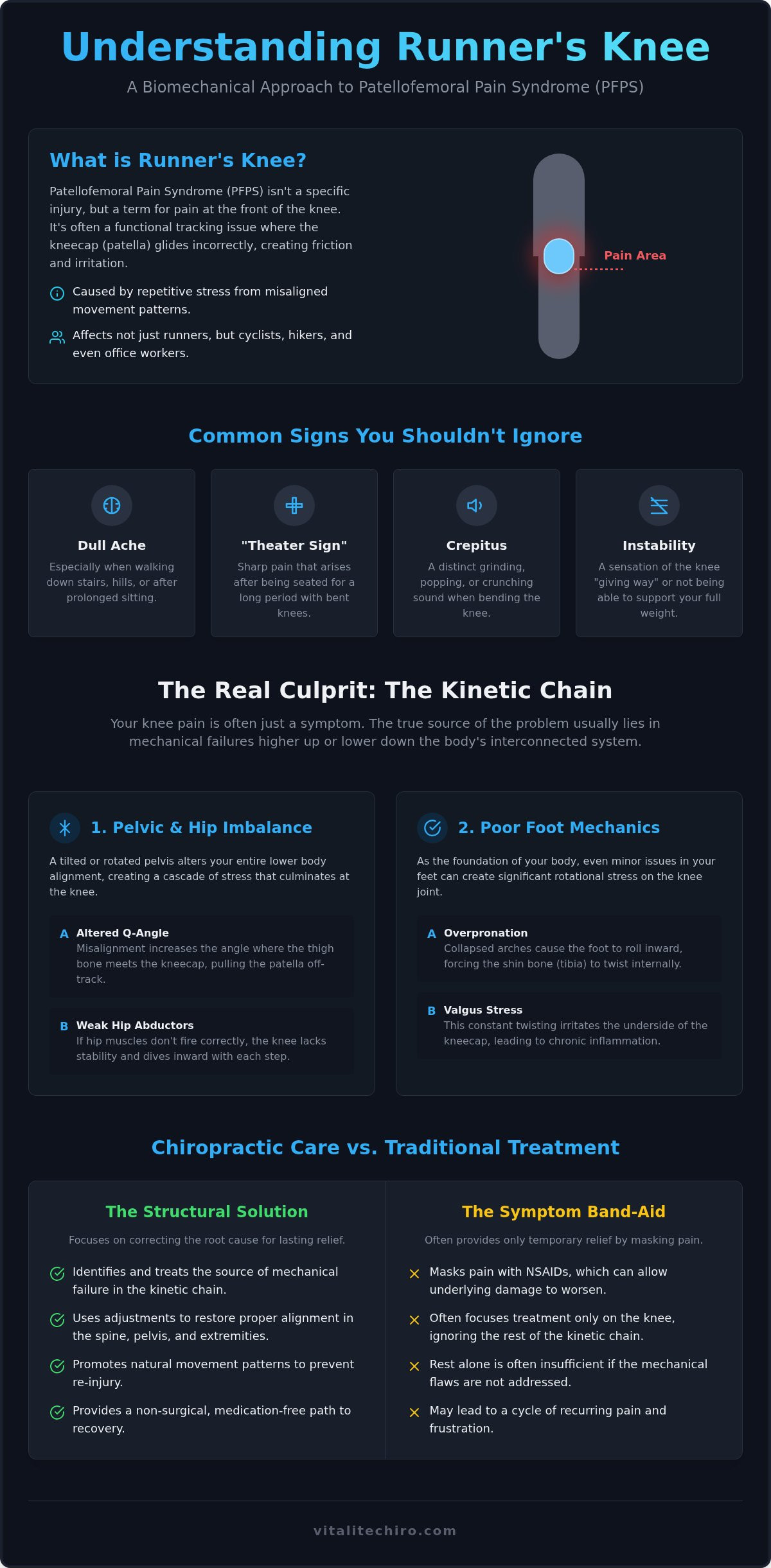
Patellofemoral Pain Syndrome (PFPS), colloquially known as runner's knee, is one of the most frequent complaints we see in our Arlington clinic. It isn't a single injury but rather a clinical description for pain located at the front of the knee and around the patella. While the name suggests it's exclusive to those training for a marathon, it actually impacts anyone whose daily movement patterns put repetitive stress on the joint. Hikers, cyclists, and even those who spend long hours at a desk can develop these symptoms when the delicate mechanics of the lower body fall out of alignment. Often, a sudden increase in mileage or switching to unsupportive footwear serves as the catalyst for the discomfort to begin.
Common Signs You Shouldn’t Ignore
Recognizing the early signals of PFPS can be the difference between a quick recovery and months of frustration. You might notice a dull ache when descending stairs or a sharp twinge after sitting through a long movie; a phenomenon often called the "theater sign." Some patients report a distinct grinding or popping sound, known as crepitus, when they squat or lunge. You may even feel a subtle "giving way" sensation as if the joint cannot fully support your weight. While it's tempting to reach for a bottle of ibuprofen to push through your next workout, masking the pain with NSAIDs often does more harm than good. Silencing the pain without fixing the mechanic allows the irritation to continue, which can eventually lead to permanent cartilage damage. Choosing to consult a chiropractor for runners knee ensures you're treating the source of the friction rather than just turning off the alarm bells.
The Anatomy of the Patella
Your kneecap is designed to be a mobile lever, gliding smoothly within a specific track on your thigh bone called the femoral groove. This movement is governed by a complex tug-of-war between your quadriceps and hamstrings. When these muscles are imbalanced or your gait is compromised, the patella begins to pull to one side, creating friction against the bone underneath. Essentially, PFPS is a functional tracking issue rather than a simple case of "wear and tear" on the joint. By evaluating how these muscles interact with your pelvic alignment, a chiropractor for runners knee can help restore the proper glide and take the pressure off the sensitive tissues surrounding the bone. This structural approach focuses on how your body moves as a whole, ensuring every part of the kinetic chain supports your recovery.
The Kinetic Chain: Why Your Hip and Foot Control Your Knee
The human body functions as a single, integrated unit rather than a collection of isolated parts. This concept, known as the kinetic chain, explains how movement at the ankle or hip directly dictates the stress placed upon the knee. In many cases of patellofemoral pain, the knee is simply the victim of mechanical failures occurring elsewhere. When you consult a chiropractor for runners knee, the diagnostic process extends far beyond the joint itself. We evaluate your gait and posture to see how your entire foundation supports your stride. It's often the case that the knee is the loudest part of the body, but the hip or foot is the true source of the problem.
The Role of Pelvic Alignment
A stable pelvis is the cornerstone of a healthy running form. If your pelvis is tilted or rotated, it fundamentally alters your Q-angle, which is the measurement of how your thigh bone meets your kneecap. An increased Q-angle puts excessive lateral pressure on the patella, causing it to track incorrectly and irritate the surrounding tissues. Additionally, spinal subluxations can interfere with the nerve signals traveling to your hip abductors. When these muscles don't fire correctly, your knee loses its lateral stability and begins to dive inward with every step. Investing in sports performance chiropractic care helps ensure your nervous system and skeletal structure work in harmony to prevent this mechanical breakdown.
Foot Mechanics and Overpronation
Your feet are the only point of contact with the ground, making them the literal foundation of your kinetic chain. If you struggle with flat feet or collapsed arches, your foot likely overpronates during each strike. This inward collapse of the arch forces the tibia, or shin bone, to twist internally. Since the knee joint is designed primarily for flexion and extension, this rotational force creates significant valgus stress. Over time, this twisting motion irritates the underside of the kneecap and leads to chronic inflammation. A chiropractor for runners knee often recommends custom orthotics to stabilize the arches and stop this destructive rotation at its source. By correcting these foundational issues, we can reduce the impact forces that travel up your leg with every mile.
Weakness in the hip abductors is another common culprit. If your gluteus medius is underactive, your thigh bone will rotate inward when you land, forcing the knee to follow suit. This inward collapse is a primary driver of the sharp pain runners feel. Our approach focuses on identifying these biomechanical gaps through a comprehensive movement assessment. It's about finding the "why" behind the pain so you can return to your favorite routes feeling stronger and more balanced. If you're ready to address the root of your discomfort, scheduling a biomechanical evaluation is the first step toward lasting relief.
Chiropractic Care vs. Traditional Treatment for Knee Pain
Traditional medicine often relies on a "symptom-first" model to manage discomfort. This usually involves a combination of rest, ice, and anti-inflammatory medications. While these tools might quiet the pain temporarily, they don't address the reason the patella isn't tracking correctly. Chiropractic care utilizes a "structure-first" philosophy. Instead of just treating the site of pain, we look at the mechanical alignment and neurological function that caused the irritation. By restoring proper motion to the joints, we help the body reduce inflammation naturally through improved circulation and lymphatic drainage.
Surgery is rarely necessary for standard cases of Patellofemoral Pain Syndrome. Most patients find that non-invasive care is highly effective once the underlying structural imbalances are corrected. Total immobilization can actually lead to muscle atrophy and stiffer joints, which makes the eventual return to running even harder. We advocate for active recovery instead. This means keeping you moving in ways that don't aggravate the injury while a chiropractor for runners knee works to restore proper joint mobility throughout your kinetic chain.
Beyond the "Quick Fix"
Many athletes seek out cortisone injections when they're desperate for immediate relief before a big race. It's vital to understand that while these shots reduce swelling, they can potentially weaken the tendons over time if used repeatedly. Relying on a chemical mask ignores the biomechanical root cause and leaves the joint vulnerable to further damage. Specialized chiropractic care for runners is a long-term performance strategy that prioritizes the longevity of your joints over a temporary patch. When you address the "why" behind the pain, you're not just fixing a problem; you're elevating your overall physical potential.
Evidence-Based Manual Therapy
Joint mobilization and soft tissue release are grounded in deep physiological science. These techniques help break up restrictive adhesions and restore the natural glide of the joint surfaces. When your joints move freely, your nervous system can better coordinate the complex muscle firing patterns required for a stable running gait. At our clinic, we often utilize the diversified technique to address specific subluxations in the spine and extremities. This precise manual adjustment helps recalibrate the body's communication pathways. Working with a chiropractor for runners knee ensures that your recovery is methodical and thorough, bridging the gap between clinical science and your daily lifestyle on the trail.
3 Targeted Strategies a Chiropractor Uses for Runner’s Knee
Recovery requires a multifaceted approach that moves beyond simple rest. When you work with a chiropractor for runners knee, the treatment protocol is designed to realign your structure and retrain your nervous system. We use a three-step strategy to ensure that every component of your movement is optimized for the trail. This methodical progression allows us to move from immediate pain relief to long-term performance enhancement.
The first step involves precise spinal and pelvic adjustments. Since the pelvis acts as the primary stabilizer for your lower extremities, any misalignment here creates an uneven distribution of weight. By balancing the load at the source, we reduce the sheer force that hits your knee joint with every step. This foundational work ensures that the rest of your kinetic chain can function without being forced to compensate for a tilted base.
Our second phase focuses on extremity manipulation. This involves adjusting the knee, ankle, and hip joints directly to restore their natural range of motion. Integrating these adjustments into a cohesive chiropractic care for runners plan ensures that your joints aren't just moving, but moving with precision. When each joint in the leg handles its fair share of the impact, the repetitive stress on the kneecap is significantly diminished.
The final component involves soft tissue modalities. These techniques address the muscle imbalances and scar tissue that often develop from chronic compensation. By releasing tension in the iliotibial (IT) band and lateral quadriceps, we allow the patella to return to its proper track. A specialized chiropractor for runners knee uses these tools to ensure your recovery is both structural and functional, preventing the return of old injury patterns.
Extremity Adjustments Explained
Many patients are surprised to learn that joints like the ankle or knee can be adjusted just like the spine. During an extremity adjustment, you might feel a quick, shallow movement or hear a faint "pop" as gas is released from the joint capsule. We often use manual diversified methods for structural changes or the Activator tool for a more targeted, low-force approach. Restoring these small joint movements is crucial because it prevents the large-scale injuries that occur when your body tries to work around a "stuck" joint.
Supportive Modalities for Faster Healing
Healing doesn't stop when you leave the adjustment table. We incorporate therapeutic exercises specifically designed to strengthen the vastus medialis oblique (VMO) muscle, which is the key stabilizer for the kneecap. For many of our athletes, custom orthotics provide 24/7 support by maintaining proper foot mechanics throughout the day. At Vitalité, we pride ourselves on providing an inclusive and supportive environment where every athlete receives the same high standard of clinical care. If you're ready to stop managing pain and start building resilience, book your initial sports injury assessment today.
Planning Your Return to Running in Arlington, VA
Returning to your routine after an injury requires more than just waiting for the pain to stop. It's about building a bridge between clinical recovery and the high-impact demands of the road. A gradual "return to run" program is essential for long-term success. We often suggest starting with a run-walk interval strategy on forgiving surfaces to test your joint's resilience. Local paths like the Mount Vernon Trail offer beautifully paved, relatively flat stretches that are perfect for low-impact re-entry. By managing your volume carefully, you allow your newly aligned joints to adapt to the stress of movement without triggering a relapse.
Regular maintenance visits are a vital part of this transition. Think of them as a tune-up for your kinetic chain. Even when you feel great, a quick check-in with a chiropractor for runners knee can catch minor pelvic shifts before they manifest as sharp pain under your kneecap. This proactive approach ensures that your body stays in a state of readiness rather than constant repair. Your best miles aren't behind you; they're waiting just around the corner as you build a more resilient foundation.
The Vitalité Recovery Roadmap
Our approach is structured to guide you through three distinct phases of healing. The initial intensive phase focuses on reducing inflammation and restoring basic spinal alignment to take the immediate pressure off the joint. Once the acute pain subsides, we move into the rehabilitation phase, where the focus shifts to strengthening the VMO and correcting gait imbalances. Finally, the wellness phase is about performance optimization. Here, we work together to ensure your biomechanics are efficient enough to handle increased speed or distance, making injury prevention a natural part of your lifestyle.
Local Resources for Arlington Runners
Arlington is home to a vibrant running community, and staying connected can be a powerful motivator during recovery. Groups like the DC Road Runners or local shop-based clubs provide supportive environments for athletes of all levels. We also highly recommend professional gait analysis for our local athletes. Seeing exactly how your foot strikes the ground provides the data needed to refine your form and select the right footwear. Consulting a chiropractor for runners knee ensures that these external factors are supported by a strong internal structure. If you're ready to move past the frustration of recurring pain, schedule your runner’s knee evaluation at Vitalité Chiropractic today. Our team is here to help you navigate the path back to the sport you love with confidence and strength.
Reclaim Your Stride on the Arlington Trails
Knee pain doesn't have to be the end of your running journey. By addressing the structural imbalances in your pelvis and feet, you can stop the cycle of recurring injury and return to the movement you love. Understanding that your knee is often the victim of mechanical failures elsewhere in the kinetic chain is the first step toward a permanent solution. Working with a chiropractor for runners knee provides the specialized expertise needed to realign your body and optimize your performance without relying on temporary fixes.
At Vitalité Chiropractic, we're dedicated to serving our diverse community with compassion and technical excellence. Dr. Sansfaute has been helping athletes find relief since 2003, providing expert care in an inclusive, multilingual, and LGBTQ+ friendly environment. We offer same-day appointments for acute pain relief to ensure you don't have to wait to start your recovery. Book your Arlington sports injury consultation today and take the first step toward a pain-free future. Your best runs are still ahead of you.
Frequently Asked Questions
Can a chiropractor really help with knee pain if the issue isn’t in my spine?
Yes, because a chiropractor for runners knee treats the body as an integrated kinetic chain rather than a collection of isolated parts. While we focus on spinal alignment to ensure proper nerve function, we also perform extremity adjustments on the hip, knee, and ankle. If your knee pain stems from a tilted pelvis or a restricted ankle joint, we address those specific areas to restore balance to your entire gait.
How many sessions will I need before I can start running again?
Every recovery timeline is unique, but most patients feel a noticeable reduction in acute pain within the first few visits. A typical plan from a chiropractor for runners knee involves an initial intensive phase of two to four weeks to stabilize the joint. We then transition into a rehabilitation phase focused on strengthening. Our goal is to get you back to a gradual run-walk program as soon as your biomechanics are stable.
Is it safe to have my knee adjusted?
Chiropractic adjustments for the knee are exceptionally safe when performed by a seasoned practitioner like Dr. Sansfaute, who has been practicing since 2003. We use precise, controlled movements to restore joint mobility without overstressing the ligaments. Depending on your comfort level and the nature of your injury, we might use manual diversified techniques or low-force tools like the Activator. These methods help realign the patella and reduce the friction causing inflammation.
Will I need to buy special shoes or orthotics?
You won't necessarily need new shoes, but we may recommend custom orthotics if your foot mechanics are the primary cause of your knee pain. Collapsed arches or overpronation can force the knee to rotate inward, creating chronic irritation. Unlike generic inserts, our custom orthotics are molded to your specific foot structure to provide 24/7 support. This foundation helps maintain the corrections made during your adjustments and prevents the return of valgus stress.
What happens if I keep running through the pain?
Continuing to run through sharp or persistent knee pain can lead to long-term cartilage damage and chronic inflammation. This often forces the body to create compensatory movement patterns, which eventually causes secondary injuries in the hips or lower back. Masking the discomfort with medication only delays the inevitable. Addressing the mechanical root cause early ensures a faster return to activity and protects the longevity of your joints for years to come.
Does insurance typically cover chiropractic care for sports injuries like runner’s knee?
Many insurance plans do provide coverage for chiropractic care when it's used to treat sports injuries like runner's knee. Since coverage varies significantly between providers and specific policies, we recommend checking with your insurance carrier to confirm your benefits. Our staff is experienced in navigating these logistics and can help you understand your options. We focus on providing a clear path to wellness that respects both your physical health and your logistical needs.
How does Dr. Sansfaute’s approach differ from standard physical therapy?
Dr. Sansfaute’s approach combines structural alignment with functional rehabilitation to provide a comprehensive solution. While standard physical therapy often focuses primarily on muscle strengthening, we first ensure the joints are properly aligned and the nervous system is communicating clearly. This "structure-first" philosophy ensures that when you do perform strengthening exercises, you're building on a balanced foundation. It's a holistic method that integrates joint mobilization with targeted therapeutic modalities for lasting results.


