
What if the solution to your recurring shin splints isn't another week of rest, but a fundamental shift in how your body absorbs every strike of the pavement? It's incredibly frustrating to feel your progress stall because of a nagging hip impingement, especially when you're terrified a doctor will simply tell you to hang up your shoes for good. You've put in the miles and the sweat, yet your race times have plateaued despite the increased volume. You aren't alone in this struggle. Research indicates that between 30% and 50% of recreational runners experience an injury each year, often due to subtle misalignments in the kinetic chain.
We understand that running is more than just exercise; it's your community and your mental clarity. Specialized chiropractic care for runners focuses on ensuring your joints and muscles work in perfect harmony to distribute force efficiently. By partnering with a sports rehabilitation expert, you can move beyond temporary fixes and address the biomechanical root causes of your discomfort. We'll show you how to optimize your form to prevent future injuries and finally shave those stubborn seconds off your personal best. This article explores how targeted adjustments and custom gait corrections create a clear recovery plan that keeps you on the trail where you belong.
Key Takeaways
- Understand how the kinetic chain connects your feet to your spine, ensuring every mile is supported by proper alignment rather than harmful compensation.
- Explore how professional chiropractic care for runners utilizes manual adjustments and soft tissue therapy to resolve the underlying biomechanical issues that cause plateauing race times.
- Identify the true sources of the "Runner's Trio", including knee, hip, and foot pain, to stop chasing symptoms and start implementing a clear path to recovery.
- Learn why custom-molded orthotics offer superior stability compared to off-the-shelf inserts by supporting all three arches of your unique foot structure.
- Discover a partnership-based approach to sports rehabilitation that prioritizes your ability to stay on the trail while optimizing your running economy.
The Kinetic Chain: Why Alignment is the Foundation of Every Mile
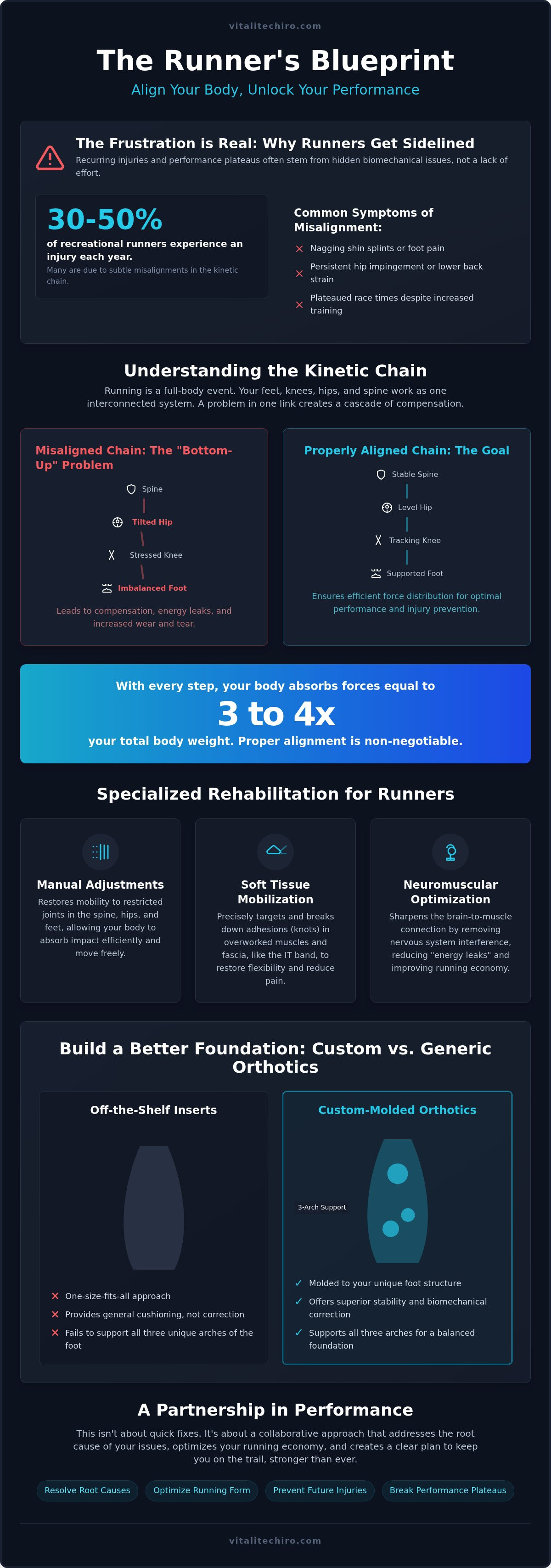
Running isn't just about legs; it's a full-body symphony of movement where every part relies on the others. This interconnectedness is known as the kinetic chain. When you run, your foot, knee, hip, and spine function as a single, continuous unit. If one link in this chain is restricted, the entire system must adapt. This is why chiropractic care for runners is so vital. It ensures that every joint is moving as intended to handle the immense stress of the sport. During a typical gait cycle, your body absorbs forces equal to three to four times your total body weight with every single step. Without proper alignment, these repetitive forces aren't distributed evenly; they're concentrated in areas that weren't designed to bear them.
A stiff ankle might seem like a minor inconvenience, but it forces the knee to over-rotate and the hip to tilt, eventually manifesting as lower back strain. These are known as compensation patterns. When your body works around a restriction, it burns more energy and increases the wear and tear on your soft tissues. In the context of running efficiency, a joint subluxation is a minor misalignment or functional restriction in a joint that disrupts the smooth transfer of force, leading to mechanical inefficiency and increased risk of injury.
The Foot-Spine Connection
Your feet are the only points of contact with the ground, making them the foundation of your posture. If your foot strike is imbalanced, it creates a "bottom-up" effect that can lead to an anterior or posterior pelvic tilt. This shift places undue stress on the sacroiliac (SI) joint, which acts as a primary shock absorber between your lower body and your spine. To maintain pelvic symmetry and ensure your hips remain level during high-mileage weeks, regular chiropractic adjustments are essential. These targeted movements restore joint mobility, preventing the compensatory shifts that lead to chronic pain and ensuring your foundation remains stable.
Neuromuscular Coordination and Running Economy
Performance isn't just about muscle strength; it's about how quickly and efficiently your brain communicates with those muscles. Sports chiropractic focuses on removing interference within the nervous system to sharpen this neuromuscular coordination. When your spine is properly aligned, your nerves can transmit signals without delay, improving your running economy by reducing "energy leaks." These leaks occur when muscles fire out of sync or work harder than necessary to stabilize a misaligned frame. By optimizing this communication, you'll experience smoother movement patterns and faster recovery times between training sessions because your body isn't fighting against its own mechanics.
Sports Rehabilitation Techniques Tailored for Runners
While general chiropractic focuses on spinal health, specialized chiropractic care for runners requires a deeper understanding of the specific stressors placed on high-impact athletes. We use the Diversified Technique, a form of manual adjustment that restores motion to restricted joints within the spine and extremities. For a marathoner or sprinter, these adjustments ensure that the joints can withstand the rigorous demands of training. By integrating sports performance chiropractic care into your routine, you move beyond simple maintenance. You create a foundation for active recovery where the body heals faster because it isn't fighting mechanical restrictions.
Manual Therapy and Soft Tissue Mobilization
High-mileage weeks often lead to the development of micro-tears and subsequent adhesions. While foam rolling is a popular habit, it often fails to reach the deeper layers of fascia where these restrictions reside. Manual therapy allows for precise pressure to break down adhesions in the IT band and calves, restoring the sliding surfaces of the muscles. We also focus heavily on hip capsule mobility. If your hip capsule is tight, your stride length suffers, forcing your body to compensate elsewhere. This clinical focus is supported by research on posture and pain, which suggests that restoring these movement patterns is critical for long-term health.
Non-Surgical Spinal Decompression
Running on asphalt and concrete creates repetitive vertical loading that can compress the intervertebral discs over time. This pressure can lead to radiating leg pain or sciatica-like symptoms that mimic a pulled hamstring. Non-surgical decompression provides a gentle, mechanical stretch to the spine, creating negative pressure within the disc to promote healing and nutrient flow. This is distinct from spinal decompression therapy used for chronic, severe pathologies. For runners, it serves as a proactive way to relieve the day-to-day pressure of gravity and impact. Integrating this with comprehensive chiropractic care for runners ensures you stay on the road without the fear of disc-related setbacks.
If you've been struggling with stubborn tightness that won't go away, it might be time to consult with a specialist who understands the runner's unique anatomy and the demands of the trail.
Addressing the 'Runner’s Trio': Knee, Hip, and Foot Pain
When pain manifests in the knee, hip, or foot, it's rarely an isolated event. These three areas form the "Runner's Trio," where a dysfunction in one often triggers a symptomatic response in another. For example, Runner’s Knee, or patellofemoral pain, is frequently a tracking issue caused by weak hip abductors or a misaligned pelvis. When the hip doesn't provide a stable base, the knee collapses inward during each strike, causing the kneecap to rub painfully against the femur. Similarly, Plantar Fasciitis isn't just a foot problem; it's often the result of a tight posterior chain. If your calves and hamstrings are restricted, they pull on the heel, creating the chronic inflammation that makes those first steps in the morning so difficult.
Effective chiropractic care for runners looks beyond the immediate site of discomfort to restore the "glide" in joints like the acetabular joint of the hip. Hip bursitis and impingement often stem from a lack of space in this joint, leading to repetitive pinching of soft tissues. By using precise adjustments to improve joint centration, we reduce this mechanical friction. This comprehensive approach ensures that you aren't just masking symptoms but are actually fixing the structural imbalances that caused the pain in the first place.
The Truth About Shin Splints
Shin splints are often dismissed as simple muscular fatigue, but they usually signal a deeper biomechanical imbalance. When your weight distribution is off, the muscles in the front of your leg, specifically the anterior tibialis, work overtime to stabilize the foot. We focus on ankle adjustments to restore the "spring" in your step, ensuring the talus and calcaneus bones move freely. To support this, we recommend specific corrective exercises, such as eccentric toe raises, to strengthen the anterior tibialis and better manage tibial stress during high-impact runs.
IT Band Syndrome and Pelvic Stability
Many runners spend hours stretching their IT band with little relief. This is because the IT band is a thick piece of connective tissue that shouldn't be "loose"; rather, it should be properly positioned. If your pelvis is unlevel, the IT band is pulled taut like a guitar string, causing friction at the knee. Through spinal alignment, we restore glute medius activation, which is the muscle responsible for keeping your pelvis level when you're on one leg. A balanced pelvis isn't just a postural goal; it's the primary structural defense against the repetitive friction that sidelines even the strongest runners. By ensuring pelvic symmetry, you allow the IT band to function without unnecessary tension.
Custom Orthotics: The Runner’s Secret to Long-Term Stability
Many runners attempt to resolve foot discomfort by purchasing mass-produced, off-the-shelf inserts at a local pharmacy. While these may provide temporary cushioning, they often fail to address the specific pathologies that lead to chronic injury. Custom orthotics are precision-engineered Class II medical devices designed to support all three arches of the foot: the medial longitudinal, the lateral longitudinal, and the transverse arch. When these arches aren't properly supported, the foot often collapses into excessive pronation. This collapse triggers a destructive chain reaction, causing an internal rotation of the tibia and femur that places immense strain on the knees and hips. By stabilizing the foundation, we ensure that every strike is absorbed safely by the skeletal system rather than the soft tissues.
The impact of foot mechanics extends far beyond the lower extremities. If your foundation is unstable, your upper body must work harder to maintain balance, often leading to an asymmetrical arm swing. We frequently integrate these corrective tools with chiropractic for shoulder injury to resolve persistent imbalances in the upper torso. When the feet are correctly aligned, the repetitive "swing" of the arms becomes more efficient, reducing the torque placed on the spine. This holistic view is a cornerstone of comprehensive chiropractic care for runners, ensuring that your entire frame moves as a synchronized unit rather than a collection of parts.
Gait Analysis and Foot Mechanics
To create a truly effective orthotic, we perform a detailed gait analysis to identify overpronation or supination in real-time. This allows us to see how your body manages weight during the mid-stance and toe-off phases of your stride. A custom insert fundamentally changes the load-bearing profile of your entire leg, shifting pressure away from vulnerable tendons and toward the structural bones of the foot. For high-mileage athletes, the lifespan of a custom orthotic typically ranges from 12 to 24 months, depending on the intensity of your training and the surfaces you frequent. Regular check-ups ensure the device continues to provide the exact level of correction your evolving mechanics require.
The Whole-Person Approach to Orthotics
We view orthotics as a sophisticated tool in your performance kit, not a crutch you'll be dependent on forever. When combined with regular adjustments, they facilitate long-term postural correction from the ground up. This approach allows for specific customization based on your preferred terrain. For instance, trail runners require a different level of lateral stability than those using road flats on asphalt. By tailoring the support to your specific shoe type and running style, we provide a seamless bridge between your body and the ground. If you're ready to stop guessing with generic inserts, you can schedule a custom gait assessment to find the stability your body deserves.
Your Sports Rehabilitation Partner in Arlington, VA
Arlington runners understand that the local landscape offers both beauty and challenge. Whether you're logging high-intensity intervals on the W&OD Trail or training for a marathon along the Mount Vernon Trail, the varied terrain and hard surfaces demand a lot from your body. Local expertise matters because we know exactly where you've been running and the specific mechanical stress those routes impose. At Vitalité Chiropractic, we don't just see a patient; we see an athlete with a goal. Dr. W. Jean‑Luc Sansfaute has been practicing since 2003, bringing over two decades of clinical experience to every evaluation. This seasoned perspective allows us to distinguish between normal training fatigue and the early warning signs of a biomechanical breakdown.
Your first runner-focused evaluation is a comprehensive deep dive into your physical history and performance goals. We don't rely on quick fixes. Instead, we analyze your joint mobility, spinal alignment, and gait to identify the root causes of your discomfort. If you've suffered an acute setback during a peak training week, we offer same-day appointments to address the issue before it sidelines your entire season. Our goal is to provide the high-end, precise care you need to maintain your momentum and confidence on the road.
A Community-Focused Approach
We're proud to serve as a hub for the diverse Arlington athletic community. Our clinic provides an inclusive, LGBTQ+ friendly environment where every individual is treated with dignity and respect. Communication is a vital part of the healing process, which is why we offer multilingual support to ensure every runner is fully heard and understood. We aren't just a clinic; we're a partner in the local running scene. From supporting local running clubs to helping athletes navigate the final weeks of race preparation, we're committed to the long-term health of our community. Specialized chiropractic care for runners is most effective when it's rooted in a deep connection to the people it serves.
Building Your Personalized Performance Plan
True sports rehabilitation follows a logical progression. We guide you through a journey that begins with immediate pain relief, moves into a phase of functional maintenance, and ultimately prepares you to be PR-ready. This isn't a one-size-fits-all approach. We utilize the synergy of manual adjustments, decompression therapy, and custom orthotics to create a roadmap tailored to your unique anatomy. By addressing the nervous system and the musculoskeletal system simultaneously, we help you achieve a level of physical freedom that translates directly to faster times and pain-free mileage. It's time to stop managing pain and start optimizing performance. Book your sports rehab consultation in Arlington today!
Step Into Your Strongest Stride Yet
Your journey toward pain-free mileage begins by acknowledging that your body is a unified system. We've explored how a balanced kinetic chain, supported by the Diversified Technique and decompression therapy, prevents the compensatory patterns that lead to chronic injury. By integrating custom orthotics and targeted sports rehabilitation, you can move past recurring plateaus and focus on achieving your next personal best. You don't have to settle for "running through the pain" when a specialized recovery plan is within reach.
At Vitalité Chiropractic, we provide a welcoming and inclusive, LGBTQ+ friendly environment where every athlete is treated with individualized care. Dr. W. Jean-Luc Sansfaute has been practicing since 2003, bringing over two decades of clinical expertise to the Arlington community. Our specialized approach to chiropractic care for runners ensures that your recovery plan is as unique as your gait. Whether you're navigating the local trails or preparing for a major race, we're here to help you optimize your biomechanics and regain your physical freedom.
Ready to transform your performance? Schedule Your Runner's Biomechanical Evaluation at Vitalité Chiropractic today and discover the difference that expert, person-centered care can make. You deserve to run with confidence and strength for miles to come.
Frequently Asked Questions
How often should a runner see a chiropractor for maintenance?
Maintenance frequency depends on your weekly mileage and injury history, but once every 4 to 6 weeks is a common standard for active runners. This schedule allows for the early detection of minor joint restrictions before they manifest as acute pain. During peak training cycles for a race, some athletes increase their visits to every 2 weeks to manage the significantly higher physical load.
Can chiropractic care help with my marathon recovery time?
Yes, chiropractic care for runners significantly accelerates recovery by improving joint mobility and reducing nervous system interference. By ensuring the spine is aligned, your body can distribute nutrients and clear inflammatory markers more efficiently. Many marathoners find that a post-race adjustment reduces muscle soreness and helps them return to light training days sooner than they would otherwise.
Is it safe to run immediately after a chiropractic adjustment?
You should generally wait at least 2 to 4 hours before heading out for a run after an adjustment. This window allows the supporting muscles and ligaments to stabilize in their corrected positions. If you've received a deep soft tissue treatment or a high-velocity adjustment, your practitioner might recommend waiting until the following day for a high-intensity workout or a long trail run.
What is the difference between a sports chiropractor and a physical therapist for runners?
While both professions focus on rehabilitation, a sports chiropractor specializes in joint manipulation and nervous system health, whereas a physical therapist typically emphasizes muscle strengthening and movement patterns. In our practice, we often blend these approaches. We use adjustments to restore joint motion and then provide corrective exercises to ensure the surrounding muscles can support that newfound range of motion.
Can a chiropractor help with chronic plantar fasciitis that won't go away?
Chiropractic care for runners addresses chronic plantar fasciitis by correcting misalignments in the ankle and foot bones, such as the calcaneus and talus. We also evaluate the entire posterior chain, including the calves and hamstrings, to ensure they aren't pulling on the fascia. Integrating these adjustments with custom orthotics often provides the long-term relief that stretching alone cannot achieve.
Do I need a referral to see a sports rehabilitation chiropractor in Arlington?
No, you don't need a medical referral to schedule an appointment at our Arlington clinic. Chiropractors are primary contact healthcare providers, meaning you can book your initial evaluation directly. This accessibility is particularly helpful for runners dealing with acute training setbacks who need a same-day assessment to determine the best path forward for their upcoming race schedule.
What should I wear to my first running-focused chiropractic appointment?
You should wear comfortable athletic clothing, such as running shorts and a moisture-wicking t-shirt or tank top. This allows us to perform a full range of motion assessments and gait analysis without restriction. If you use specific running shoes or custom inserts, please bring those along so we can evaluate how they interact with your unique foot mechanics during your session.
Will a chiropractor tell me I have to stop running?
Our goal is to keep you on the trail whenever it's safely possible. We rarely recommend a total cessation of activity unless there is a high risk of a stress fracture or a severe tissue tear. Instead, we focus on active recovery or modified training plans that allow you to maintain your fitness while we address the underlying biomechanical issues through adjustments and therapy.


