
What if the secret to your next personal best isn't found in a more grueling training session, but in the precise calibration of your body's neuro-mechanical system? For many Arlington athletes, the cycle of recurring minor strains and the persistent fear of long-term joint wear can feel like an inevitable tax on an active lifestyle. You've likely grown tired of the standard advice to simply "rest and ice," which often feels like waiting for the next setback rather than preventing it. Utilizing specialized chiropractic for athletic injury prevention allows you to shift from a reactive mindset to a proactive stance, ensuring your physical foundation is as strong as your ambition.
We understand that your goal isn't just to stay out of pain, but to excel in your sport with confidence and longevity. By focusing on the relationship between spinal alignment and nervous system function, we help you build a resilient, injury-proof body that's prepared for the demands of high-level performance. This article will explore how targeted adjustments and therapeutic modalities increase your range of motion and accelerate recovery between sessions. You'll discover a clear "pre-hab" plan designed to optimize your biomechanics and keep you on the field, the track, or the trail for years to come.
Key Takeaways
- Learn how to transition from reactive pain relief to proactive performance care by addressing micro-trauma before it manifests as a major injury.
- Understand how specialized chiropractic for athletic injury prevention optimizes your entire kinetic chain, ensuring your joints and muscles operate with clinical precision.
- Discover the critical difference between muscular fitness and structural integrity, and why stretching alone can't resolve underlying mechanical joint restrictions.
- Gain a clear framework for an "Athlete's Maintenance Schedule" to help you identify physical imbalances and maintain resilience between training sessions.
- Explore how a personalized, whole-person approach in Arlington can safeguard your long-term athletic career through expert sports injury care and biomechanical support.
Beyond the Quick Fix: Why Proactive Chiropractic is Essential for Modern Athletes
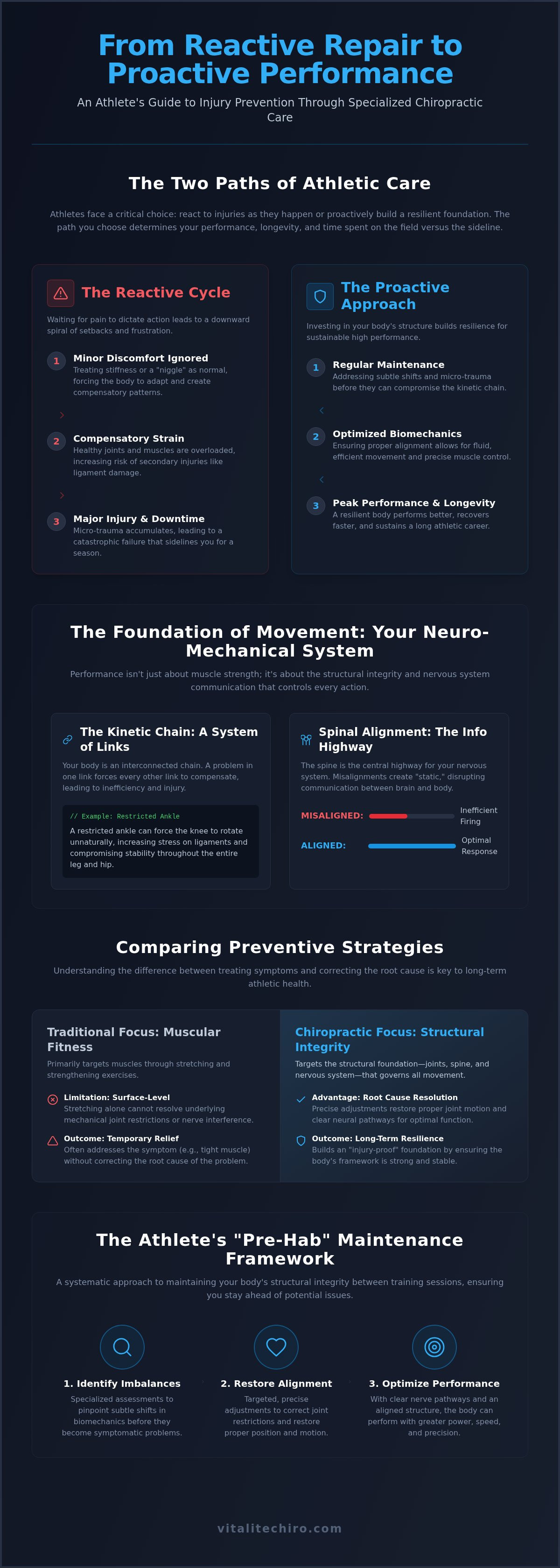
Many athletes view healthcare as a repair shop, a place to visit only when a part finally fails. This reactive approach focuses heavily on pain management, but modern performance care requires a fundamental shift in perspective. By utilizing chiropractic for athletic injury prevention, you address the subtle structural shifts that occur long before a season-ending injury manifests. It's about ensuring your body functions as a finely tuned instrument rather than a collection of parts waiting to break. When you prioritize the integrity of your musculoskeletal system, you move beyond the "quick fix" and into a state of sustainable athletic excellence.
The Hidden Cost of Pushing Through Minor Discomfort
The "no pain, no gain" mentality often masks the early warning signs of physical breakdown. Ignoring a slight stiffness in your hip or a persistent "niggle" in your shoulder forces your body to adapt. These adaptations create compensatory patterns where healthy joints take on the workload of restricted ones, leading to secondary injuries and decreased efficiency. Consider the following impacts of neglecting early care:
- Compensatory Strain: A restricted ankle can force the knee to rotate unnaturally, increasing the risk of ligament damage.
- Economic Toll: The cost of surgery and months of rehabilitation far outweighs the investment in regular maintenance visits.
- Physical Downtime: Maintenance ensures you stay on the field, whereas ignoring issues can sideline you for an entire season.
Micro-trauma is the repetitive stress that precedes a tear. By addressing these small, invisible stresses early, you prevent the catastrophic failures that halt your progress and threaten your long-term health.
Defining the Preventive Role of Spinal Alignment
Your spine serves as the central highway for your nervous system, the "software" that directs every muscle contraction, reflex, and balance adjustment. Sports chiropractic focuses on removing interference along this highway to ensure clear communication between the brain and the body. Even minor spinal subluxations can create "noise" in muscle recruitment, causing your hamstrings to fire a fraction of a second late or your core to stabilize inefficiently.
An aligned spine provides the structural foundation for all power-generating movements. When your alignment is precise, your body moves with a sense of fluid efficiency that boosts your performance while lowering the risk of strain. This is why chiropractic for athletic injury prevention is so effective; it optimizes the very system that controls your movement. There is also a significant psychological benefit to training with a body that feels balanced. When you aren't distracted by nagging physical imbalances, you can focus entirely on your strategy and execution, stepping onto the field with the confidence that your body is ready for the challenge.
The Biomechanics of Prevention: How Adjustments Protect Your Joints and Muscles
Your body operates as a single, interconnected unit known as the kinetic chain. When you run, jump, or swing a racket, force travels from your feet, through your legs and pelvis, up the spine, and out through your shoulders. If one link in this chain is misaligned, every other link must compensate for the deficiency. Using chiropractic for athletic injury prevention ensures that these links remain stacked and functional. By reducing mechanical friction in the joints through precise manual adjustments, we help you avoid the chronic inflammation that many athletes mistake for "aging." Instead of letting joints grind under uneven loads, regular care maintains the structural integrity of the cartilage and surrounding tissues. This proactive maintenance prevents the gradual breakdown of joint surfaces, ensuring your body remains capable of high-intensity training for decades.
Restoring Symmetry to Prevent Compensatory Injuries
Athletes in sports with "one-sided" dominance, such as tennis, golf, or baseball pitching, are particularly prone to muscular asymmetry. Over time, these subtle shifts in weight distribution lead to lopsided wear that eventually causes a breakdown. For example, a minor hip imbalance often causes an athlete to favor one leg during a stride, which eventually manifests as a chronic ankle strain on the opposite side as it overworks to stabilize the body. Our specific use of chiropractic for athletic injury prevention identifies and corrects these hidden imbalances before they become painful. Common signs of weight distribution shifts include:
- Uneven wear on the soles of your running shoes.
- One hip sitting higher than the other when looking in a mirror.
- A persistent "tight" feeling on only one side of the lower back or neck.
Addressing these early allows you to maintain true muscular symmetry, which is essential for distributing force evenly across the body and protecting your muscles from being pulled in directions they aren't meant to go.
Enhancing Proprioception and Neuromuscular Control
Proprioception is your body's ability to sense its position in space without looking. It's the reason you can land a jump, change direction on a dime, or maintain balance on uneven terrain. Research regarding the Integration of Chiropractic Care into the Sports Industry suggests that spinal health directly impacts this neurological feedback loop. Faster nerve transmission means better balance and significantly fewer falls during high-speed play. We often use the Diversified Technique to "reboot" muscle response, ensuring your nervous system communicates with your limbs at peak speed. This "reboot" clears the interference in your nerves, allowing for sharper reflexes and more precise movement. If you're ready to optimize your biomechanics, our team can help you build a more resilient foundation for your training.
Comparing Preventive Strategies: Chiropractic vs. Traditional Athletic Training
Many athletes rely heavily on stretching and foam rolling to maintain their physical health. While these are excellent tools for managing soft tissue, they often fail to address the underlying mechanical joint restrictions that lead to injury. If a joint isn't moving through its full physiological range, no amount of stretching will resolve the restriction; instead, you're simply stretching the muscles around a stuck joint. This is why chiropractic for athletic injury prevention is a necessary addition to any training regimen. It ensures your structural integrity is sound before you layer on the intense demands of muscular fitness. By clearing these mechanical blocks, we allow your body to move as it was designed, rather than forcing it to fight against its own framework.
Strength and conditioning programs focus on the "engine" of the body, building power, speed, and endurance. However, a powerful engine in a crooked chassis will eventually lead to a breakdown. Chiropractic care serves as the essential structural support that complements your hard work in the gym. Beyond alignment, manual therapy plays a significant role in recovery by clearing metabolic waste from overworked tissues. Through targeted adjustments and therapeutic modalities, we encourage lymphatic drainage and improve blood flow, which helps you recover faster between grueling sessions. This holistic approach ensures that your body isn't just strong, but also resilient and capable of handling repetitive stress without failing.
Addressing the Root Cause vs. Managing Symptoms
We often see athletes frustrated by issues that won't go away despite diligent self-care. For instance, foam rolling a tight IT band is temporary if the pelvis is rotated, because the bone itself is pulling the muscle out of its natural path. We take an "inside-out" approach, starting with the nervous system to ensure the brain's signals aren't muffled by spinal interference. In this partnership, chiropractic is the alignment to the trainer's engine work. By correcting the structural root cause, we stop the cycle of recurring minor strains that halt your progress. This method transforms your care from reactive pain management into a proactive strategy that keeps you performing at your peak.
Integrating Manual Therapy with Strength and Conditioning
The synergy between spinal adjustments and core stability exercises is a game-changer for long-term health. When your spine is properly aligned, your core muscles can engage more effectively to protect your lower back during heavy lifts. To further enhance this stability, custom orthotics provide a stable base for heavy lifting, ensuring that force is distributed correctly from the feet upward. When reviewing research on sports injury prevention strategies, it's clear that combining structural care with functional training yields the best results. Timing your visits is also important. Seeing a chiropractor before high-intensity training can optimize your movement patterns, while post-training visits assist in flushing out the byproducts of exertion and restoring balance to the nervous system. This integrated schedule ensures you're always training on a solid, reliable foundation.
Building Your Injury-Proof Foundation: A Practical Maintenance Framework
Resilience is built through consistency rather than intensity. While many athletes seek care only during a crisis, a structured maintenance framework is the most effective way to utilize chiropractic for athletic injury prevention. Your body requires regular calibration to handle the cumulative stress of training. For casual athletes, a monthly check-up often suffices to clear minor restrictions. However, for those in high-performance phases, such as a marathon training block, bi-weekly visits may be necessary to stay ahead of the curve. Integrating chiropractic care for runners into your schedule ensures that as your mileage increases, your pelvis and spine remain stable under the repetitive impact.
Supporting your structural health also requires attention to hydration and nutrition. Your spinal discs are primarily composed of water; they rely on adequate hydration to maintain their height and shock-absorbing capabilities. When you're dehydrated, these discs become less resilient, making your spine more susceptible to minor misalignments. Pairing high-quality nutrition with regular adjustments creates a biological environment where tissues can repair efficiently. This comprehensive approach ensures that the work we do in the office is supported by your daily habits, creating a truly injury-proof foundation.
The 'Pre-hab' Checklist for Arlington Athletes
Maintaining your progress between appointments is essential for long-term success. We recommend a simple morning mobility routine that reinforces the work done during your adjustments. Focus on dynamic movements that open the hips and activate the thoracic spine. Additionally, perform a regular footwear audit. Check the soles of your running shoes for uneven wear patterns. If the outside of one heel is significantly more worn than the other, it's a clear signal of a gait imbalance that needs structural attention. This is especially vital for those preparing for the steep hills of the W&OD trail or navigating the varied terrain of local trail runs, where a stable base is your best defense against a rolled ankle.
Recognizing the Red Flags Before They Become Injuries
Your body often whispers before it screams. Learning to identify subtle red flags can save you from months of rehabilitation. Stand in front of a mirror and check for uneven shoulder height or "hip hiking," where one side of your pelvis appears higher than the other. These are visible signs of compensation. You should also watch for a loss of range of motion in only one direction. If you can turn your head easily to the left but feel a "catch" when turning right, your body is already protecting a restriction. Persistent stiffness that doesn't resolve after a ten-minute warm-up is another indicator that your biomechanics are compromised. If you've noticed these red flags, book your assessment at Vitalité Chiropractic today to address them before they sideline your progress.
Optimizing Performance and Longevity at Vitalité Chiropractic
At Vitalité Chiropractic, we believe that every athlete deserves a healthcare partner who understands the unique demands of their sport and the specific nuances of their body. Since 2003, Dr. W. Jean-Luc Sansfaute has provided expert sports injury care to the Arlington community, helping individuals move from the frustration of recurring injuries to the confidence of peak physical function. Integrating chiropractic for athletic injury prevention into your lifestyle isn't just about the occasional adjustment; it's about a personalized, whole-person approach that considers your biomechanics, your training environment, and your long-term wellness goals. For those concerned about disc health or chronic compression from high-impact sports, we utilize advanced decompression therapy as a proactive tool to maintain spinal space and prevent degenerative wear.
Specialized Techniques for the Arlington Athletic Community
Dr. Sansfaute’s diversified approach is never one-size-fits-all. Whether you're a competitive triathlete or a weekend hiker, your care plan is adapted to the specific stresses of your sport. We know that for Arlington professionals, time is a valuable commodity. That's why we offer same-day appointments for urgent athletic needs, ensuring you don't have to wait for the care you require to stay on track. Our commitment to the community is reflected in our inclusive, LGBTQ+ friendly environment and our multilingual support. We take the time to ensure every athlete is heard and understood, creating a space where you can focus entirely on your improvement and long-term health.
Your Path to Sustainable Athletic Excellence
True success lies in moving beyond simple recovery and into the realm of optimization. When your body is properly aligned and your nervous system is clear of interference, you unlock a level of performance that once seemed out of reach. Chiropractic for athletic injury prevention provides the foundation for this growth, allowing you to train harder and recover faster without the constant fear of a setback. Scheduling your first assessment at Vitalité Chiropractic is the first step toward building that resilient, injury-proof body. During this comprehensive evaluation, we'll identify any hidden imbalances and create a tailored roadmap for your success. Investing in your structural health today is the best way to ensure a lifetime of physical freedom and renewed energy. We're ready to help you reach your next milestone with a body that is as strong and adaptable as your spirit.
Invest in Your Athletic Longevity
Your journey toward sustainable excellence requires more than just grit and training volume; it demands a body that is structurally sound and neurologically sharp. By prioritizing chiropractic for athletic injury prevention, you ensure that your body remains a resilient asset rather than a liability. We've explored how proactive care clears the "noise" in your nervous system and protects your kinetic chain from the cumulative stress of high-performance training. Whether you're navigating the local trails or preparing for a national competition, having a partner who understands your biomechanics makes all the difference.
Since 2003, we've been proud to serve the Arlington community with inclusive, multilingual, and LGBTQ+ friendly care. We understand that your time is valuable, which is why we offer same-day appointments for your urgent athletic needs. Don't wait for a minor strain to become a season-ending injury. Schedule your athletic performance assessment at Vitalité Chiropractic today to align your physical foundation with your athletic ambitions. We look forward to helping you achieve a level of physical freedom that allows you to pursue your sport with renewed energy and total confidence.
Frequently Asked Questions
How often should an athlete see a chiropractor for injury prevention?
Most athletes benefit from a monthly maintenance visit to keep their biomechanics in check. During peak training cycles, such as preparing for a marathon, we might suggest bi-weekly appointments to manage cumulative stress. This frequency ensures that minor misalignments are corrected before they evolve into performance-limiting restrictions. Every plan is individualized to match your specific sport and the intensity of your current training season.
Can chiropractic care help with sports that aren't 'high impact' like swimming or cycling?
Chiropractic care is highly effective for low-impact athletes. Swimmers often deal with shoulder impingement due to repetitive overhead motion; cyclists face hip and lower back tightness from sustained seated postures. By maintaining structural symmetry, we help these athletes avoid overuse injuries and ensure that every stroke or pedal revolution is as efficient as possible. Proactive care keeps your joints moving fluidly, regardless of the sport's impact level.
Is it safe to get adjusted right before a big race or game?
It's generally safe and beneficial to get adjusted before a big race, provided you've received care previously. An adjustment can optimize your nervous system and joint mobility for peak performance. We don't recommend your first-ever adjustment the day before a major event. It's better to establish a routine during your training phase so your body knows exactly how to integrate the restorative effects of an adjustment.
What is the difference between a sports chiropractor and a regular one?
A sports chiropractor focuses specifically on the biomechanical demands of athletic movement and the entire kinetic chain. While a traditional practitioner may focus primarily on spinal health, a sports-focused expert integrates gait analysis and extremity care. This specialized approach is a vital part of chiropractic for athletic injury prevention because it addresses how your body functions as a unified system during high-intensity activity.
Can chiropractic care help prevent ACL or knee injuries?
We help prevent knee injuries by optimizing the mechanics of the joints above and below the knee. If your hip is restricted or your ankle lacks mobility, your knee must take on extra rotational force, which increases ACL risk. By ensuring proper alignment and improving neuromuscular control, we reduce the likelihood of the compensatory movements that lead to ligament tears. Proper structural balance is your best defense against knee strain.
Will I need an X-ray before starting preventive chiropractic care?
An X-ray isn't always required before beginning preventive care. Dr. Sansfaute performs a thorough physical and neurological examination to determine if imaging is clinically indicated. We only recommend X-rays if your history or specific physical findings suggest an underlying structural issue that must be visualized to ensure your safety. Our priority is providing precise care that respects your unique health profile and athletic goals.
How does spinal alignment affect my reaction time and athletic coordination?
Spinal alignment directly impacts your reaction time by removing interference within the central nervous system. When your vertebrae are properly positioned, sensory data travels between your brain and muscles with maximum speed. This clear communication allows for sharper reflexes and more precise coordination. Utilizing chiropractic for athletic injury prevention ensures your "internal software" is running at peak efficiency for every game or race.
Do I need a referral to see a sports chiropractor in Arlington?
You don't need a referral to see a sports chiropractor at our Arlington clinic. Virginia is a direct-access state, which means you can schedule your assessment whenever you feel ready to optimize your health. We offer same-day appointments to support your training needs and provide an inclusive environment for our diverse community. Our goal is to make professional care accessible for every local athlete.


