
Could a pregnancy-specific chiropractic approach support pelvic comfort without promising to turn a baby or determine how labor will unfold? If you're searching for a Webster technique chiropractor Arlington VA, start by understanding what the technique assesses and what it cannot guarantee.
It’s reasonable to want clear answers about what happens during a visit, whether care will feel comfortable, and how it may fit alongside prenatal care. The Webster Technique focuses on pelvic assessment and adjustment. It is not a method for manually turning a baby, and it cannot guarantee fetal positioning, pain relief, or a particular birth outcome.
This guide explains the technique’s purpose and limits, what to discuss at an initial appointment, and how prenatal chiropractic care may fit your needs. At Vitalité Chiropractic in Arlington, Dr. W. Jean-Luc Sansfaute brings chiropractic experience dating to 2003 and a person-centered approach to care. Your comfort, health history, and coordination with your obstetric team are important parts of the conversation.
Key Takeaways
- The Webster Technique assesses pelvic and related musculoskeletal function during pregnancy. It does not guarantee a change in fetal position.
- Evidence about comfort or symptoms does not establish a specific birth outcome.
- Before prenatal chiropractic care, prepare to discuss your pregnancy history, current symptoms, goals, and relevant medical guidance.
- If you’re researching a Webster technique chiropractor Arlington VA, consider how personalized prenatal chiropractic care may fit alongside your obstetric care.
- Vitalité Chiropractic offers prenatal care in Arlington with attention to each patient’s concerns and comfort.
What Is the Webster Technique During Pregnancy?
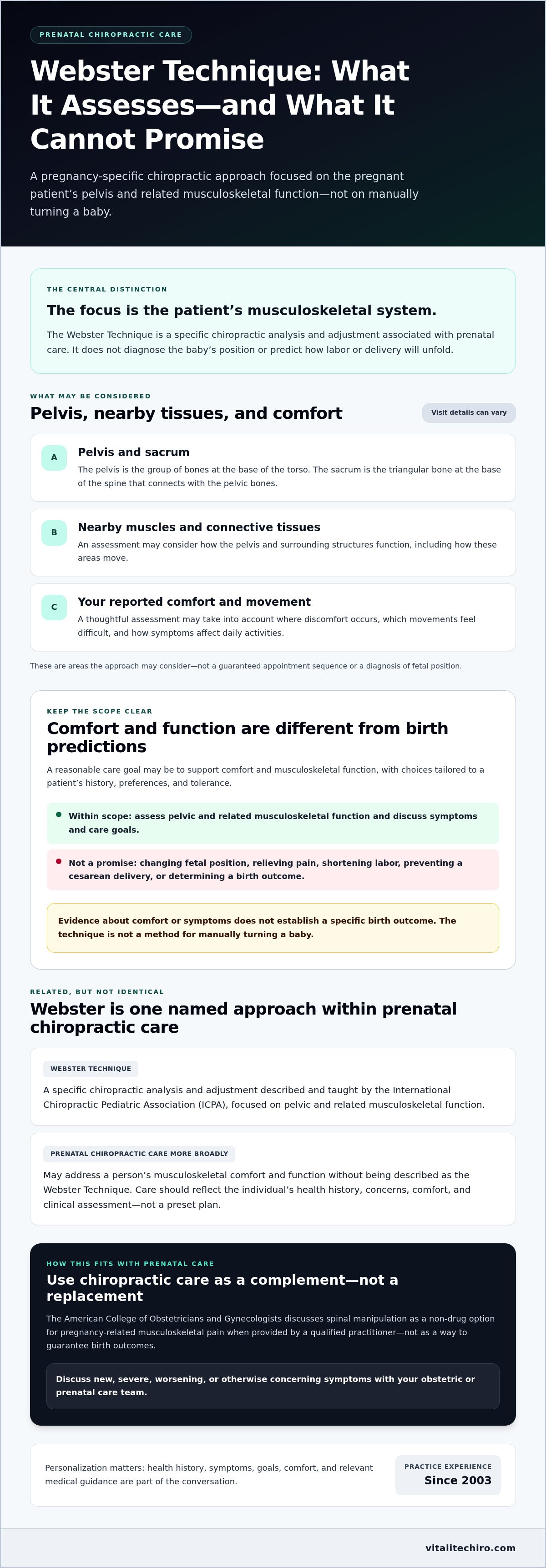
The Webster Technique is a specific chiropractic approach that assesses pelvic and related musculoskeletal function during pregnancy. It is associated with prenatal chiropractic care, but it is not a method for manually turning a baby or a promise about fetal position, labor, or delivery.
That distinction matters. The technique focuses on the pregnant patient’s musculoskeletal system, including the pelvis and surrounding structures. The International Chiropractic Pediatric Association (ICPA), which describes and teaches the Webster Technique, characterizes it as a specific chiropractic analysis and adjustment. This description concerns the patient’s body, not a diagnosis of the baby’s position or a prediction of birth outcomes.
What does the Webster Technique assess?
In plain language, the assessment considers how the pelvis and nearby muscles and connective tissues are functioning. The pelvis is the group of bones at the base of the torso. The sacrum is the triangular bone at the base of the spine that connects with the pelvic bones. A practitioner may consider how these areas move and relate to the patient’s reported comfort. Visit details can vary, so don’t assume every appointment follows the same sequence.
This is not an examination that establishes how a baby is positioned. Nor does it show that a particular pelvic finding will change fetal position or determine the course of delivery. Your symptoms and treatment choices belong in a broader care conversation, including prenatal medical guidance when relevant.
How is Webster different from general prenatal chiropractic care?
Webster is a named approach within the broader category of prenatal chiropractic care. General prenatal care may address a person’s musculoskeletal comfort and function without being described as the Webster Technique. The approach should reflect the individual’s health history, concerns, comfort, and clinical assessment, rather than a preset plan. The American College of Obstetricians and Gynecologists discusses spinal manipulation as a non-drug option for pregnancy-related musculoskeletal pain when provided by a qualified practitioner, not as a way to guarantee birth outcomes.
If you’re looking for a Webster technique chiropractor Arlington VA, clarify whether your question is about the named technique or prenatal chiropractic care more broadly. Vitalité Chiropractic provides personalized prenatal chiropractic care in Arlington, with attention to each patient’s comfort and concerns. Dr. W. Jean-Luc Sansfaute has practiced since 2003.
For a broader overview of how prenatal chiropractic care may relate to comfort and pelvic health, see Prenatal Chiropractic Care Benefits: A Guide to Comfort and Pelvic Health. Assessment can inform a conversation about musculoskeletal care, but it cannot promise that a baby will turn, reduce labor time, prevent a cesarean delivery, or resolve pain.
How Does the Webster Technique Relate to Pregnancy-Related Pelvic Discomfort?
Pelvic or lower-back discomfort can arise as the body adapts to pregnancy, but there isn’t one pattern that applies to everyone. Changes in posture, balance, movement, and the demands placed on the trunk and pelvis may influence how a person feels. Discomfort deserves individual attention, not an assumption that a particular joint or ligament is “out of place.”
Why can pelvic and lower-back discomfort change during pregnancy?
The pelvis is a ring of bones that supports the trunk and connects it to the legs. At its back is the sacrum, a triangular bone at the base of the spine. As pregnancy progresses, changes in body shape and center of mass can affect posture and everyday movements such as walking, standing, or turning in bed. Pregnancy-related hormonal changes can also affect ligament laxity, meaning the connective tissues that support joints may become more flexible. These changes may contribute to how movement feels, but they don’t explain everyone’s symptoms or establish a diagnosis.
Experiences and care needs vary. The American Pregnancy Association discusses chiropractic care and the Webster Technique in the context of pregnancy, while the American College of Obstetricians and Gynecologists describes spinal manipulation as a possible non-drug option for pregnancy-related musculoskeletal pain when provided by a qualified practitioner. Neither source makes symptom relief or birth outcomes certain. The association’s overview of the benefits of chiropractic care during pregnancy offers additional background.
Discuss new, severe, worsening, or otherwise concerning symptoms with your obstetric or prenatal care team. This helps distinguish routine musculoskeletal discomfort from symptoms that need medical assessment. Chiropractic care should complement, not replace, prenatal medical care.
What can chiropractic care reasonably aim to address?
A thoughtful assessment may consider which movements feel difficult, where discomfort occurs, and how symptoms affect daily activities. A reasonable care goal is to support comfort and musculoskeletal function, with choices tailored to the patient’s history, preferences, and tolerance. The Webster Technique is one specific approach associated with prenatal chiropractic care; it is not a fetal-positioning treatment or a way to predict delivery.
That distinction is useful when searching for a Webster technique chiropractor Arlington VA. Keep a conversation about pelvic or back discomfort focused on your symptoms and goals, rather than promises about a baby’s position, labor, or delivery. For general information on chiropractic adjustments, The Complete Guide to Professional Chiropractic Adjustments: Science, Safety, and Healing offers broader context.
At Vitalité Chiropractic, prenatal care is personalized to each patient’s comfort and concerns. To discuss how chiropractic care may fit with your prenatal plan, explore personalized prenatal chiropractic care with Vitalité Chiropractic.
What Does the Evidence Say About Webster Technique Claims?
Read the evidence in layers. A possible benefit for musculoskeletal comfort is not proof that the Webster Technique changes fetal position, prevents a complication, shortens labor, or determines how delivery unfolds. These are different claims, and each requires evidence that directly studies that outcome. A statistic about chiropractic care generally also cannot automatically be attributed to the Webster Technique specifically.
Before accepting a percentage shared on a clinic page or elsewhere, look for the original research. Check what it measured, who took part, how many participants were included, and whether there was a comparison group. See whether the study examined the Webster Technique or a different form of care. Without those details, a precise-sounding figure may not tell you what to expect in your own pregnancy.
Can the Webster Technique turn a breech baby?
No one should interpret the Webster Technique as a guaranteed fetal-turning method. It is described as an approach focused on the pregnant patient’s musculoskeletal assessment, not a way to manually reposition a fetus. Evidence about pelvic or back symptoms does not establish that the technique prevents breech presentation or reliably changes fetal position. If you have questions about your baby’s position, discuss them with your prenatal medical team, which can assess your pregnancy and explain appropriate options.
How should readers interpret pain-relief and labor statistics?
Study design matters. An association between receiving chiropractic care and an outcome does not, by itself, prove the care caused it. For pain-relief or labor-time claims, check the sample size, comparison group, care provided, and whether the results apply to the Webster Technique rather than another intervention. The American College of Obstetricians and Gynecologists discusses spinal manipulation as a possible non-drug option for pregnancy-related musculoskeletal pain when provided by a qualified practitioner. That is not an endorsement of guaranteed birth outcomes.
| Question | What can reasonably be said | What requires caution |
|---|---|---|
| Musculoskeletal goals | Care may be considered in relation to comfort, movement, and musculoskeletal symptoms. | Individual results vary; symptom support is not assured. |
| Evidence for Webster specifically | Look for research that directly evaluates the technique and clearly describes its methods. | Findings about chiropractic care broadly may not apply to this approach. |
| Fetal position or delivery | These questions belong in prenatal medical care. | Claims of turning a breech baby, shortening labor, or preventing a cesarean require direct evidence and should never be presented as promises. |
If you’re researching a Webster technique chiropractor Arlington VA, use this evidence lens to distinguish a musculoskeletal care discussion from a prediction about birth. A careful practitioner should explain the intended focus and limits clearly. Prenatal chiropractic care should be coordinated with your obstetric care, not used as a replacement.
What Should You Discuss Before Prenatal Chiropractic Care in Arlington?
A useful first conversation gives the clinician context, not just a list of sore spots. Share what has changed during your pregnancy, what feels difficult in daily life, and what you hope chiropractic care may support. This helps keep the discussion centered on your circumstances rather than a standard approach or a promised outcome.
Which health details are useful to share?
Before an appointment, consider noting your pregnancy stage, current symptoms, relevant health history, and any guidance from your prenatal care team. Mention prior injuries or diagnoses, too. Include recent symptom changes or new medical guidance. This context helps inform a conversation about whether care may fit your needs.
A simple preparation sequence can help you organize the details:
- Describe your pregnancy history and any relevant diagnoses or prior injuries.
- Explain where you feel discomfort, what affects it, and how it changes your movement or routine.
- Share your care goals and any questions or guidance from your obstetric clinician.
- Discuss what positions or types of contact feel comfortable, and speak up if that changes.
This sequence is a conversation aid, not a required clinical protocol. If you have a new, severe, or concerning symptom, or a medical question about whether treatment is appropriate, contact your prenatal medical team. Chiropractic care should complement that care, not replace it.
How can you make a first conversation more useful?
Be specific about your priorities. For example, explain that standing for a long time increases discomfort or that you want to understand how care could fit with your existing prenatal plan. You don’t need technical terms. Clear descriptions of what you feel and what matters to you are a useful starting point.
- Ask what the proposed care is intended to address and what it cannot promise.
- Share concerns about positioning, pressure, or comfort before care begins.
- Discuss how the approach fits alongside guidance from your obstetric clinician.
- Let the clinician know if your comfort or symptoms change during the discussion or care.
Positioning and treatment choices should account for your comfort, pregnancy circumstances, and clinical assessment. You can pause the conversation, ask for an explanation, or raise a concern at any time. A respectful, individualized discussion is valuable when searching for a Webster technique chiropractor Arlington VA, since understanding the approach and its limits matters as much as its name.
Vitalité Chiropractic provides personalized prenatal chiropractic care in Arlington, with attention to each patient’s concerns and comfort. Discuss your prenatal chiropractic care needs with Vitalité Chiropractic as part of an informed conversation about your care.
Explore Personalized Prenatal Chiropractic Care at Vitalité Chiropractic
Pregnancy can bring changing needs, questions, and comfort considerations. At Vitalité Chiropractic in Arlington, prenatal chiropractic care is personalized, with attention to your concerns and circumstances. An initial conversation is an opportunity to explain what you’re experiencing, discuss what you hope care may support, and consider how chiropractic care can fit alongside prenatal medical care.
Dr. W. Jean-Luc Sansfaute has practiced since 2003. Your pregnancy history, current symptoms, preferences, and medical guidance can help shape an individualized discussion. No single approach or outcome should be assumed in advance.
What makes a person-centered prenatal care conversation valuable?
Your day-to-day experience matters. You might describe discomfort that affects walking, sitting, or resting, or explain that you want to understand possible musculoskeletal support during pregnancy. Those details keep the discussion relevant to your needs rather than generalized claims. You can also raise concerns about positioning, comfort, or how a proposed approach fits your existing prenatal care.
For readers searching Webster technique chiropractor Arlington VA, it’s useful to separate learning about a named technique from discussing prenatal chiropractic care more broadly. Vitalité Chiropractic provides personalized prenatal chiropractic care, with respectful attention to each patient. An appointment is a place to talk through your goals and questions, not to promise fetal positioning, pain relief, or a particular labor or delivery outcome.
Chiropractic care should complement, not replace, prenatal medical care. If you have a medical concern or your symptoms change, bring that information into the conversation and coordinate with your obstetric clinician as appropriate. Informed care starts with clear communication and realistic expectations.
How can Arlington patients take the next step?
Before scheduling, it may help to note your pregnancy stage, current symptoms, relevant health history, and any guidance from your prenatal care team. You don’t need a polished list. A few points can make it easier to explain what matters most and ask how care may fit your circumstances.
Vitalité Chiropractic offers online scheduling, or you can call (703) 879-5144 to discuss prenatal chiropractic care. Focus the conversation on your pregnancy context, comfort, and care goals, while keeping your prenatal care team’s guidance in view.
When you’re ready, schedule an appointment with Vitalité Chiropractic.
Take a Thoughtful Next Step for Your Pregnancy Care
Choosing prenatal chiropractic care doesn’t require you to have every answer in advance. Start with what matters to you: feeling heard, understanding the purpose and limits of an approach, and making choices that fit alongside your prenatal medical care. If you’re searching for a Webster technique chiropractor Arlington VA, let those priorities guide your questions and help you decide what conversation would be useful.
Bring questions about your symptoms, comfort, and care goals to an appointment, then take time to consider the information shared. A good next step should feel informed and personal, not driven by a promise about fetal position or birth outcomes.
Vitalité Chiropractic offers prenatal chiropractic care tailored to individual needs. Schedule an appointment with Vitalité Chiropractic to discuss whether this care may fit your circumstances and how it can complement your prenatal plan. You deserve to feel respected as you explore your options.
Frequently Asked Questions
Is the Webster Technique only used during pregnancy?
No. The Webster Technique is commonly discussed in prenatal chiropractic care, but the name doesn’t mean every pregnancy visit uses it or that it’s suitable for every patient. Chiropractic care includes broader approaches, and individual circumstances guide the clinical discussion. If you’re comparing options, ask what a proposed approach is intended to address and how it differs from general prenatal care, rather than relying on a technique’s name alone.
When during pregnancy can someone discuss chiropractic care?
There’s no single timing recommendation that applies to everyone. You can raise the subject with your prenatal clinician or a chiropractor when you have questions or musculoskeletal discomfort. If you’re searching for a Webster technique chiropractor Arlington VA, share your pregnancy stage, symptoms, health history, and comfort considerations during the conversation. Seek medical guidance for new or concerning symptoms instead of assuming they’re routine pregnancy changes.
Is the Webster Technique painful?
People may experience care differently, so there’s no reliable way to predict exactly how it will feel for you. Before an appointment, describe any concerns about touch, pressure, or positioning. During the visit, speak up if something feels uncomfortable and ask to pause or discuss another approach. Discomfort isn’t evidence that treatment is working. For severe or concerning symptoms, contact an appropriate medical professional.
Can prenatal chiropractic care be combined with obstetric care?
Yes, chiropractic care can be discussed as complementary care, but it shouldn’t replace prenatal medical care. Keep your obstetric clinician informed and share relevant medical guidance with the chiropractor. For example, if your care team has given you advice related to a symptom or activity, bring it into the discussion. Your prenatal team remains an important resource for pregnancy symptoms, fetal-position questions, and other medical concerns.
Does the Webster Technique induce labor?
No. Don’t assume the Webster Technique induces labor or use it as a substitute for medical advice about labor. Claims about labor timing or delivery outcomes need careful evidence and context; a promotional statistic alone can’t establish that a technique caused an outcome. If you’re approaching your due date, experiencing possible labor symptoms, or have questions about timing, contact your prenatal medical team for guidance specific to your pregnancy.
What should I wear to a prenatal chiropractic appointment?
Choose clothing that feels comfortable and allows you to move without restriction. Don’t assume a particular outfit or treatment setup will be used. If clothing or a position makes it difficult to communicate your symptoms or feels uncomfortable, say so. You can also mention any pregnancy-related guidance that affects positioning. The discussion should be shaped around your comfort and individual circumstances, not a one-size-fits-all expectation.


