
There isn’t one visit count that fits everyone: how many visits you need depends on your condition, symptom severity, and goals. The right questions to ask a new chiropractor can help you understand how they’ll assess your needs, set treatment goals, and track progress instead of relying on a one-size-fits-all schedule.
It’s reasonable to want clarity before your first appointment, especially about what treatment involves and whether it fits your concerns. This guide covers questions about symptom relief, personalized care plans, first-visit procedures, credentials and experience, and additional therapies and services. You’ll also learn what to ask about progress and at-home recommendations, so you can have a more informed conversation and feel prepared to decide on your next steps.
Key Takeaways
- Describe your symptoms, health history, and goals so the chiropractor can assess whether care may be appropriate for your concerns.
- Ask how a treatment plan sets goals, recommends visit frequency, and measures progress over time.
- Find out what the first appointment includes and whether imaging or treatment may be recommended after the assessment.
- Discuss the chiropractor’s education, licensing, and experience with concerns like yours.
- Ask how additional approaches, such as decompression therapy or sports injury care, may fit your needs. After a neck injury, seek urgent medical help for tingling or pins and needles on one or both sides of the body, according to NHS.
1. Whether chiropractic care may help specific symptoms
Ask whether your symptoms could involve muscles, joints, or spinal movement. Chiropractic care commonly addresses musculoskeletal concerns such as back pain, neck pain, joint dysfunction, muscle tension, sciatica, sports injuries, and some headaches. Headaches associated with muscle tension or joint dysfunction in the neck may improve with chiropractic treatment. Describe where the discomfort occurs, when it began, and which movements affect it.
Give a specific example when describing symptoms: “My lower back hurts after sitting, and bending makes it worse.” Ask what findings would make chiropractic care appropriate and what might suggest another cause. Sciatica can result from disc problems, spinal stenosis, or muscle irritation, so symptoms alone don’t establish the cause. A careful assessment considers your history and physical findings before discussing care.
Ask what examination steps the chiropractor recommends before treatment. A hands-on examination may assess joint function, spinal movement, and soft tissues; reflex tests can also help investigate a concern. X-rays may be recommended when clinically necessary to assess spinal structure and guide an appropriate approach. Ask what the images would help determine and how the results could affect the plan.
Ask whether any health condition could affect the technique or make an adjustment unsuitable. Osteoporosis or another condition that increases injury risk may call for low-force techniques. Share your medical history, medications, past injuries, and any new or changing symptoms. A useful discussion explains why an approach is proposed and how your comfort and response will be considered.
Pregnancy and recovery after surgery call for specific questions. Ask how prenatal chiropractic care would account for your pregnancy and current symptoms. After surgery, the chiropractor may review your health history before deciding whether adjustments are appropriate. Explain what procedure you had and when, then ask which examination findings would guide the decision. Your history helps shape a relevant safety discussion.
Notice how the chiropractor responds to your concerns. Do they listen to your symptom timeline, explain examination findings in plain language, and invite questions before discussing adjustments? Ask how they would recognize progress and what might prompt them to reconsider the approach. If your symptoms don’t appear musculoskeletal or the assessment points to another cause, ask what next step makes sense.
After a neck injury, tingling or pins and needles on 1 or both sides of the body warrant urgent medical help, according to NHS. Don’t treat those symptoms as a routine appointment question. For other concerns, ask how the chiropractor distinguishes a symptom suitable for chiropractic care from one requiring a different evaluation. Clear answers help you understand both the potential role and limits of treatment.
2. Do you provide a customized treatment plan for all your patients?
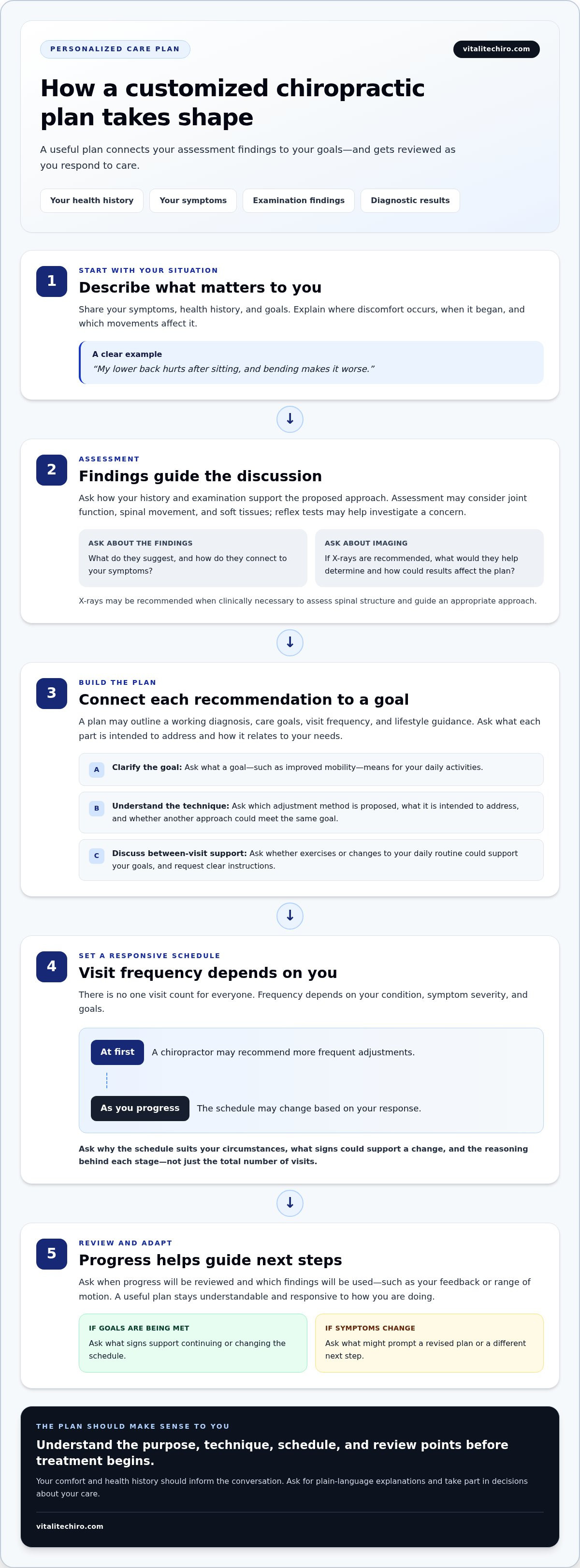
A treatment plan should connect assessment findings with your goals, not default to a standard schedule. When preparing questions to ask a new chiropractor, include how your health history, symptoms, examination, and diagnostic results shape recommendations. A plan may outline the working diagnosis, care goals, visit frequency, and lifestyle guidance. Ask how each part relates to your needs and what it is intended to address.
Chiropractors commonly assess and treat musculoskeletal concerns involving the spine, muscles, and joints, including back pain, neck pain, sciatica, headaches, and sports injuries. Ask how the examination supports the proposed approach. If your symptoms or history suggest a concern beyond musculoskeletal care, ask how that affects the recommendation. A clear discussion explains the intended role of chiropractic care and how findings guide next steps.
Ask for a plain-language explanation of each part of the plan. For example, ask what a goal such as improved mobility means for your daily activities. Clarify which findings the chiropractor will use to evaluate progress, such as your feedback or range of motion. Ask when progress will be reviewed and what changes might lead to a revised plan. These questions help you understand each recommendation and take part in care decisions.
Visit frequency depends on your condition, symptom severity, and goals. A practical question to ask a new chiropractor is why the proposed schedule suits those factors. Find out whether it may change as you progress and what signs would support a change. A chiropractor may recommend more frequent adjustments at first, then adjust the schedule based on your response. Ask the reasoning behind each stage, not just the total number of visits.
Discuss the techniques in the plan before treatment begins. Chiropractic adjustments use controlled movements applied to spinal joints, and techniques can differ in how force is delivered. Ask which method is proposed, what it is intended to address, and whether another approach could meet the same goal. Your comfort and health history should inform the conversation. You can also ask what to expect during and after an adjustment.
A plan may pair adjustments with practical steps between visits. Ask whether exercises or changes to your daily routine could support your goals, and request clear instructions. If you’re pregnant, ask how prenatal care would be tailored to your circumstances. For an activity-related concern, ask how sports injury care could shape the plan’s goals and approach.
A useful treatment plan remains understandable and responsive to your progress. Ask what happens if a goal isn’t being met or your symptoms change. If you’re considering care that includes chiropractic adjustments, make sure you understand the proposed technique, purpose, and review points before proceeding.
3. What to expect at a first chiropractic appointment
Your first appointment usually begins with forms about your medical history and current symptoms. Then you’ll discuss what brought you in, when it began, and how it affects daily activities. Bring relevant health details, such as previous injuries, surgery, or changes in symptoms. Explain your goals too, such as sitting comfortably at work or returning to a sport. This conversation helps guide the examination and identify what needs attention.
The physical examination can include posture, range of motion, muscle strength, and muscle tension. The chiropractor may also assess spinal movement and joint function with hands-on methods such as palpation or reflex tests. Ask what each test evaluates and how the findings relate to your symptoms. If the chiropractor recommends X-rays, ask what they need to assess and how the results would affect the approach. Imaging is recommended when clinically necessary.
After reviewing your history and examination, the chiropractor explains the findings and discusses next steps. Some chiropractors begin adjustments during the first visit; others wait until the second appointment. Ask what determines the timing and what treatment would involve. Understand the proposed approach before it begins, including what you may feel during an adjustment. Share any discomfort or concerns as they arise, rather than waiting until the appointment ends.
Progress depends on your condition, symptom severity, and goals, so visit frequency varies from person to person. Ask what the initial schedule is based on and what could lead to changes. A chiropractor may start with more frequent adjustments, then modify the schedule as you progress. Ask how improvement will be assessed. Your feedback, range-of-motion assessments, visual observations, and X-rays can all contribute to progress monitoring.
Set practical progress markers with the chiropractor. For example, note whether turning your head becomes easier or back discomfort interferes less with a usual activity. Ask when those markers will be reviewed and what would prompt a change to the plan. A single appointment may not fully resolve a musculoskeletal issue, so discuss the expected course and signs of improvement instead of assuming one visit settles the question.
Before treatment, ask how to prepare, including whether to hydrate, eat, stretch, or track symptoms. Afterward, ask about aftercare instructions and whether to avoid strenuous activity. Mild soreness, temporary discomfort, or a mild headache can follow an adjustment. Ask what response to expect and how to describe any symptoms that concern you. At-home exercises may also support flexibility, muscle strength, and the benefits of adjustments.
4. #2 What Credentials and Experience Do You Have?
In the United States, chiropractors typically earn a Doctor of Chiropractic degree, often abbreviated DC. Chiropractic students complete at least three years of undergraduate courses before pursuing the degree. Chiropractors spend at least four years earning their DC degree. Ask what degree the practitioner holds and where they completed their chiropractic education. These details help you understand their formal training before discussing your condition.
Chiropractors should hold a general chiropractic license and any licenses required locally. To verify credentials and disciplinary history, ask for the practitioner’s license information and state, then use the relevant state licensing authority’s lookup to review license status and public disciplinary records. Requirements differ by state, so focus on the state where the chiropractor practices.
Experience is most useful when it relates to your concern. Ask, “How often do you assess people with symptoms like mine?” Then ask what kinds of cases they’ve managed, such as recurring lower back pain, a sports injury, or neck stiffness. Look for a clear explanation of their experience, not a promise of a particular outcome.
Ask how the chiropractor evaluates your specific condition before recommending care. For example, after an injury, the practitioner may assess spinal alignment, joint function, and soft tissue. Ask which examination findings would guide the approach and how they connect to your symptoms. A thorough answer explains the reasoning in language you understand, rather than relying on unfamiliar clinical terms.
Discuss the practitioner’s experience with the techniques they may use. If spinal manipulation is proposed, ask what the technique involves, what it aims to address, and what alternatives may be considered. The chiropractor should explain why the approach fits your examination and health history. Ask how they adapt the technique if your comfort or movement differs from the typical example.
For a sports injury, ask whether the practitioner has worked with similar activity-related concerns and how they assess movement demands. For pregnancy-related care, ask about experience adapting the examination and approach to prenatal needs. You can also ask for references from people with similar conditions, while respecting patient privacy. These questions help you compare relevant experience with your own goals.
Notice how the chiropractor responds. Do they answer directly, explain what they know, and invite follow-up questions about your injury or treatment options? Ask how they’ll communicate findings after an examination and what might prompt a change in approach. Specific answers about education, licensing, case experience, and clinical reasoning give you a clearer basis for deciding whether the care feels appropriate.
5. Additional therapies and services
Ask which additional approaches relate directly to your symptoms and examination findings. A useful answer explains each therapy’s purpose, how it complements other care, and how progress will be reviewed. For example, a chiropractor might discuss spinal decompression for certain spinal concerns or recommend exercises to support strength and flexibility. Ask how an option fits your treatment goals rather than choosing a therapy because it sounds comprehensive.
Spinal decompression therapy uses a motorized table to apply controlled traction. A harness is placed around the pelvis or neck, depending on the area being treated. Ask which area the treatment targets, what the table does, and how the chiropractor decides whether it suits your assessment. Decompression is commonly used for conditions such as sciatica, spinal stenosis, and disc problems. Your symptoms and examination findings should inform the discussion.
Other practices may use therapeutic modalities such as TENS or hydrotherapy, or discuss soft-tissue techniques. These approaches differ in purpose and application. Ask what a modality is intended to address, what you’ll experience during a session, and how the practitioner will assess its usefulness. If it’s paired with an adjustment, ask why the combination suits your needs. Clear explanations help you understand each part of care.
Exercise recommendations can make care more practical between appointments. Ask which movements support your goals, how to perform them, and what changes mean you should pause and discuss the exercise. For example, ask whether a stretch targets flexibility or an exercise aims to strengthen a particular muscle group. Ask how the activity relates to your symptoms and fits your usual routine.
Some chiropractors discuss complementary options such as physical therapy, fitness coaching, or nutritional counseling. Ask how that support relates to your concern and whether it works alongside the chiropractic plan. Keep the conversation focused on your health goals, not a long list of add-ons. For example, if your priority is returning to sport, ask which parts of the plan address movement and activity demands.
Additional services should have a clear role in your care. Ask how each option relates to the assessment, what progress would look like, and when the approach might be reconsidered. If spinal decompression is relevant to your care discussion, explore spinal decompression therapy as one approach that uses controlled traction. The central question is how a specific therapy supports your goals and overall wellness.
Vitalité Chiropractic: Chiropractic Adjustments
Vitalité Chiropractic offers chiropractic adjustments for musculoskeletal symptoms, along with decompression therapy, sports injury care, and prenatal chiropractic care. These are options to discuss in relation to your symptoms, health history, and goals. For example, someone with an activity-related injury can ask about sports injury care, while a pregnant patient can discuss prenatal chiropractic care and how the approach is tailored to their needs.
Before beginning, share what you’ve learned from asking about assessment, techniques, and progress. This conversation can help you understand how care may fit your situation and what to expect from the proposed approach. Contact Vitalité Chiropractic to discuss your concerns and care options.
Take the Next Step With Confidence
Your first conversation can turn uncertainty into a clearer path forward. Keep your questions to ask a new chiropractor focused on what matters to you: feeling heard, understanding the reasoning behind care, and knowing how progress will be discussed. You don’t need every answer before you begin. Bring your concerns and take the conversation one step at a time.
Vitalité Chiropractic offers Chiropractic Adjustments, Decompression Therapy, and Sports Injury Care. If you’re considering care for a musculoskeletal concern or activity-related injury, these services may be relevant to discuss. A thoughtful next step is to share what you hope to address and learn how the approach relates to your needs.
Contact Vitalité Chiropractic today to start a conversation about your care. You deserve to feel informed as you decide what comes next.
Frequently Asked Questions
How Many Visits Does It Take to Get Better?
There isn’t a standard visit count; it depends on your condition, symptom severity, and goals. To make progress easier to notice, choose a daily activity to track, such as sitting through a work meeting or taking a usual walk. Note changes in comfort and function between appointments. Those observations can help you discuss whether your care schedule still fits your needs.
Do you provide a customized treatment plan for all your patients?
A treatment plan should reflect your assessment and priorities, not a preset sequence. Ask which parts are essential, what choices you have, and when the plan will be reviewed. You might also discuss how care fits your daily routine, including work demands or exercise habits. In Arlington, Virginia, a clear discussion can help you understand how recommendations relate to your goals.
What Are Your Payment Options?
Vitalité Chiropractic accepts most major insurance plans and offers flexible payment options. Coverage and patient responsibility can vary by plan, so have your insurance details ready when discussing care. Ask what payment methods are available and what information you may need for your records. Understanding these details early can help you plan appointments and avoid surprises during your course of care.
Do You Have Any References I Can Contact?
Ask whether references are available from people with concerns similar to yours, such as a sports injury or persistent neck discomfort. Patient privacy may limit what a practitioner can share, so ask about other ways to understand their relevant experience. For example, request a general explanation of the types of cases they commonly assess and how they approach care discussions.
Do You Recommend Any Precautions Following Treatment Sessions?
Ask for aftercare guidance that matches the technique used and your planned activities. Some adjustments may take a day or two for the body to accommodate. Before leaving, clarify whether to modify strenuous activity, how to resume your usual exercise, and what changes to monitor. A brief note about your response after each session can help you describe patterns at a later appointment.
What Credentials and Experience Do You Have?
Ask about the chiropractor’s Doctor of Chiropractic degree, current state license, and experience with your specific concern. Dr. W. Jean-Luc Sansfaute, DC, has practiced since 2003. You can also ask how experience with cases like yours informs examination and care choices. In the United States, licensing requirements differ by state, so focus on the state where the practitioner provides care.
Will You Offer Treatment During My First Appointment?
At Vitalité Chiropractic, the care process includes patient forms, a consultation, an examination, X-ray studies when necessary, and a report of findings before treatment begins. Ask what the examination revealed and how the proposed care relates to your goals. This gives you a chance to understand the recommendation and raise questions before treatment starts.
How Quickly Do Patients With Similar Issues See Improvement?
Improvement timing varies with the condition, its severity, and your response to care. Vitalité Chiropractic describes a relief phase of 2-4 weeks, followed by a corrective phase of 4-12 weeks. These phases describe the clinic’s care process, not a guaranteed personal timeline. Ask which changes you and the chiropractor will use to review progress, such as comfort during a particular daily activity.


