
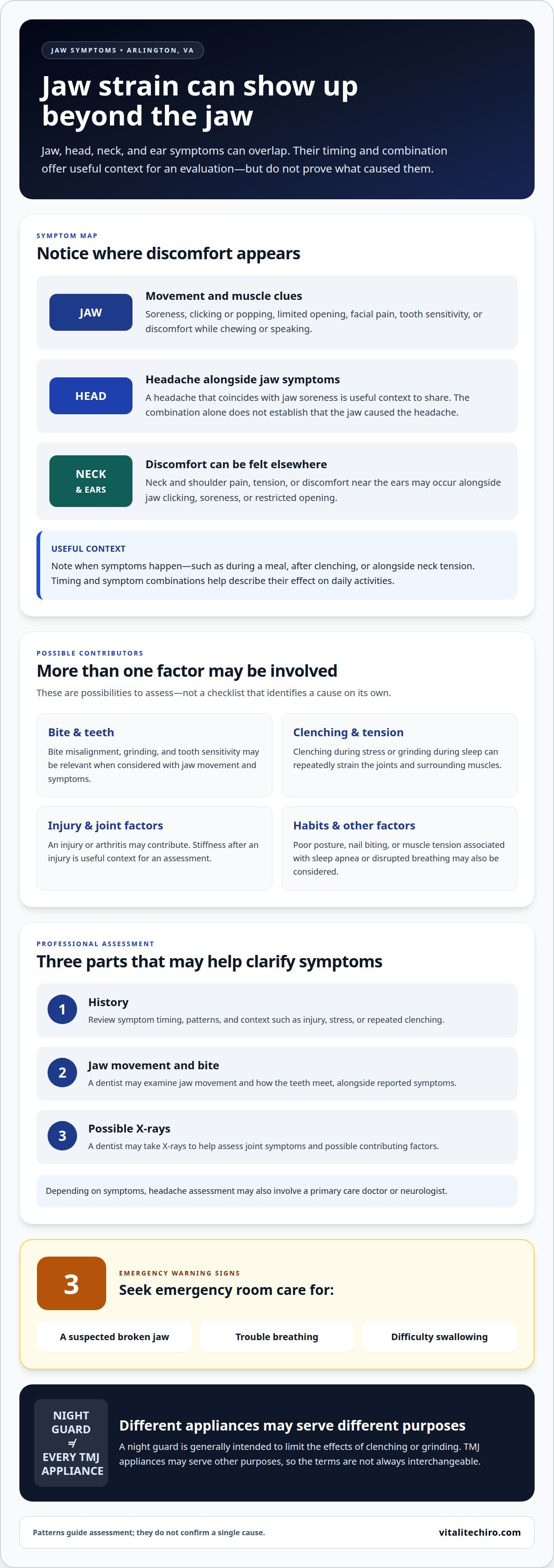
A night guard isn’t automatically the same as every TMJ appliance. For jaw pain and headache treatment in Arlington, VA, the right approach depends on whether jaw-joint or muscle strain may be contributing to your symptoms. Jaw discomfort can occur alongside headaches and neck pain, particularly when clenching or grinding keeps the jaw muscles under strain.
That connection can be easy to miss: discomfort may extend beyond the jaw, while stiffness, clicking, or difficulty opening the mouth can offer another clue. A night guard is generally intended to limit the effects of clenching or grinding, while TMJ appliances may serve other purposes. The terms aren’t always interchangeable, and an evaluation can help clarify what may be behind your symptoms.
Here, you’ll learn how TMJ symptoms can involve the jaw, head, and neck, what commonly contributes to jaw strain, and when stiffness or locking deserves attention. You’ll also learn what professional assessment and treatment may involve, so you can understand possible next steps without assuming every headache begins in the jaw.
Key Takeaways
- Recognize how jaw symptoms can affect everyday activities and sometimes accompany head or neck discomfort.
- Understand why bite alignment, clenching, and other factors may contribute to jaw strain.
- Learn when jaw stiffness or restricted movement calls for professional evaluation.
- Explore how assessing the relationship between jaw tension, headaches, and neck pain can help guide care.
TMJ symptoms and their effect on daily life
The temporomandibular joints connect the lower jaw to the skull and support talking, eating, and yawning. When a disorder affects these joints or nearby muscles, symptoms can extend from the jaw into the head, neck, and ears.
Jaw and Head Symptoms
Jaw soreness, clicking or popping, and limited opening can make chewing or speaking uncomfortable. Some people also experience facial pain, tension headaches, or difficulty opening and closing the mouth. Notice when symptoms occur, such as during a meal or after clenching. That pattern helps describe the strain and its effect on daily tasks.
Tooth sensitivity may accompany clenching or grinding. Symptoms can develop gradually or follow an injury or stressful period, so a treatment plan considers their timing and combination rather than relying on one sign alone.
Neck and Ear Symptoms
TMJ disorders can occur alongside neck and shoulder pain, headaches, or discomfort near the ears. These symptoms can make it harder to tell jaw-related strain from discomfort felt elsewhere. Note whether neck tension or ear-area pain appears with jaw clicking, soreness, or restricted opening.
For example, a headache that coincides with jaw soreness is useful context during an evaluation. The pattern doesn’t prove that the jaw caused the headache, but it helps a professional assess the symptoms together.
Which professional treats jaw pain and headaches? For suspected TMJ symptoms, a dentist can examine the jaw and bite. Headache assessment may also involve a primary care doctor or neurologist, depending on the symptoms.
How is TMJ disorder diagnosed? A dentist may review your history, examine jaw movement and bite, and take X-rays. These steps help assess joint symptoms and possible contributing factors.
When is jaw pain an emergency? A suspected broken jaw, trouble breathing, or difficulty swallowing warrants an emergency room visit.
What professional treatments may help safely? Options depend on the findings and can include a custom oral appliance or conservative care. The National Institute of Dental and Craniofacial Research describes heat or cold with gentle jaw exercises as an initial approach.
What risks can treatments involve? Medication, mouth guards, injections, and surgery have different risk considerations. Possible effects depend on the specific treatment, so discuss how those considerations apply before choosing an option.
What Are the Common Causes of TMJ Issues?
Jaw joint pain may have several contributors, so identifying the pattern matters. For jaw pain and headache treatment in Arlington, VA, an evaluation can consider bite mechanics, muscle strain, injury, and dental symptoms together.
Bite Misalignment
When upper and lower teeth don’t meet comfortably, jaw muscles may work differently during chewing. A misaligned bite is one possible contributor to temporomandibular joint dysfunction, especially if movement brings discomfort or clicking. Bite alignment is one factor to assess, not proof that it causes every headache.
A professional assessment considers how the teeth meet alongside joint movement and symptoms. For example, discomfort during chewing can provide useful context when considered with other findings. The pattern of symptoms helps guide the evaluation, rather than relying on bite position alone.
TMJ Causes and Risk Factors
Possible contributors include injury, arthritis, and muscle tension associated with sleep apnea or disrupted breathing. Clenching during stress or grinding teeth during sleep can also repeatedly load the joints and surrounding muscles. These factors may overlap, so the timing and context of symptoms can help describe what’s happening.
Stress may coincide with worsening symptoms, while poor posture or habits such as nail biting can add strain over time. A professional can consider whether symptoms follow an injury, arise during stressful periods, or accompany repeated clenching. That context helps distinguish possible contributors without assuming a single cause.
Dental Problems and Migraines
Dental factors can overlap with TMJ symptoms. Bite misalignment may affect jaw movement, while grinding can place repeated pressure on teeth and muscles. Tooth sensitivity alongside jaw discomfort is another detail to mention during an assessment, since it may help clarify which concerns need attention.
Jaw pain and headaches can occur together, but that combination doesn’t identify the cause. For people seeking jaw pain and headache treatment in Arlington, VA, it’s useful to distinguish jaw-related symptoms from a migraine or dental concern. A professional assessment can consider those patterns together.
Explore jaw pain and headache care to learn more about care options.
Jaw muscle stiffness and lockjaw
Stiffness can make routine jaw movement feel restricted, especially during chewing or speaking. In a temporomandibular disorder, the joint and surrounding muscles may contribute to discomfort. Teeth grinding or clenching can keep those muscles under repeated strain. A clinician considers whether stiffness persists, affects facial movement, or occurs with limited opening.
Lockjaw describes the jaw becoming stuck in an open or closed position. You may struggle to open your mouth fully, close it comfortably, or move it through its usual range. This restriction differs from brief muscle tightness because it directly interferes with jaw function. The joint’s movement and surrounding symptoms help guide assessment.
Jaw muscle tension can also build alongside facial soreness and tenderness. For example, discomfort after a night of teeth grinding may suggest repeated loading, while stiffness after an injury raises a different concern. These patterns don’t identify a cause on their own, but they help a dental professional evaluate the joint, muscles, and movement together.
According to the National Institute of Dental and Craniofacial Research (NIDCR), initial care for jaw discomfort may include heat or cold along with gentle stretching and strengthening exercises. A professional can determine which approaches suit the person’s symptoms and jaw function. Ongoing pain, limited movement, or clicking warrants dental evaluation, particularly when symptoms last more than a few weeks or repeatedly return.
Muscle relaxants may be prescribed as a last alternative for TMJ symptoms. Medication decisions depend on the patient and overall treatment plan, so the clinician weighs symptoms and other relevant health details. The aim is to address muscle tension without overlooking the joint’s structure or factors such as grinding.
Persistent lockjaw or difficulty opening your mouth calls for prompt assessment. Don’t force the jaw through restricted movement. A dental evaluation can examine jaw mobility and identify whether joint or muscle problems may be contributing. If you suspect a broken jaw or have trouble breathing or swallowing, seek emergency care.
Headaches and neck pain associated with jaw strain
A temporomandibular disorder can involve headaches and neck pain alongside jaw symptoms. Discomfort may show up beyond the joint, making its source less obvious. Jaw soreness, restricted movement, or clicking that occurs with head or neck discomfort gives a dentist useful context when assessing the full symptom pattern.
Pay attention to what happens during ordinary activities. Chewing requires jaw movement, while clenching can place repeated strain on the jaw muscles. If headaches or neck tension coincide with jaw discomfort during these activities, note the timing and combination. Such patterns help describe symptoms clearly, but they don’t establish that the jaw is the sole cause.
Jaw alignment and popping sounds are also relevant details. A bite that feels uneven, clicking during movement, or difficulty opening the mouth can occur with TMJ symptoms. These signs are more informative when considered together with headache location, neck discomfort, and changes over time. Symptoms can develop gradually or follow injury or stress, so their progression also matters.
A practical next step is to describe the pattern to a dentist: when the head or neck pain starts, whether chewing or clenching coincides with it, and whether jaw movement clicks or feels restricted. Mention whether discomfort is occasional or persistent, and whether several symptoms appear together. This helps the professional assess jaw and headache symptoms without assuming every headache has the same cause. Severe or unusual head pain deserves attention in its own right, rather than being attributed automatically to jaw strain.
If jaw discomfort and headaches are affecting daily activities, book an evaluation for your symptoms.
Vitalité Chiropractic
Vitalité Chiropractic can be a next step if jaw discomfort occurs alongside headaches or neck pain and you want to explore conservative chiropractic care in Arlington. A conversation about your symptoms and how they affect daily movement can help determine whether chiropractic adjustments are appropriate to consider as part of your care.
Chiropractic care may be relevant when musculoskeletal discomfort accompanies jaw strain, but it doesn’t replace dental evaluation for suspected TMJ or bite problems. Share the symptoms you’ve noticed, including whether chewing or jaw movement changes them. This context can guide a discussion of your options and whether Vitalité Chiropractic’s services fit your needs.
If you’d like to discuss your jaw, head, or neck discomfort, contact Vitalité Chiropractic in Arlington.
Take a Thoughtful Next Step Toward Relief
Persistent discomfort can make everyday movement feel harder, but the next step is to understand what care fits your needs. For jaw pain and headache treatment in Arlington, VA, consider how jaw symptoms affect your comfort and whether they occur alongside broader musculoskeletal concerns. If dental or joint symptoms need assessment, a dental professional can help evaluate them.
Vitalité Chiropractic offers chiropractic adjustments, decompression therapy, and sports injury care in Arlington. These services address musculoskeletal needs, and an individualized conversation can help determine whether they relate to your concerns. Your symptoms, health history, and goals all matter when considering a care plan. Outcomes vary, so a discussion can help clarify appropriate options.
Take the next step at your pace. Contact Vitalité Chiropractic to discuss your concerns and possible care options. With a thoughtful assessment, you can move forward with greater clarity and a plan centered on your needs.
Frequently Asked Questions
Is a night guard the same as a TMJ appliance?
No. A night guard generally limits tooth contact during clenching or grinding, while “TMJ appliance” describes devices with different jaw-related purposes. For example, a custom splint can separate the teeth and help absorb pressure from nighttime grinding. The appropriate design depends on the problem being addressed. An appliance intended for jaw symptoms isn’t automatically interchangeable with a basic night guard.
What Causes TMJ Pain?
Possible contributors include jaw injury, arthritis, bite alignment, clenching or grinding, and muscle tension associated with disrupted breathing. Dental problems may overlap, particularly when grinding causes tooth sensitivity. Jaw pain and headaches together don’t identify one cause. A migraine can occur alongside jaw symptoms, so clinicians consider headache patterns and jaw or dental findings rather than assuming one explains everything.
Will I need surgery?
TMJ surgery isn’t automatically the next step; it may be considered when other methods don’t provide adequate relief. Procedures can involve repairing or reshaping the joint, bone grafts, or joint replacement. The procedure depends on the joint problem being treated. An evaluation helps establish whether a structural issue is present and what options make sense before surgery is considered.
Can TMJ go away on its own?
TMJ symptoms can fluctuate, and a temporary lull doesn’t establish that the underlying cause has resolved. Whether symptoms settle depends in part on what’s contributing, such as ongoing clenching or an injury. Pay attention to whether discomfort returns during chewing or jaw movement. Persistent or recurring symptoms deserve assessment, especially if they interfere with normal mouth opening or daily activities.
Can a chiropractor adjust my jaw?
Chiropractic adjustments address musculoskeletal concerns, but a general adjustment shouldn’t be assumed to include direct TMJ treatment. Jaw pain involving clicking, restricted movement, or bite changes calls for assessment of the jaw and dental structures. A chiropractor can discuss whether chiropractic care may fit alongside appropriate evaluation, without treating it as a substitute for diagnosing a dental or joint problem.
Does insurance cover TMJ treatment?
Coverage depends on your policy and the specific service. Vitalité Chiropractic accepts most major insurance plans, but that doesn’t mean every plan covers every TMJ-related service. Before care, review your policy’s benefits for the proposed treatment and any exclusions or out-of-pocket responsibilities. Coverage terms vary by plan, so your insurer’s explanation of benefits is the practical guide to your policy.


