
About eight in 10 Americans experience back pain at some point in their lives, so lower-back discomfort is common. At-home exercises for back pain relief can offer a gentle way to move, but ongoing pain or a recent back injury calls for extra care before you begin.
If you’re looking for a simple place to start, this guide covers two accessible movements: the knee-to-chest stretch and a supported bridge. Learn how to approach each gently and what to notice as you move.
You’ll also learn when to speak with a healthcare professional before exercising, especially if your pain persists or began after an injury. Starting thoughtfully can help you choose movements suited to your situation instead of pushing through discomfort without guidance.
Key Takeaways
- Use controlled movement and a comfortable range when trying the knee-to-chest stretch; stop if it increases your pain.
- Try a supported bridge with steady breathing and careful positioning rather than forcing your back into an arch.
- Recognize that lower-back pain can have different causes, including muscle or tendon strain, so the right approach depends on your symptoms.
- Talk with a healthcare professional before starting exercises for ongoing pain or after a back injury, especially if you have weakness or numbness.
Knee-to-chest stretch
For pelvic tilts, lie on your back with your knees bent, gently flatten your lower back, then release. For cat-cow, start on your hands and knees, slowly round your spine, then extend it. Keep both movements controlled and within a comfortable range; don’t force a painful position.
Perform the knee-to-chest stretch
- Lie on your back with both knees bent and feet resting on the floor. Bring one knee toward your chest, holding behind the thigh or over the shin.
- Hold the stretch briefly, then lower your foot with control. Repeat 2 to 3 times, then switch legs. Keep your head and shoulders relaxed, and avoid pulling sharply or lifting your lower back off the floor.
Stretch the hips, glutes, and hamstrings
- For a figure-four glute stretch, lie on your back and cross one ankle over the opposite thigh. Draw the supporting leg toward your chest until you feel a gentle stretch in the hip or glute. Repeat 5 to 10 times; hold the final repetition for 30 seconds.
- For a hamstring stretch, raise one leg and gently straighten the knee until you feel tension along the back of your thigh. Hold for five seconds and repeat 10 times on each side. Keep the movement easy, without bouncing or pulling into discomfort.
- Try a seated lower back rotational stretch by sitting upright with knees bent and feet on the floor. The Mayo Clinic says to hold the seated lower back rotational stretch for 10 seconds. Return to center and repeat on the other side.
- Use a small, controlled range for each lower-back rotation. If twisting increases your lower back pain, stop that movement rather than trying to extend farther.
- For cat-cow mobility, move slowly between rounding your back and extending it. The Mayo Clinic recommends repeating the cat stretch 3 to 5 times twice a day. Keep your hands beneath your shoulders and knees beneath your hips as you move.
Supported bridge
Bridge variations work the gluteal muscles and trunk, building strength around the lumbar spine. Keep these at-home exercises for back pain relief controlled and comfortable. Start with a supported version, progressing only if you can move without increased discomfort.
Practice the supported bridge
- Lie on your back with knees bent, feet flat, and arms relaxed beside you. This is your starting position; keep your feet parallel and your lower back comfortable.
- Press through your feet and slowly lift your hips. Keep your thighs aligned instead of letting your knees drift outward. Hold the position briefly, then lower slowly. Repeat 3-5 times, resting 30-60 seconds between sets.
- Stop if the lift causes sharp discomfort or makes your back arch forcefully. A smaller rise is preferable to losing control or pushing through pain.
Try a supine bridge
- For a supine bridge, use the same starting position and lift your pelvis until your hips align with your knees and shoulders. The Mayo Clinic suggests holding this position for three deep breaths, then lowering with control.
- Perform 10 repetitions as a manageable set, keeping your breathing steady. Keep your feet flat, and avoid twisting your spine as you rise or return to the floor.
- Bridge Pose uses a breath-based hold. Its instructions describe holding for 6-8 deep breaths, then lowering the back gradually after exhaling. Don’t force a higher lift to imitate a deeper pose.
To strengthen your core and back, practice controlled bridges alongside other movements that build trunk stability. Add these at-home exercises for back pain relief only when you can perform each movement comfortably. If recurring pain makes a bridge difficult, discuss your exercise choices with a healthcare professional. Chiropractic adjustments may be a relevant care option to discuss.
The Mayo Clinic recommends beginning its bridge exercise at five repetitions a day, gradually increasing to 30 repetitions. Another glute bridge plan uses 15 repetitions for three sets.
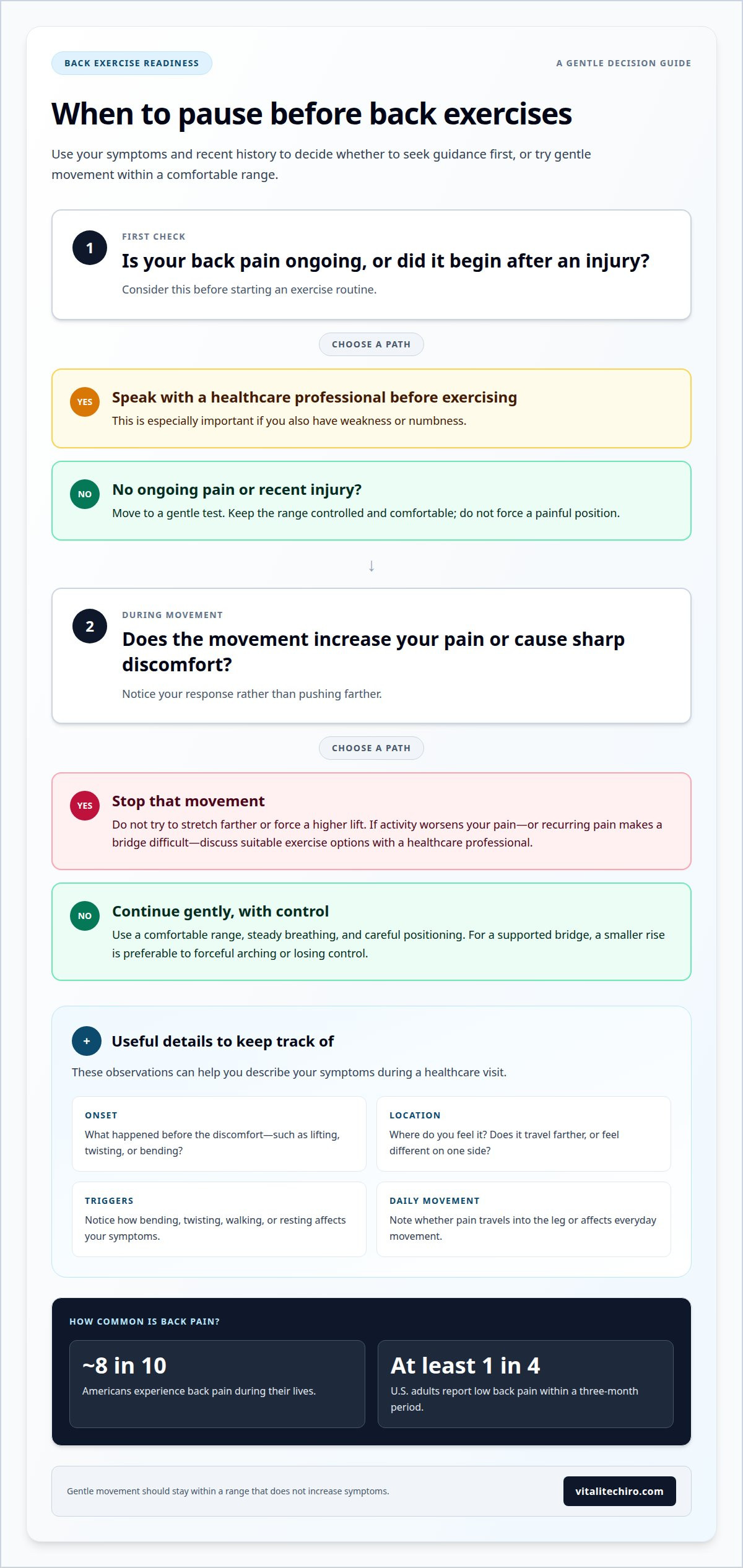
How common is lower back pain?
Roughly eight in 10 Americans experience back pain during their lives, and at least one-fourth of U.S. adults report low back pain within a three-month period. Gentle walking or swimming can be low-impact activity options; choose a pace and movement range that don’t increase your symptoms.
- Notice what preceded the discomfort. Muscle or tendon strains can follow heavy lifting, lifting incorrectly, twisting, or bending. For example, note whether pain began while carrying a load or turning to reach something. This may help describe the onset clearly during a healthcare visit.
- Track where the pain travels. Note whether the sensation stays in the lumbar area or travels farther, and whether one side feels different.
- Consider your usual position. A 2019 study in Applied Ergonomics found an association between static sitting behavior and chronic low back pain among call-center workers. The finding describes an association, not proof that sitting alone causes pain. If your day involves a fixed position, observe when you can change position or stand briefly.
- Describe what changes your symptoms. Record whether bending, twisting, walking, or resting affects your lower back pain. Include a practical example, such as discomfort during a forward bend or after sitting. These details help distinguish the movements that aggravate symptoms from those you tolerate.
- Choose gentle movement thoughtfully. Walking and swimming are examples of low-impact activities. Keep movement comfortable rather than forcing a stretch to release tight muscles or strengthen your back. If an activity worsens pain, stop and discuss suitable options with a healthcare professional.
- Use symptoms to guide your next step. Back pain has different possible causes, so a stretch that suits one person may not suit another. Share the location, onset, and triggers you observed, especially if pain travels into the leg or affects daily movement.
Consulting a healthcare professional before exercising for ongoing back pain or after an injury
Discuss exercise choices with a healthcare professional before starting a routine for ongoing back pain or after an injury. A physical therapist or another member of your healthcare team can help identify suitable movements.
There’s no single schedule for every back exercise. For example, the Mayo Clinic recommends repeating its cat stretch 3 to 5 times twice a day; follow the instructions for each movement you use.
Identify movements to avoid
- Notice which movements worsen your symptoms, then leave those out of your routine. For example, if a spinal twist increases pain, don’t repeat it or push farther into the stretch.
- Keep any movement gentle and controlled. During a floor exercise, set your feet flat and move without forcing your back into an uncomfortable position. Tell your healthcare professional which actions aggravate symptoms, such as bending, twisting, or lifting.
Know when to stop and seek care
- Stop exercising if a movement increases your pain, or if weakness or numbness occurs. A doctor should assess lower-back pain that is acute, persists more than a few days, or comes with weakness or numbness.
- These are the warning signs identified here for seeking medical care. Don’t treat new weakness or numbness as a cue to repeat an exercise. Describe when it began and which movement preceded it when speaking with a healthcare professional.
- For back pain after a sports injury, discuss sports injury care as a next step.
Consider pregnancy and older adulthood
- Before beginning a back-exercise routine during pregnancy, discuss the planned movements with a healthcare professional. Explain whether you’re considering a stretch, a bridge, or an abdominal exercise, so the advice addresses the actual activity.
- Older adults should also discuss a new routine before starting, particularly if balance or comfortable movement is a concern. Ask which starting position is appropriate, and whether a supported version is preferable to a movement performed standing.
- For either situation, avoid assuming that a routine suited to someone else will fit your needs. A healthcare professional can consider your symptoms, injury history, and the movements you want to perform.
Vitalité Chiropractic
Vitalité Chiropractic in Arlington, Virginia, can help you consider next steps if lower-back pain persists, follows an injury, or makes choosing exercises difficult. Discussing your symptoms and movement goals can help clarify whether chiropractic adjustments or decompression therapy may be relevant to your care.
If back pain began during sports, discuss whether Sports Injury Care may be appropriate. Prenatal Chiropractic Care is available for pregnancy-related needs. The right approach depends on your circumstances, so describe which movements aggravate your symptoms and whether pain limits daily activities.
For guidance on back pain and suitable care options, contact Vitalité Chiropractic in Arlington.
Build a steadier path forward
Aim for a routine you can approach consistently, rather than testing how much discomfort you can tolerate. With at-home exercises for back pain relief, notice how movement affects everyday activities such as getting dressed, walking, or rising from a chair. These changes can help you describe what’s improving and what still feels difficult.
If pain continues to limit your movement, or you’re unsure which exercises suit your situation, seek professional guidance before progressing. Discussing your symptoms, injury history, and goals can help shape a considered plan. You don’t need to have every detail figured out before asking for support.
Contact Vitalité Chiropractic for support as you consider your next steps. A thoughtful, individualized approach can help you move forward with greater clarity and confidence.
Frequently Asked Questions
How do you relieve back pain?
To manage back pain, choose comfortable movement and adjust activities that aggravate it. For example, break up prolonged sitting with brief opportunities to stand or walk, and avoid forcing a stretch that worsens symptoms. Note which daily tasks feel easier or harder. If pain persists, follows an injury, or limits movement, discuss next steps with a healthcare professional.
Which at-home exercises can relieve lower back pain?
Knee-to-chest stretches and supported bridges are two options in this guide. Choose a variation that lets you move smoothly, and keep the range small if a larger movement feels uncomfortable. You could also try a gentle pelvic tilt, focusing on control rather than effort. Stop any exercise that increases pain, and discuss persistent symptoms with a healthcare professional.
How do heat, ice, and stretching compare for back pain relief?
Heat and ice are temperature-based comfort measures, while stretching involves movement; they aren’t interchangeable. Notice which approach feels comfortable, and avoid applying anything in a way that irritates your skin or increases discomfort. Stretch gently instead of using it to push through pain. If you’re unsure which option suits your symptoms, or your pain is ongoing, ask a healthcare professional for guidance.


