
The closest office isn’t automatically the right fit. Finding a chiropractor you can trust in Arlington means considering location alongside the practitioner’s credentials, approach to care, and patient feedback. Start with clinics that are practical to reach, then look for a provider whose experience and communication style suit your needs.
It’s reasonable to want care that feels professionally grounded and personal. This guide explains how to review a chiropractor’s qualifications, understand individualized care, and assess whether patient feedback reflects clear communication and respect. You’ll also learn how to weigh travel time against the quality of the fit, so you can make a more confident choice for your health.
Key Takeaways
- Look for care plans shaped around your health history, concerns, and goals, with treatment options explained clearly.
- Review a chiropractor’s education and experience to understand how their background aligns with the care you’re seeking.
- Patient feedback can offer insight into communication, respect, and how clearly a practitioner explains care.
- Consider travel time and appointment access alongside clinical fit so getting to care feels practical over time.
Individualized chiropractic evaluations and care plans
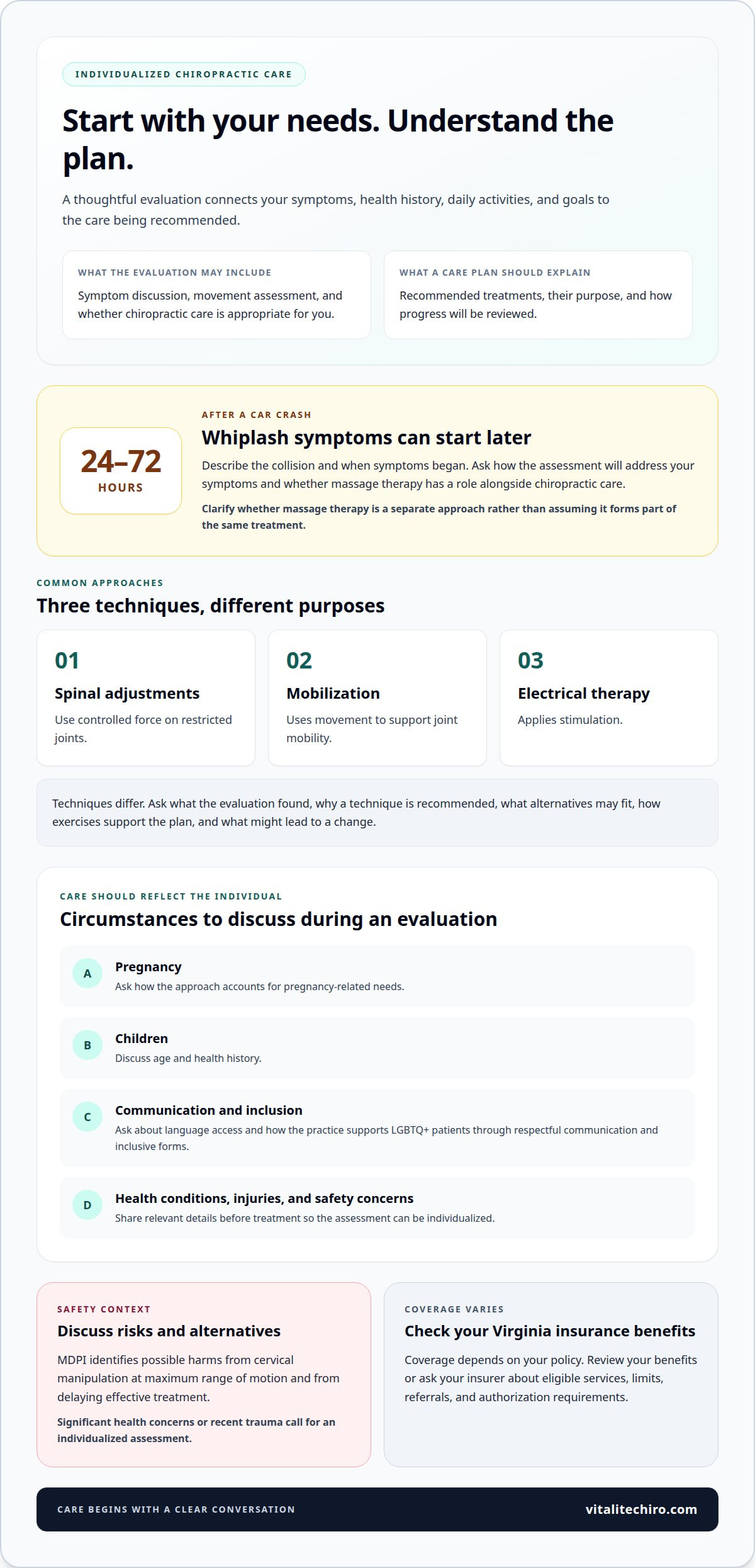
Finding a chiropractor you can trust in Arlington starts with an evaluation of your symptoms, health history, daily activities, and goals. The chiropractor can assess your movement and discuss whether chiropractic care is appropriate for you. A care plan should explain recommended treatments, their purpose, and how progress will be reviewed. Someone with discomfort after desk work, for example, may have different priorities from an athlete returning to training.
Common approaches include spinal adjustments, mobilization, and electrical therapy. Adjustments use controlled force on restricted joints; mobilization uses movement to support joint mobility, while electrical therapy applies stimulation. Since techniques differ, ask what the evaluation found, why a particular technique is recommended, and what alternatives may fit. Ask how exercises support the plan and what might lead to a change.
Care should reflect the individual. Adults, pregnant patients, and children have different circumstances to discuss during an evaluation. For prenatal care, ask how the approach accounts for pregnancy-related needs. For children, discuss age and health history. You can also ask about language access and how the practice supports LGBTQ+ patients through respectful communication and inclusive forms.
After a car crash, describe the collision and when symptoms began. Whiplash symptoms can start 24 to 72 hours afterward. Ask how the assessment will address your symptoms and whether massage therapy has a role alongside chiropractic care. Clarify whether it is a separate approach rather than assuming it forms part of the same treatment.
When finding a chiropractor you can trust in Arlington, discuss health conditions, recent injuries, and safety concerns before treatment. MDPI identifies possible harms from cervical manipulation at maximum range of motion and from delaying effective treatment. People with significant health concerns or recent trauma need an individualized assessment. Virginia insurance coverage depends on your policy, so review your benefits or ask your insurer about eligible services, limits, referrals, and authorization requirements.
Evaluating a chiropractor's credentials and experience
Credentials and relevant experience help you assess whether a practitioner’s background fits your needs. In Arlington, Virginia, review education, license status, and experience with concerns such as neck pain before booking an appointment.
Provider Credentials and Education
Look for a Doctor of Chiropractic degree and confirm the practitioner’s name and education through reliable professional records. Education provides important context, but it doesn’t show how a chiropractor approaches each individual. Ask how their training informs the assessment and treatment options they recommend. Someone seeking better mobility, for example, may want to understand how the practitioner evaluates movement and function.
Experience and License History
Use Virginia’s official practitioner license lookup to confirm the chiropractor’s current license and review any disciplinary history shown. Search by the provider’s full name, then compare the result with the name used for the appointment. Ask about experience treating concerns similar to yours, such as recurring neck pain or limitations linked to your lifestyle. A clear response should connect that experience to your goals without promising a particular outcome.
Experience is most useful when it relates to the care you’re considering. Ask how the practitioner assesses progress, adapts a care plan, and decides whether an approach remains appropriate. If you’re considering prenatal care, for example, ask about experience working with pregnant patients and how the evaluation accounts for individual needs. Specific answers help you understand the reasoning behind recommendations.
At an appointment, notice whether the chiropractor explains findings in language you understand and welcomes questions. You might ask, “How will this approach support my mobility?” or “What would lead you to revise the plan?” These questions reveal how clinical experience informs decisions, while giving you a clearer sense of communication and fit. For an approach centered on your needs, explore personalized chiropractic care.
Other professional backgrounds can offer useful points of comparison. Ashlyn Smith has five years of experience in chiropractic care. Chiropractor DFW says Ashlyn Smith has nearly two years of dedication to the practice. Dr. Kirtland Speaks received his doctorate from Logan Chiropractic College in 1994. Tracy Blakley earned a Bachelor of Science in Health Promotion and Wellness from the University of Central Arkansas before attending Logan University for his Doctorate of Chiropractic.
Reviewing patient feedback about communication and trust
Patient feedback can reveal how a chiropractor explains care, responds to concerns, and treats people. Look for specific examples, not just praise or criticism.
Patient Reviews and Practice Reputation
Read several reviews and look for recurring details about listening, clear explanations, and respectful interactions. A patient describing how a doctor discussed headaches, movement, and next steps offers more useful context than a general claim of excellent care. Notice whether reviews mention follow-up questions or practical guidance. One complaint alone may not show a pattern, but repeated concerns about communication deserve attention.
Ratings and Survey Responses
A star rating summarizes opinions, but it can’t explain each patient’s experience. Read survey responses for comments about appointment communication, staff interactions, and whether patients understood their options. Healthgrades describes chiropractors as teaching patients about their condition, treatment plan, and home exercises. Look for feedback that reflects these details, such as an explanation of an exercise’s purpose or how it supports movement.
Warning Signs of Untrustworthy Care
Be cautious of reviews describing pressure to accept treatment without an explanation, dismissive responses to questions, or promises of guaranteed relief. A plan that doesn’t account for a patient’s concerns or changing symptoms is another warning sign. Trustworthy communication leaves room for questions and explains the reasoning behind recommendations, rather than relying on fear or urgency.
Home exercises can show whether education continues beyond the appointment. For example, feedback about receiving clear instructions for a movement routine may indicate that patients understood how to follow the plan. Consider whether reviewers describe realistic guidance for daily wellness, not only short-term relief or tissue-focused treatment.
For a new-patient examination, ask for a price estimate before booking and clarify what the examination includes. The price depends on the services involved and your coverage; request a quote and ask your insurer about applicable benefits. Clear information about costs, treatment recommendations, and follow-up helps you make an informed choice without relying on ratings alone.
Clinic location and access
In Arlington, a clinic’s location affects how easily care fits your routine. Consider your usual routes, such as the trip from home, work, or a regular activity. Use a map to compare travel options and note where traffic or transfers could make the trip harder. A nearby clinic may be more practical if your schedule makes longer journeys difficult.
Check the full address and directions before arranging an appointment. Review the clinic’s building information for the entrance, floor, and any posted accessibility details. If you use mobility aids, have difficulty walking, or need another accommodation, clarify the route and access arrangements before your visit. Small logistical details can shape whether an examination feels manageable.
Think beyond the first visit. If your care plan involves follow-up appointments, consider how the journey fits into a typical week. For example, think about whether you can travel after work or arrange transport during your usual daytime schedule. Practical access matters because a route that works once may be difficult to maintain consistently.
Location doesn’t replace clinical fit. A convenient address should still lead to care that explains spinal findings, discusses chiropractic adjustments, and answers questions about techniques. Consider how the clinic communicates directions and appointment details, too. Clear information can help you prepare, arrive on time, and focus on the examination rather than last-minute logistics.
Before choosing, compare the route with your real schedule and access needs. Look at the clinic’s published directions, consider your usual transport, and identify any barriers that could affect repeat visits. If a location seems suitable, plan your chiropractic appointment around the route that best supports your routine.
Vitalité Chiropractic
Vitalité Chiropractic helps Arlington patients explore chiropractic care suited to their concerns and goals. To understand a practitioner’s approach, consider how an evaluation connects your symptoms, health history, and daily needs with appropriate care.
Care options include chiropractic adjustments and decompression therapy, as well as sports injury care and prenatal chiropractic care. Start the conversation with what you’re experiencing, what you hope to address, and which questions matter to you. Clear explanations can help you understand the proposed approach and decide whether it feels like a good fit.
For an individualized discussion about your chiropractic care needs, contact Vitalité Chiropractic in Arlington.
Take the Next Step Toward Personalized Care
Choosing a chiropractor is the start of a conversation about what you want to improve and how care can fit your life. As your needs change, keep sharing what feels different, what remains difficult, and what matters most to your daily wellbeing. That ongoing dialogue helps you stay engaged in decisions about your care.
If you’re finding a chiropractor you can trust in Arlington, the next step can be a direct discussion about your goals and suitable options. Vitalité Chiropractic offers chiropractic adjustments, decompression therapy, and sports injury care. Ask how these services relate to your concerns and what an individualized approach may involve.
Start with the questions that matter to you. A clear conversation can help you decide whether the approach suits your needs and supports a confident path forward.
Contact Vitalité Chiropractic today to discuss your care needs and take a considered next step.
Frequently Asked Questions
How can I find Chiropractors within a specific distance from my location?
Use a map app to set your current location and search within a distance you choose. Compare driving, walking, and transit routes, since the closest clinic by straight-line distance may not be the easiest to reach. Test the route from home and work at times you could travel, then shortlist options whose commute suits your routine.
What qualifications and credentials should I look for when choosing a chiropractor?
Look for a Doctor of Chiropractic degree, an active Virginia license, and experience relevant to your needs. For a practical reference, Dr. W. Jean-Luc Sansfaute, DC, has practiced since 2003. Ask how a chiropractor’s training and clinical experience relate to your concern, such as returning to exercise after an injury. Clear, specific answers help you judge whether the background fits your goals.
How do I find patient reviews and trustworthy recommendations for Arlington chiropractors?
Start with recent reviews on independent platforms, then look for detailed accounts that match your situation, such as care after a sports injury or support during pregnancy. A recommendation from someone you know can add context, but ask what they valued: attentive listening, clear explanations, or convenient scheduling. Treat feedback as perspective, not a substitute for discussing your needs with the practitioner.
How can I compare Arlington chiropractors by location, hours, experience, and payment options?
Compare clinics using the same details: route from your regular starting point, posted appointment hours, provider experience relevant to your concern, and accepted payment methods. Vitalité Chiropractic is at 1530 Wilson Blvd, #1040, Arlington, VA 22209, and accepts most major insurance plans with flexible payment options. Dr. Sansfaute has practiced since 2003. Ask your insurer what your individual plan covers.


