
Sports chiropractic care looks beyond the sore spot. A sports chiropractor near Ballston assesses how you move and where discomfort may be affecting your activity, then may use adjustments, mobilization, and soft-tissue treatment as part of care. The approach connects your symptoms with the movement demands of your sport or training.
When pain or stiffness interrupts your routine, it’s natural to want care that takes your goals seriously. This article explains how sports injury care works, how an assessment can guide treatment, and what athletes can expect from different approaches. You’ll also learn how to choose a next step, whether you’re returning to training or seeking support for an ongoing sports-related concern.
Key Takeaways
- Learn how rehabilitative exercises and sport-specific training can support a gradual return to athletic activity.
- Recognize when sports chiropractic care may be relevant for athletes with movement-related discomfort or limitations.
- Understand how adjustments, mobilization, and soft-tissue treatment address different aspects of movement and comfort.
- See how orthopedic and functional assessments help shape care around an athlete’s symptoms, movement, and goals.
What Is Sports Medicine Chiropractic Care?
Sports medicine focuses on musculoskeletal concerns related to athletics and exercise. Chiropractic care considers how movement, joint function, and symptoms affect training. For a runner with ankle stiffness, an assessment may consider how the foot, ankle, and leg move together. A sports chiropractor near Ballston can relate those findings to the athlete’s activity demands.
How does chiropractic care compare with physical therapy? Physical therapy commonly emphasizes rehabilitation exercises and functional training, while chiropractic care may include adjustments or joint mobilization. Both approaches can support care for sports injuries, and a plan may combine exercise with hands-on treatment based on the athlete’s needs.
Rehabilitative exercise connects care to the demands of a sport. An athlete might progress from controlled balance work to movements that resemble running, jumping, or changing direction. Exercise choices can reflect the activity, symptoms, and current movement capacity, rather than treating every athlete’s recovery as identical.
What are local sports chiropractors’ ratings and patient reviews? Ratings differ across platforms, and reviews describe individual experiences with communication, scheduling, or care. The specific practice’s published rating and reviews offer a more useful reference than a general impression of local providers.
Do sports chiropractors near Ballston accept new patients and offer same-day appointments? Same-day appointments are offered, and new-patient scheduling depends on available appointment times. A first visit typically explores symptoms, activity demands, and movement limitations.
Which insurance plans do sports chiropractors near Ballston accept? Vitalité Chiropractic accepts most major insurance plans. Coverage and benefits depend on the insurer and specific policy, so review your plan’s terms to understand how care is covered.
What credentials and sports medicine experience should you look for? Consider professional training and experience with athletic injuries, exercise-related symptoms, and sport-specific movement. A sports chiropractor near Ballston should be able to explain the assessment process and how care relates to your goals, such as returning to tennis after shoulder discomfort.
Athletes who may benefit
Sports chiropractic care can be relevant across athletic levels and disciplines. Dr. Tony Smith treats athletes ranging from youth and high school competitors to collegiate athletes, weekend warriors, and professionals. Their schedules and performance demands differ, but each athlete may seek help when discomfort or restricted movement interferes with training, competition, or everyday activity.
A recreational runner, for example, might notice stiffness during longer runs, while a tennis player may struggle with shoulder movement during a serve. A high school athlete could feel limited when changing direction on the field. These examples involve different movements and demands, so an assessment should consider the activity, where symptoms arise, and which motions feel restricted.
Athletic training places repeated demands on the body. A swimmer’s shoulder, a weightlifter’s hip, and a soccer player’s ankle each experience sport-specific loads. Sports injury care can consider those patterns alongside the athlete’s training routine and current mobility. The goal is to understand how a concern relates to performance, not to assume every athlete needs the same treatment.
Athletic development also shapes care. A young competitor may be learning new skills and managing a changing training schedule, while an experienced athlete may focus on movement quality across demanding sessions. In either case, a clinician can relate the athlete’s goals to observed movement and symptoms. That context helps distinguish a general concern from one that appears during a specific task, such as sprinting or overhead lifting.
Care may be worth discussing when an injury, recurring discomfort, or limited mobility affects your performance. Athletes who feel comfortable during daily activities but struggle during a particular drill can describe that exact movement during an appointment. A sports chiropractor near Ballston can use those details to focus an assessment on the sport and the athlete’s priorities.
For a focused conversation about athletic movement and care options, talk through your sports-related concerns.
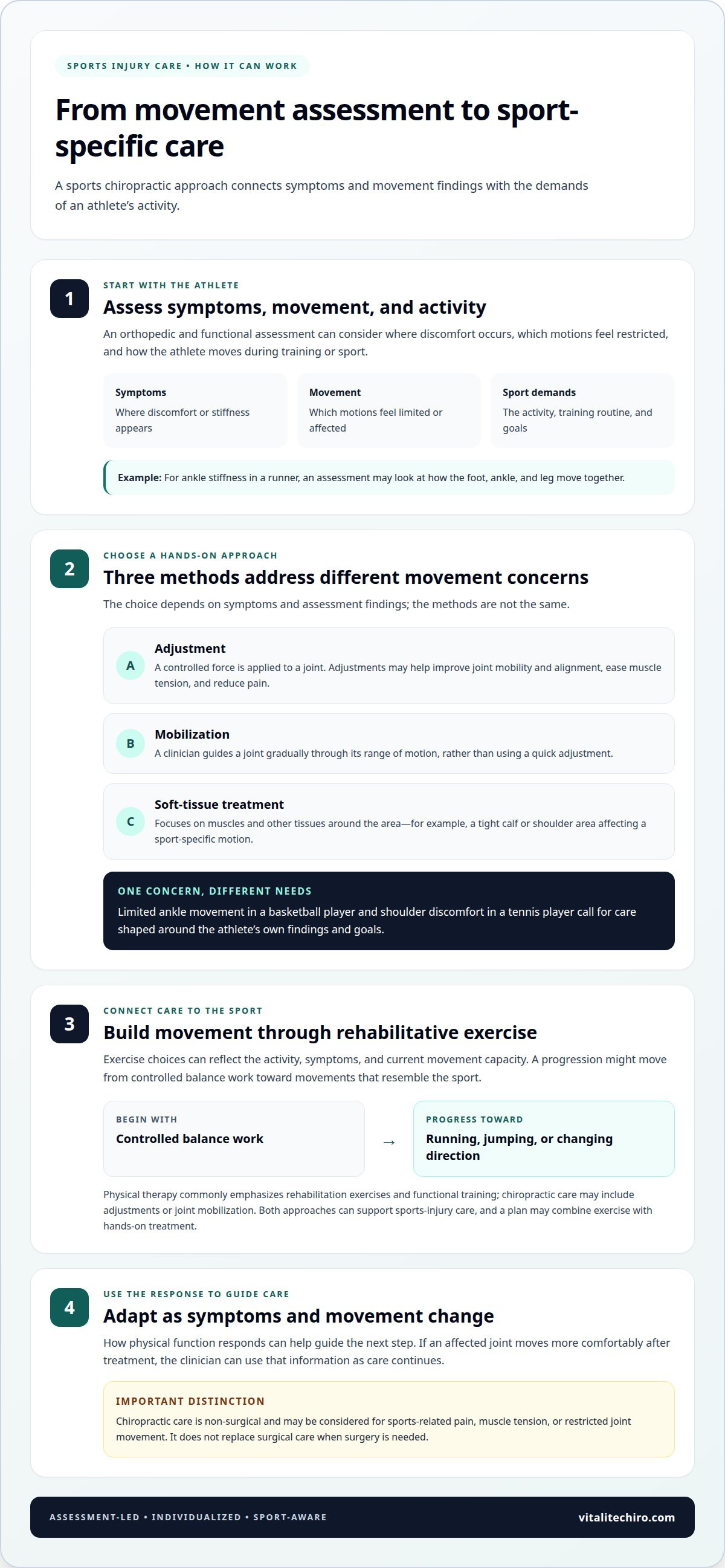
Chiropractic adjustments, mobilization, and soft-tissue treatment
Sports chiropractic care can combine hands-on methods to address different movement concerns. An adjustment applies a controlled force to a joint; mobilization uses guided movement through its range. Soft-tissue treatment focuses on muscles and other tissues around the area. For a basketball player with limited ankle movement, these methods address distinct parts of the same concern.
Adjustments may help improve joint mobility and alignment, ease muscle tension, and reduce pain. Mobilization offers a different approach: the clinician moves a joint gradually, rather than using a quick adjustment. Soft-tissue work can focus on a tight calf or shoulder area affecting a sport-specific motion. The choice depends on the athlete’s symptoms and assessment findings.
Individualized care connects treatment with the athlete’s goals. For example, a tennis player with shoulder discomfort may prioritize comfortable arm movement, while a runner with restricted ankle mobility has different needs. The clinician can adapt the approach as symptoms and movement change, rather than applying one routine to every injury.
Chiropractic care is non-surgical and may be considered for sports-related pain, muscle tension, or restricted joint movement. It does not replace surgical care when surgery is needed. Understanding that distinction helps athletes consider what an approach involves without assuming every injury has the same needs.
Recovery also involves noticing how physical function responds to care. If an athlete can move an affected joint more comfortably after treatment, the clinician can use that information to guide the next step. Rehabilitation exercises may complement hands-on care, connecting mobility with sport-specific movements such as reaching overhead or pushing off during a run.
Orthopedic and functional assessment
An orthopedic and functional assessment examines how a musculoskeletal concern affects movement. The clinician begins by discussing the injury, when symptoms appear, and which activities change them. A runner might describe discomfort during push-off, while a swimmer may report pain during an overhead stroke. These details help focus the examination on relevant movements.
Next, the clinician may observe posture, walking, joint motion, and strength. A bodyweight squat, for example, can show how the hips, knees, and ankles coordinate under load. A single-leg balance task may reveal differences between sides. These observations describe function during a specific task, but they don’t, by themselves, explain every cause of pain.
Orthopedic tests can help assess a particular joint or tissue. For shoulder symptoms, the clinician may examine arm movement and compare it with the athlete’s report of discomfort. For an ankle concern, the assessment may include joint mobility and weight-bearing movement. Findings are considered together, rather than relying on one test to define the whole injury.
The assessment also connects symptoms with the athlete’s sport. A tennis serve, a running stride, and a basketball landing place different demands on the body. The clinician can identify which part of the movement feels limited and whether mobility, strength, or coordination may be relevant. This gives the care plan a functional focus, such as comfortable reaching or controlled landing.
Clear communication matters. The clinician can explain what each test examines, describe the findings in plain language, and relate them to the athlete’s goals. If pain or limited function calls for professional assessment, schedule an orthopedic and movement assessment to discuss the concern and its effect on your activity.
Vitalité Chiropractic: Sports Injury Care
Vitalité Chiropractic provides Sports Injury Care in Arlington for athletes managing discomfort or movement limitations that affect training. Care may include Chiropractic Adjustments, with the approach shaped around your symptoms, activity, and goals. If back discomfort during practice or stiffness limits a familiar movement, an assessment can help clarify appropriate next steps.
Vitalité Chiropractic also offers Decompression Therapy. The right approach depends on the concern and the athlete’s needs. If an injury or recurring discomfort makes it harder to take part in the activities that matter to you, contact Vitalité Chiropractic to discuss your concerns and care options.
Make Your Next Step a Thoughtful One
Your return to sport is personal. Start by describing what feels different, which movements are affected, and what you hope to resume. That context helps a clinician connect your concerns with the demands of your activity and discuss an appropriate path forward.
If you’re considering a sports chiropractor near Ballston, Vitalité Chiropractic provides Sports Injury Care, Chiropractic Adjustments, and Decompression Therapy. The right care depends on your needs and goals, so a conversation can help you understand how these options may relate to your concern.
Reaching out doesn’t require a perfect explanation of your symptoms. Start with what you notice during practice, training, or daily movement, and discuss what you’d like to work toward. Contact Vitalité Chiropractic to discuss care and take a considered step toward moving with greater confidence.
Frequently Asked Questions
How long does recovery from a sports injury take?
Recovery time depends on the injury, affected tissue, symptoms, and the sport’s physical demands. An ankle injury that affects walking differs from one that limits sprinting or cutting. A clinician considers function and activity goals when discussing progression. Changes in pain and movement help guide next steps, since an individual recovery timeline depends on how the injury responds.
Are there any side effects to chiropractic care for athletes?
Temporary soreness or stiffness can occur after chiropractic treatment. The technique used and the area treated affect how someone may feel afterward. Athletes can describe their response at follow-up so the clinician can adjust the approach. If symptoms feel severe or concerning, seek appropriate medical attention rather than continuing an activity that aggravates them.
Can a chiropractor help with back and neck pain?
Yes, chiropractic care can address back and neck concerns. Vitalité Chiropractic offers Chiropractic Adjustments. For an athlete whose neck discomfort makes it difficult to turn while tracking a ball, or whose back pain limits bending, an assessment can connect symptoms with movement and activity. A sports chiropractor near Ballston can then discuss whether chiropractic care fits the concern.
Do I need a referral to make an appointment?
Schedule directly by phone or through the online booking option. Your visit begins with patient forms and a consultation about your concerns, followed by an examination. If you plan to use insurance, your specific plan may have referral requirements that affect coverage. Bring relevant details about your symptoms and sport to help shape the initial discussion.
Who can benefit?
Athletes and active people may benefit from discussing care when discomfort affects training, competition, or sport-related movement. For example, a cyclist with back discomfort while leaning over the handlebars can explain when symptoms begin and which rides are affected. A sports chiropractor near Ballston can use those details to understand the concern and discuss how it relates to your goals.
What sports chiropractors are near Ballston, Arlington, VA?
Vitalité Chiropractic is an Arlington, Virginia practice that offers Sports Injury Care. If you’re looking for a sports chiropractor near Ballston, you can discuss symptoms that affect training or competition and how they influence your activity. The practice also offers Chiropractic Adjustments and Decompression Therapy. Describing the sport, affected area, and triggering movements can help focus the conversation.


