
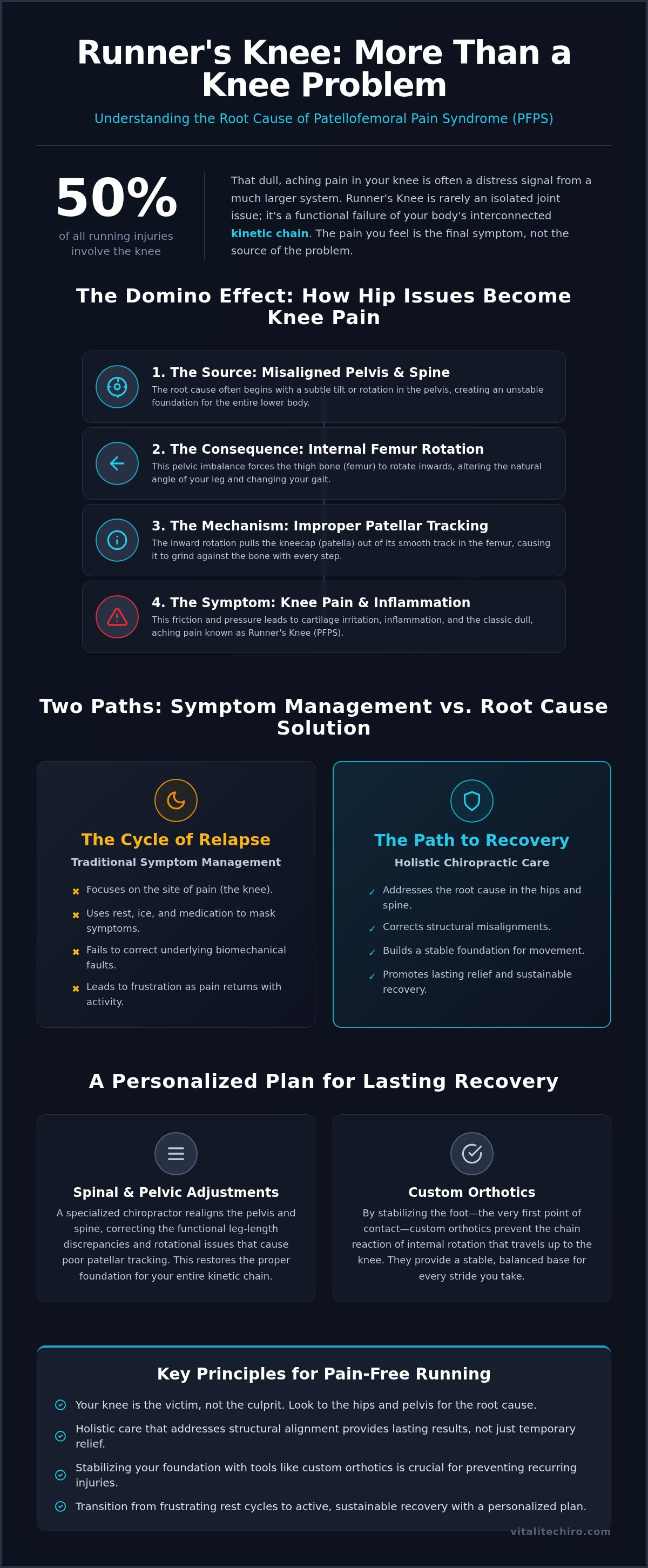
Your runner's knee is rarely just a knee problem; it's a functional failure of your entire kinetic chain. Research indicates the knee accounts for up to 50% of all running injuries, leaving many athletes in a frustrating cycle of rest and relapse. If you've felt that dull, aching pain while pacing yourself on the W&OD Trail, you aren't alone. It's discouraging to pause your training only to have the same twinge return the moment you lace up your shoes. Finding a specialized chiropractor for runner's knee Arlington VA can change that perspective. We understand that your discomfort often starts with misalignments in the hips or spine rather than the joint itself.
By addressing these root biomechanical causes, you can stop managing symptoms and start actual recovery. This guide explores how specialized chiropractic care and custom orthotics provide a path back to pain-free miles. You'll discover how a personalized plan, focusing on your body's unique alignment, ensures you return to the Arlington trails with confidence. We'll look at why the pain persists and how a whole-person approach restores your physical freedom. It's time to embrace a solution that supports your long-term health and keeps you moving forward.
Key Takeaways
- Recognize that Patellofemoral Pain Syndrome is frequently a symptom of biomechanical failures in the hips and pelvis, not just the knee joint itself.
- Contrast the temporary relief of symptom-masking medications with a holistic approach that addresses the structural misalignments causing your discomfort.
- Understand how stabilizing your foundation with custom orthotics can prevent the internal rotation and tracking issues that lead to recurring injuries.
- See why consulting a dedicated chiropractor for runner's knee Arlington VA is essential for building a personalized recovery plan that restores your natural movement.
- Transition from frustrating rest cycles to active recovery with strategies designed to get you back on the Arlington trails safely and sustainably.
Understanding Runner's Knee in the Arlington Running Community
For many athletes in Northern Virginia, the joy of a crisp morning run is often interrupted by a persistent, dull ache centered in the knee. Clinically known as Patellofemoral Pain Syndrome (PFPS), this condition is more commonly referred to as runner's knee. It typically manifests as a tender sensation behind or around the patella, especially during activity. You might notice it most when you're descending stairs or pushing through the final miles of a workout. In our active community, this injury frequently surfaces during the peak training months for the Marine Corps Marathon.
The rigorous mileage required for marathon preparation puts immense strain on the joints. When you combine high volume with the challenging topography of the North Arlington hills, the risk of developing PFPS increases. Steep climbs and rapid descents in neighborhoods like Rosslyn force the knee to manage intense eccentric loads. This can quickly lead to inflammation if your biomechanics aren't perfectly aligned. Identifying these triggers early is the first step toward lasting recovery.
The Anatomy of Patellofemoral Pain
Your kneecap is designed to glide smoothly within a groove at the end of your femur as you move. This movement is supported by a layer of articular cartilage and lubricated by synovial fluid, which helps minimize friction. In a healthy knee, this tracking is precise and effortless. However, PFPS occurs when the patella shifts slightly out of its intended path, creating irritation against the femoral groove. It's accurate to define PFPS as a functional tracking issue rather than just simple wear and tear of the joint tissues.
Local Factors: From the W&OD Trail to Rosslyn Hills
Arlington offers some of the best running infrastructure in the country, but the environment itself can be demanding. The repetitive impact of running on the paved surfaces of the W&OD Trail can exacerbate existing physical imbalances over time. While these trails are convenient, the hard asphalt doesn't absorb shock as well as softer surfaces, placing more stress on your patellar alignment. Additionally, the uneven terrain and steep elevation changes found in Rosslyn increase the pressure on your kneecap significantly.
Many local runners tend to ignore early warning signs like minor stiffness or a clicking sensation. They often wait until the pain becomes sharp or chronic before seeking professional help. Consulting a chiropractor for runner's knee Arlington VA allows you to address these issues before they limit your mobility. By understanding how local terrain affects your stride, you can adjust your training and seek the specialized care needed to stay on the trails safely.
The Kinetic Chain: Why Knee Pain Often Starts in the Hips and Spine
The human body operates as a series of interconnected segments known as the kinetic chain. In this system, the foot, knee, hip, and spine must work in perfect harmony to distribute the forces of every stride. When one link fails, the stress doesn't disappear; it simply migrates to the next available joint. Most often, the knee becomes the "victim" of dysfunction occurring further up the chain. If you've been searching for a chiropractor for runner's knee Arlington VA, you likely realize that treating the joint in isolation rarely provides a permanent solution. True recovery requires a thorough evaluation of your pelvic and spinal alignment.
A primary driver of patellar tracking issues is a misaligned pelvis. When the pelvis is rotated or tilted, it forces the femur, or thigh bone, to rotate internally. This shift changes your "Q-angle," which is the measurement of the relationship between your hip width and knee alignment. An increased Q-angle places excessive lateral pressure on the kneecap, grinding the cartilage and causing the classic dull ache of runner's knee. While strengthening exercises for runner's knee are helpful, they can't fully succeed if the underlying skeletal structure remains skewed.
Pelvic Alignment and Patellar Tracking
A tilted pelvis often creates what we call a functional leg-length discrepancy. This means your legs aren't actually different lengths, but they behave as if they are, causing an uneven gait that wears down the knee joint. This imbalance is frequently linked to a weak gluteus medius. If the nerves exiting your spine are compressed, the signals to these stabilizing muscles become dampened. This leads to knee valgus, a condition where the knee caves inward during a run. Our clinical approach focuses on restoring pelvic symmetry, ensuring your hips provide a level platform for your knees to track safely.
The Role of the Spine in Lower Extremity Mechanics
Your lumbar spine houses the nerve roots that power the primary stabilizers of the knee, including the quadriceps. Spinal subluxations, or minor misalignments, can interfere with this neurological communication, leading to subtle muscle imbalances. We utilize the chiropractic adjustment as a precise tool for a neurological reset. By clearing these interferences, we restore the brain-to-body connection, allowing your muscles to fire with the correct timing and intensity. This improvement in spinal mobility translates directly to a more efficient running gait. If you're ready to address these root causes, our team can help you optimize your biomechanics for the long term.
Chiropractic Care vs. Traditional Runner's Knee Treatments
Traditional management of Patellofemoral Pain Syndrome often relies on a combination of NSAIDs and the R.I.C.E. protocol. While rest and ice can manage acute inflammation, they don't address why the irritation started. Masking pain with medication may allow you to finish a run, but it often leads to further joint degradation by ignoring the underlying mechanical failure. Choosing a chiropractor for runner's knee Arlington VA offers a shift from passive waiting to active, structural correction. Instead of just managing the ache, we focus on why your patella isn't tracking correctly, providing a non-invasive alternative to more aggressive interventions like corticosteroid injections.
Manual Therapy and the Diversified Technique
Restoring optimal joint play is essential for a fluid running stride. We utilize the Diversified Technique, a widely respected method of manual adjustment, to ensure the knee, ankle, and hip joints are moving through their full range of motion. This isn't just about the "pop" or "click"; it's about neurological input and mechanical alignment. When joints are stuck, the surrounding soft tissues become overworked. Our approach incorporates soft tissue mobilization to break up adhesions in the IT band and quadriceps. These manual therapies work together to reduce the lateral pull on your kneecap, allowing the cartilage to heal without the constant friction of a misaligned stride.
Beyond the Adjustment: Therapeutic Modalities
At Vitalité Chiropractic, we believe your recovery should be as unique as your gait. Finding a skilled chiropractor for runner's knee Arlington VA means moving beyond temporary fixes to find a sustainable solution. Our specialized sports injury care integrates advanced therapeutic modalities to support the manual work. For runners who experience concurrent lower back stiffness or disc issues, decompression therapy can be a game-changer. It helps relieve pressure on the nerve roots that control your leg muscles, ensuring your body has the neurological strength to maintain proper form.
We take pride in being a community-oriented, inclusive space. Our person-centered care ensures that every runner, regardless of their background or experience level, feels heard and supported. This "whole-person" philosophy is vital for avoiding compensatory injuries. When you only treat the knee, you risk developing hip or ankle problems later. By looking at your entire physical structure, we help you build a resilient foundation that stands up to the demands of the Arlington trails.
Custom Orthotics: Building a Stable Foundation for Your Knees
Every stride begins at the ground. If your foundation is unstable, your knees inevitably pay the price. Overpronation, or the inward collapse of the arches, isn't just a foot issue; it's a primary mechanical trigger for Patellofemoral Pain Syndrome. When the arch flattens during a run, it forces the tibia to rotate internally. This creates a "corkscrew" effect that pulls the kneecap out of its natural track. While many athletes try "off-the-shelf" inserts, these generic products lack the structural precision required to correct complex gait imbalances. As a specialized chiropractor for runner's knee Arlington VA, we utilize custom orthotics to address these mechanical failures at their source.
Our diagnostic process involves advanced digital foot scanning and a comprehensive biomechanical analysis. We don't just look at the height of your arch. We evaluate how your entire foot behaves under the pressure of movement. This data allows us to create a corrective tool that mirrors your unique anatomy, providing support where you need it most. By stabilizing the foot, we stop the chain reaction of misalignment before it reaches your knee joint.
How Foot Mechanics Dictate Knee Health
The relationship between your feet and knees is direct and uncompromising. When your foot mechanics are flawed, the resulting "corkscrew" rotation places immense lateral stress on the patellar cartilage. Our custom orthotics are designed to realign the calcaneus, or heel bone, which serves as the anchor for the entire leg. By keeping the heel in a neutral position, the orthotic prevents the tibia from rotating excessively. Essentially, your feet serve as the structural foundation for both your knee health and your entire spinal alignment.
Integrating Orthotics into Your Running Routine
Transitioning into custom inserts requires a methodical approach to ensure your body adapts comfortably. We recommend wearing them for short walks initially before gradually introducing them to your training runs on Arlington's paved trails. This steady integration prevents the development of new compensatory aches in the small muscles of the feet. These inserts do more than provide comfort; they complement your regular adjustments to facilitate long-term posture correction. For runners dealing with chronic issues, custom inserts are a cost-effective alternative to repeated cycles of physical therapy. They offer a permanent mechanical solution that protects your joints mile after mile. If you're ready to stabilize your stride, you can schedule a biomechanical foot scan to begin your personalized recovery.
Personalized Recovery at Vitalité Chiropractic in Arlington
Vitalité Chiropractic is more than a clinical space; it's a dedicated partner in your athletic journey. Dr. W. Jean-Luc Sansfaute has practiced since 2003, bringing over two decades of experience to the treatment of complex sports injuries. We've built our practice on a foundation of professional confidence and person-centered empathy. We pride ourselves on being a community-oriented, inclusive environment where all Arlington runners feel a sense of belonging. Our clinic is LGBTQ+ friendly and provides multilingual support in English, French, and Spanish to serve our diverse local population effectively. We understand that acute pain doesn't follow a schedule, which is why we offer same-day appointments for runners dealing with sudden flare-ups.
Your First Visit: A Comprehensive Athletic Assessment
When you consult a chiropractor for runner's knee Arlington VA, your journey begins with a deep dive into your unique biomechanics. During your initial visit, we conduct a comprehensive athletic assessment that includes detailed gait analysis and spinal screening. Dr. Sansfaute looks beyond the localized knee pain to identify the specific misalignments in your pelvis or feet that are driving the dysfunction. Based on your personal running goals, he develops a customized chiropractic care plan. We prioritize patient education throughout this process, ensuring you understand the "why" behind your treatment to help prevent future occurrences of runner's knee.
Long-Term Wellness and Performance Optimization
Our philosophy focuses on moving you from a state of simple pain relief to one of performance optimization. While resolving the immediate ache is important, we want to help you achieve a more efficient stride and faster recovery times. Regular maintenance adjustments help Arlington runners stay on the road year-round by keeping the kinetic chain in sync. This proactive approach prevents the compensatory injuries that often arise when one part of the body is forced to work harder than another. By maintaining your structural integrity, you can focus on your training without the anxiety of recurring injury. Don't let persistent discomfort dictate your training schedule. Take the next step toward physical freedom and schedule your runner's knee consultation at Vitalité Chiropractic today.
Reclaim Your Miles on the Arlington Trails
Addressing the root biomechanical causes of runner's knee is the only sustainable way to break the cycle of recurring pain. Your discomfort is often a signal of dysfunction elsewhere in the kinetic chain, from pelvic misalignments to unstable foot mechanics. By choosing a specialized chiropractor for runner's knee Arlington VA, you transition from masking symptoms to correcting the structural failures that hinder your performance. Our approach combines sports-specific rehabilitation with custom orthotics to ensure your body operates as a synchronized, powerful unit.
Dr. Sansfaute provides over 20 years of clinical experience to every unique case, offering a high-end level of care that prioritizes your safety and long-term wellness. At Vitalité Chiropractic, we're proud to maintain an inclusive and LGBTQ+ friendly practice that welcomes every member of our diverse community. It's time to stop letting joint frustration dictate your pace. Book your same-day runner's knee evaluation in Arlington today and rediscover the joy of pain-free movement. We're ready to help you return to the trails with a stronger, more resilient stride.
Frequently Asked Questions
How can a chiropractor help with runner's knee specifically?
A specialized chiropractor for runner's knee Arlington VA addresses the biomechanical misalignments that cause improper patellar tracking. Instead of just treating the localized inflammation, we evaluate the entire kinetic chain. This includes adjusting the pelvis, hips, and ankles to ensure the kneecap glides smoothly within its groove. By restoring proper joint play and neurological function, we resolve the underlying mechanical failures that lead to chronic irritation during your runs.
Is runner's knee caused by a problem in the back or the knee itself?
While the pain is felt in the knee, the root cause is frequently found in the lumbar spine or pelvis. Misalignments in the lower back can interfere with the nerves that power your quadriceps and glutes, which are essential for stabilizing the knee. A tilted pelvis can also force the thigh bone to rotate internally. This shift places excessive stress on the knee joint, making it a victim of dysfunction elsewhere.
Do I need custom orthotics if I already have high-quality running shoes?
High-quality running shoes offer generic cushioning, but they cannot correct your specific anatomical imbalances. Custom orthotics provide a tailored foundation that addresses issues like overpronation or fallen arches. By stabilizing the calcaneus and preventing internal tibial rotation, these inserts stop the corkscrew effect that pulls your kneecap out of alignment. This precision support is vital for long-term joint health and cannot be replicated by off-the-shelf footwear.
How many chiropractic sessions are typically needed to see improvement in knee pain?
Every athlete's recovery timeline is unique and depends on the severity of the tracking issue. Many patients notice a significant improvement in mobility and pain levels within the first few sessions. Chronic cases involving years of compensatory movement may require a more extended plan to retrain the muscles and stabilize the joints. We offer same-day appointments for acute flare-ups to provide immediate relief and start your personalized recovery journey as quickly as possible.
Can I continue running while receiving chiropractic treatment for runner's knee?
Total rest is rarely the answer for Patellofemoral Pain Syndrome. In most cases, you can continue running with specific modifications to your mileage, intensity, or terrain. We focus on active recovery, helping you maintain your fitness while we correct your biomechanics. By adjusting your gait and utilizing custom orthotics, we allow you to stay active without further aggravating the joint. Our goal is to keep you moving toward your training milestones safely.
What happens if runner's knee is left untreated?
Ignoring the dull ache behind your kneecap can lead to permanent cartilage degradation and chronic inflammation. Over time, your body will develop compensatory patterns, often leading to secondary injuries in the hips, lower back, or ankles. What begins as a minor annoyance can evolve into a condition that requires more invasive interventions. Early treatment ensures that we can resolve the tracking issue before it causes lasting damage to the joint's structural integrity.
Is chiropractic care for knee pain covered by most insurance plans in Virginia?
Most major insurance plans in Virginia provide coverage for chiropractic adjustments and therapeutic modalities. While specific benefits vary by provider, chiropractic care is widely recognized as an effective, non-invasive treatment for sports injuries. We recommend contacting your insurance carrier directly to verify your specific coverage details. Our team is dedicated to providing transparent information regarding professional fees for adjustments, decompression therapy, and custom orthotics to help you plan your care.
What is the difference between chiropractic care and physical therapy for runner's knee?
Chiropractic care emphasizes the alignment of the skeletal system and the health of the nervous system. We use precise adjustments to restore joint play in the spine and extremities, ensuring your muscles receive clear neurological signals. Physical therapy typically focuses on strengthening and stretching specific muscle groups. These two disciplines are complementary. While physical therapy builds the strength to support the joint, chiropractic care ensures the joint is properly aligned and functioning correctly from the start.


