
Should a hands-on spinal adjustment be routine before a chiropractor understands your needs? It’s reasonable to want clear answers before agreeing to care, especially if you’re unsure what an adjustment feels like or whether it may be appropriate for you. If “manual spinal adjustment Arlington VA” is what brought you here, the key question isn’t only what the technique involves. It’s whether the chiropractor takes time to understand your health, comfort level, and goals first.
This article explains manual adjustment in plain language and outlines how an individualized assessment can help a chiropractor decide whether it may suit you. You’ll find practical questions to ask about the technique, possible discomfort, and other options before deciding. Vitalité Chiropractic offers chiropractic adjustments using diversified techniques in Arlington. Led by Dr. W. Jean-Luc Sansfaute, who has practiced since 2003, the clinic can discuss what its approach involves. The recommendation for your care, however, should reflect your individual assessment. The goal is to help you feel informed, heard, and comfortable taking the next step at your own pace.
Key Takeaways
- A manual spinal adjustment uses a chiropractor’s hands to apply controlled force to a joint. The technique and recommendations should be based on your assessment.
- Before agreeing to hands-on care, ask how your symptoms and health history inform the recommendation, what to expect, and what alternatives may be considered.
- When comparing providers for manual spinal adjustment Arlington VA, look for clear explanations, respect for consent, relevant experience, and credentials you can verify.
- Your visit may include sharing concerns, an assessment, a discussion of options, and a decision made together. The exact flow can vary.
- Vitalité Chiropractic serves Arlington and offers chiropractic adjustments using diversified techniques. Ask the clinic what to expect when exploring care.
What Is a Manual Spinal Adjustment, and What Does It Involve?
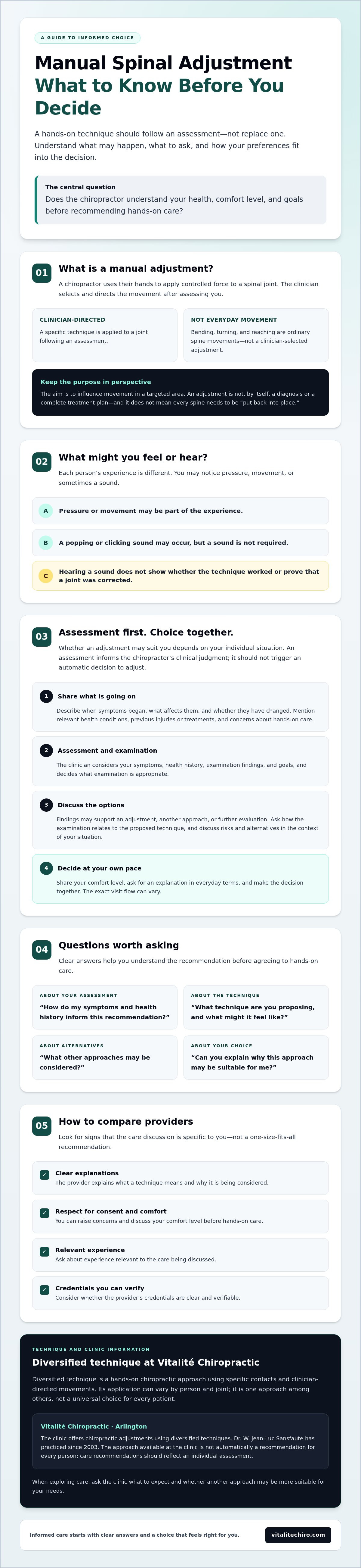
A manual spinal adjustment is a hands-on technique in which a chiropractor applies controlled force to a joint in the spine. The clinician selects and directs the movement after assessing you. This differs from everyday stretching or turning, which you do without a clinician applying a specific technique. The broader term spinal manipulation covers techniques used by different practitioners, so the specific approach can vary. If you’re researching manual spinal adjustment Arlington VA, ask what technique a provider means and how it would be used in your case.
People may notice pressure, movement, or sometimes a sound during an adjustment, but each person’s experience is different. A sound isn’t required, and hearing one doesn’t show whether the technique has worked. An adjustment is also only one possible part of care. It isn’t, by itself, a diagnosis or a complete treatment plan. Recommendations should reflect your symptoms, health history, assessment, and preferences.
How Is a Manual Adjustment Different from Everyday Back Movement?
Your spine moves throughout the day as you bend, turn, and reach. A manual adjustment differs because a clinician selects a specific technique and applies it to a joint after assessing you. The aim is to influence movement in the targeted area, not to suggest that every spine is misaligned or needs to be “put back into place.”
If you’re considering manual spinal adjustment Arlington VA, ask why a particular technique is being proposed and what it may feel like. You can explain your comfort level before care begins and ask the clinician to describe the movement in everyday terms. A popping or clicking sound may occur, but it isn’t a measure of success or proof that a joint has been corrected.
What Does “Diversified Technique” Mean in Chiropractic Care?
Diversified technique is a hands-on chiropractic approach that uses specific contacts and clinician-directed movements. Its application can vary depending on the person and the joint being addressed. It’s one approach among others, not a universal choice for every patient. A chiropractor should explain why the technique is being considered and whether another approach may be more suitable.
Vitalité Chiropractic offers chiropractic adjustments using diversified techniques. That describes an approach available at the clinic, not a recommendation for every person who visits. As you explore manual spinal adjustment Arlington VA, this complete guide to professional chiropractic adjustments offers more context on adjustment terminology and care considerations.
Is Manual Spinal Adjustment Right for You? Assessment, Safety, and Choice
A manual adjustment isn’t suitable for everyone. If you’re researching manual spinal adjustment Arlington VA, deciding whether to use one calls for more than identifying where you feel discomfort. A chiropractor should consider your symptoms, health history, examination findings, and goals before recommending hands-on care. The assessment informs clinical judgment. It shouldn’t be treated as a one-size-fits-all checklist or an automatic decision to adjust.
What Should a Chiropractor Review Before an Adjustment?
Be ready to describe when your symptoms began, what affects them, and whether they’ve changed. Mention relevant health conditions, previous injuries or treatments, and any concerns that could affect how you feel about hands-on care. The clinician can decide what examination is appropriate and consider whether the findings support an adjustment, another approach, or further evaluation.
As you consider manual spinal adjustment Arlington VA, ask what the examination suggests and how it connects to the proposed technique. Risks and alternatives should be discussed in the context of your individual situation, not dismissed with a blanket assurance that a procedure is safe for everyone. The National Center for Complementary and Integrative Health’s Spinal Manipulation: What You Need To Know offers an evidence-based overview of research and safety considerations.
What If You Prefer a Gentler Approach or Have Questions?
If you’re looking into manual spinal adjustment Arlington VA but feel uncertain about hands-on care, say so before treatment begins. Ask how the technique will be performed, what potential risks apply to you, and whether other options are worth discussing. A clinician should explain the plan and give you room to decide. You can pause or decline. Your comfort and consent matter.
Seek prompt medical evaluation rather than routine chiropractic booking for severe or sudden symptoms, such as new weakness or symptoms following a serious injury. If you’re unsure how urgently to seek help, contact an appropriate medical professional or emergency service for guidance.
Choosing a provider starts with finding a clinician who listens and explains how recommendations relate to your assessment. If you’d like to ask Vitalité Chiropractic about its adjustment care, you can learn about the practice. Exploring an appointment doesn’t obligate you to proceed with a technique.
How to Compare Manual Spinal Adjustment Providers in Arlington, VA
Choosing a provider is about more than finding a nearby clinic. When comparing manual spinal adjustment in Arlington, VA, consider how a clinician assesses your needs, explains recommendations, and involves you in decisions. These practical signs can help you distinguish an individualized discussion from a routine that treats every patient the same.
| What to compare | What to look for |
|---|---|
| Assessment | The clinician asks about your concerns and considers relevant history before recommending hands-on care. |
| Explanation | You receive a clear description of the proposed technique, its purpose, and possible risks and alternatives. |
| Consent | You have time to ask questions and decide whether you want to proceed before a technique is performed. |
| Experience | You can verify the clinician’s credentials and ask about relevant experience using reliable sources, such as the Virginia Board of Medicine’s provider resources. |
| Access | The Arlington location, scheduling process, and appointment availability fit your practical needs. Confirm current availability directly with the clinic. |
What Questions Can You Ask Before Choosing a Chiropractor?
Useful questions include: “How will you decide whether manual care fits my needs?” “What might the technique feel like?” and “What alternatives could we discuss?” You can also ask about fees, insurance or payment arrangements, and how to schedule. Clear answers help you understand the proposed care before deciding. For broader background on adjustment procedures and considerations, Mayo Clinic explains what to expect and potential risks.
How Can You Assess a Clinic’s Approach to Individualized Care?
Notice whether the clinician listens without rushing, explains how recommendations relate to your concerns, and welcomes questions about your preferences. A useful discussion should leave room for options rather than presenting one technique as right for everyone. Experience is one factor to weigh, but it doesn’t guarantee a particular outcome.
Vitalité Chiropractic is an Arlington practice led by Dr. W. Jean-Luc Sansfaute, who has practiced since 2003. The clinic’s location and Dr. Sansfaute’s experience can inform your comparison, but they don’t replace an individual assessment. A patient-centered adjustment visit should include a relevant assessment, a clear explanation, and your informed choice before hands-on care.
What Happens Before, During, and After a Manual Adjustment Visit?
A manual adjustment appointment should give you time to describe what’s going on and understand the proposed care. The precise flow varies by patient and clinic, but a visit may follow a simple sequence: share your concerns, complete an appropriate assessment, discuss options, and decide together whether to proceed. Booking an appointment doesn’t mean an adjustment is automatic.
How Should You Prepare for a Chiropractic Appointment?
A little preparation can help you make the most of the conversation. Consider bringing or noting:
- A concise account of your symptoms, including when they began and any changes you’ve noticed.
- Relevant prior care or imaging information, if available.
- Health conditions, medications, previous injuries, or other details that may affect care.
- Questions about the technique, possible options, and what follow-up might involve.
Wear comfortable clothing that lets you move as needed. You don’t need to arrive with every detail organized. Share what you can, and mention if your symptoms have changed since you scheduled. Tell the clinician about any movement or position that causes discomfort.
What Should You Discuss Before Hands-On Treatment Begins?
Before an adjustment, ask what the clinician proposes to do and why it’s being considered based on your assessment. You can ask what the movement may feel like, whether other options are appropriate to discuss, and what to expect afterward. If an explanation isn’t clear, ask for it in different words. You can pause, decline, or request clarification before or during care.
After the assessment, the clinician should explain the options and give you space to decide. If you choose not to have a manual adjustment, discuss what other next steps may be appropriate. Follow-up recommendations should be explained rather than assumed, and you can raise new questions or concerns at that point.
For a manual spinal adjustment in Arlington, VA, the visit should reflect your circumstances, not a fixed routine. If you’re considering chiropractic adjustments at Vitalité Chiropractic, you can contact the clinic to ask about scheduling and what information to bring. Confirm current appointment availability directly with the office.
Explore Manual Spinal Adjustment at Vitalité Chiropractic in Arlington
For people exploring manual spinal adjustment in Arlington, VA, Vitalité Chiropractic offers chiropractic adjustments using diversified techniques. The Arlington practice is led by Dr. W. Jean-Luc Sansfaute, who has practiced since 2003. That information can help you compare providers, but it doesn’t determine whether an adjustment is right for you or guarantee a particular result.
The next step is an individual conversation. Your symptoms, health history, concerns, and comfort level should inform the clinician’s evaluation and any care recommendations. Ask how a proposed adjustment relates to your situation, what it may involve, and whether other options should be considered. Care should be discussed with you, not simply prescribed as a routine.
What Can You Ask Vitalité Chiropractic About Manual Care?
Bring questions about what you’re experiencing and what you hope to address. For example, ask how the clinician will determine whether a manual adjustment is appropriate, what the technique may feel like, and how your preferences will shape the discussion. Share any discomfort or hesitation openly. Those details can help make the conversation more useful.
If you’d like broader context on the clinic’s perspective, read about its whole-body approach to chiropractic care in Arlington. Use that information as a starting point for questions about your own needs, rather than assuming every patient receives the same recommendations.
How Can You Take the Next Step in Arlington?
You can request an appointment online or call Vitalité Chiropractic at (703) 879-5144. Same-day appointments may be available, but availability can change, so confirm current scheduling details directly with the clinic. Before booking, you may also ask what information to bring and what to expect from the initial assessment.
Taking the next step doesn’t mean committing to a particular technique. It’s an opportunity to discuss your concerns, understand the clinician’s recommendations, and decide what feels appropriate for you. If you’re ready to ask about chiropractic adjustments in Arlington, contact Vitalité Chiropractic to learn about scheduling and begin the conversation.
Choose Care That Starts With Your Needs
A manual spinal adjustment should follow an individualized assessment, a clear discussion, and your informed choice. Suitability depends on your circumstances. Ask how a recommended technique relates to your symptoms, what alternatives may be considered, and what to expect before hands-on care begins.
If you’re exploring manual spinal adjustment Arlington VA, Vitalité Chiropractic serves patients in Arlington and offers chiropractic adjustments using diversified techniques. The practice is led by Dr. W. Experience and location may help you compare providers, while your own evaluation and questions should guide decisions about care. Confirm current clinician credentials and contact details as you make plans.
Ready to discuss your concerns and learn about scheduling? Contact Vitalité Chiropractic in Arlington. Taking the next step can simply mean starting a conversation at a pace that feels comfortable to you.
Frequently Asked Questions
What is a manual spinal adjustment?
A manual spinal adjustment is a hands-on technique in which a chiropractor applies controlled force to a spinal joint. The clinician selects the technique after considering your concerns and assessment findings. The movement and sensations can vary, and an adjustment is only one possible part of care, not a diagnosis or a complete treatment plan. Ask the chiropractor to explain the proposed technique before deciding whether to proceed.
Is manual spinal adjustment safe for everyone?
No. Whether an adjustment may be appropriate depends on your symptoms, health history, examination findings, and the clinician’s judgment. Share relevant health conditions, previous injuries, medications, and changes in how you feel. Ask about potential risks and alternatives in the context of your situation. If symptoms are severe or sudden, seek prompt medical evaluation rather than treating a routine chiropractic appointment as urgent care.
Does a manual spinal adjustment hurt?
People experience adjustments differently, so no one can promise exactly how it will feel. You may notice pressure or movement, and a sound can sometimes occur, but it isn’t required or proof of a particular result. Tell the chiropractor if you’re uncomfortable, worried about a sensation, or want to pause. Discuss your comfort level and questions before hands-on care begins so you can make an informed choice.
What is the difference between manual and instrument-assisted adjustments?
A manual adjustment uses the chiropractor’s hands to apply controlled force to a joint. An instrument-assisted approach uses a device to deliver force instead of the clinician’s hands. The specific methods and sensations may differ, and one approach isn’t automatically right for every patient. Ask what technique a provider is proposing, why it may fit your needs, and whether other options are available for discussion.
How do I choose a chiropractor for manual spinal adjustment in Arlington, VA?
Look for a clinician who reviews your concerns, explains recommendations clearly, welcomes questions, and respects your preferences and consent. Verify credentials and relevant experience through reliable sources, and ask how the clinician decides whether manual care may suit you. Consider practical details such as the Arlington location, scheduling, and fees. At Vitalité Chiropractic, Dr. W. Jean-Luc Sansfaute has practiced since 2003. Experience isn’t a guarantee of results.
What happens during a manual spinal adjustment appointment?
The visit may begin with a discussion of your symptoms, health history, and goals, followed by an assessment suited to your situation. The chiropractor can then explain findings, discuss care options, and ask whether you wish to proceed with an adjustment. Appointment flow varies by patient and clinic. Before hands-on treatment, ask what the technique involves and share any relevant concerns or discomfort.
Can I ask the chiropractor to stop or use a different approach?
Yes. You can ask the chiropractor to pause, stop, explain a step again, or discuss a different approach. Raise your comfort level and preferences before treatment begins, and speak up if anything feels uncomfortable during care. The clinician should discuss the plan with you before using a technique. If you don’t want an adjustment, say so and ask what other options may be appropriate to consider.


