
A work injury can affect how you move long after your shift ends. For construction workers, repeated strain may contribute to pain, guarded movement, and added stress on other parts of the body. A chiropractor for construction workers in Arlington can assess when discomfort began and how job-related movements may be contributing.
It makes sense to focus on the painful spot, especially when lifting, bending, or looking upward makes symptoms worse. But lasting care also considers the movements and demands behind the pain. This article explains the repetitive injury cycle and how it can affect back and neck comfort, outlines what an injury and movement assessment may involve, and describes customized, drug-free treatment options. You’ll also learn what helps shape an individualized care plan, so you can better understand the steps from assessment toward improving comfort and function.
Key Takeaways
- Notice how recurring back or neck discomfort may relate to repeated work demands and changes in movement, not just one painful spot.
- Learn which details of your symptoms, work tasks, and movement can help shape an individualized care plan.
- Understand how chiropractic adjustments, decompression therapy, and other noninvasive options may be considered for your needs.
- See how an injury and movement assessment can help guide treatment choices and clarify the next steps toward improved comfort and function.
Back and neck pain
Construction work can strain the back and neck through repeated lifting, overhead tasks, prolonged bending, and carrying materials. Symptoms may affect the lower back, neck, or shoulders and can persist when demanding movements continue despite discomfort. For example, repeatedly turning to check overhead work may leave a worker with neck stiffness and shoulder tension. An assessment considers where pain occurs, which movements trigger it, and how it affects work and daily life.
Pain can also affect areas beyond the spine. Neck discomfort may occur with headaches or upper-body tension, while shoulder pain can make reaching and carrying harder. Hip or knee symptoms may interfere with squatting, climbing, or walking around a site. Wrist and ankle pain can affect gripping tools or maintaining balance. Because these symptoms can have different causes, their location alone doesn’t identify what is driving them. The pattern, onset, and effect on movement help guide the evaluation.
Lower-back pain may be associated with disc conditions or sciatica, which can involve pain traveling into the leg. A clinician considers the symptom pattern and movement limitations before discussing care. Chiropractic adjustments may be one option when appropriate for the individual’s presentation. The aim is to connect the assessment with practical needs, such as bending, lifting, and returning to daily tasks, rather than treating every worker’s pain alike.
Evidence should be interpreted carefully. The National Center for Biotechnology Information describes clinical-science evidence for chiropractic care’s effectiveness for back pain, neck pain, and headache. A separate review summarized by the National Center for Biotechnology Information (NCBI) reports that recent reviews and meta-analyses found chiropractic no better than placebo interventions or natural disease progression. These differing conclusions do not guarantee an individual outcome. For a construction worker, a focused evaluation of pain, movement, and function is a practical next step. Changes in comfort and quality of life can then be considered alongside work demands and broader wellness needs.
Customized chiropractic treatment plans
A treatment plan should reflect the injury, symptoms, and tasks a construction worker needs to perform. A chiropractor for construction workers in Arlington can consider whether pain followed a specific incident or developed gradually, then assess how bending, lifting, or overhead work affects movement. Persistent stiffness during overhead tasks, for example, calls for a different discussion than discomfort when lifting from the floor. These details help shape care around functional goals, rather than a standard sequence for every patient.
Personalized chiropractic care may include adjustments or other appropriate therapy, guided by the assessment and the person’s response. The plan can account for pain location, posture, movement limitations, and changes over time. If symptoms shift from the lower back toward the leg, that change is relevant to the next clinical discussion. Progress is reviewed against practical goals, such as moving more comfortably through essential work tasks, and care can be adjusted as needs evolve.
When choosing care for a construction-related injury in Arlington, look for an approach that considers injury history, work demands, movement, and individual goals before recommending treatment. Reviews can illustrate patient experiences; look for comments about communication and care planning, while remembering that one person’s experience doesn’t predict another’s. Insurance plans and coverage terms are also practical considerations, since benefits depend on the specific policy and covered care.
The potential benefit of an individualized plan is care directed toward a person’s symptoms and functional priorities. A key risk is continuing with an approach that isn’t helping or overlooking a meaningful change in symptoms, so reassessment matters. For a clearer picture of how chiropractic care is tailored, consider the assessment process alongside the proposed treatment plan.
Drug-free, noninvasive chiropractic treatments
At your first appointment, discuss the workplace injury, symptoms, and daily demands. Bring a concise timeline of when the pain began, which tasks affect it, your insurance card, and any relevant medical records or imaging reports. For example, note whether lifting, reaching, or gripping changes the discomfort. These details help connect the examination with functional goals and inform the treatment discussion.
Noninvasive care can include chiropractic adjustments and soft-tissue techniques. A clinician may assess how joints move and whether surrounding muscle tension is associated with a patient’s symptoms. Massage is one familiar soft-tissue approach, but the technique selected depends on the examination and the area involved. Doctors’ notes or imaging reports can add context when they’re available, especially after a workplace injury.
Same-day appointments are available in Arlington, while evening hours depend on each practice’s schedule. Treatment costs depend on the case and are given after a quote request; relevant factors include the injury assessment and proposed care. Insurance coverage varies by policy and covered services, so review your plan’s benefits and any documentation requirements before treatment.
Ask how the clinician will assess progress, which symptoms to report, and how treatment relates to work activities. For example, a plan for shoulder discomfort during overhead tasks should consider that movement, rather than focusing only on the area at rest. This practical discussion clarifies the purpose of care and helps you make informed decisions.
Drug-free care offers an option for people seeking noninvasive approaches, but treatment selection should reflect the injury and examination findings. A clear explanation of the proposed approach, expected steps, and alternatives supports informed consent. Explore noninvasive chiropractic care as part of a conversation about your needs and return to functional activities in Arlington’s construction community.
Injury evaluation and movement assessment
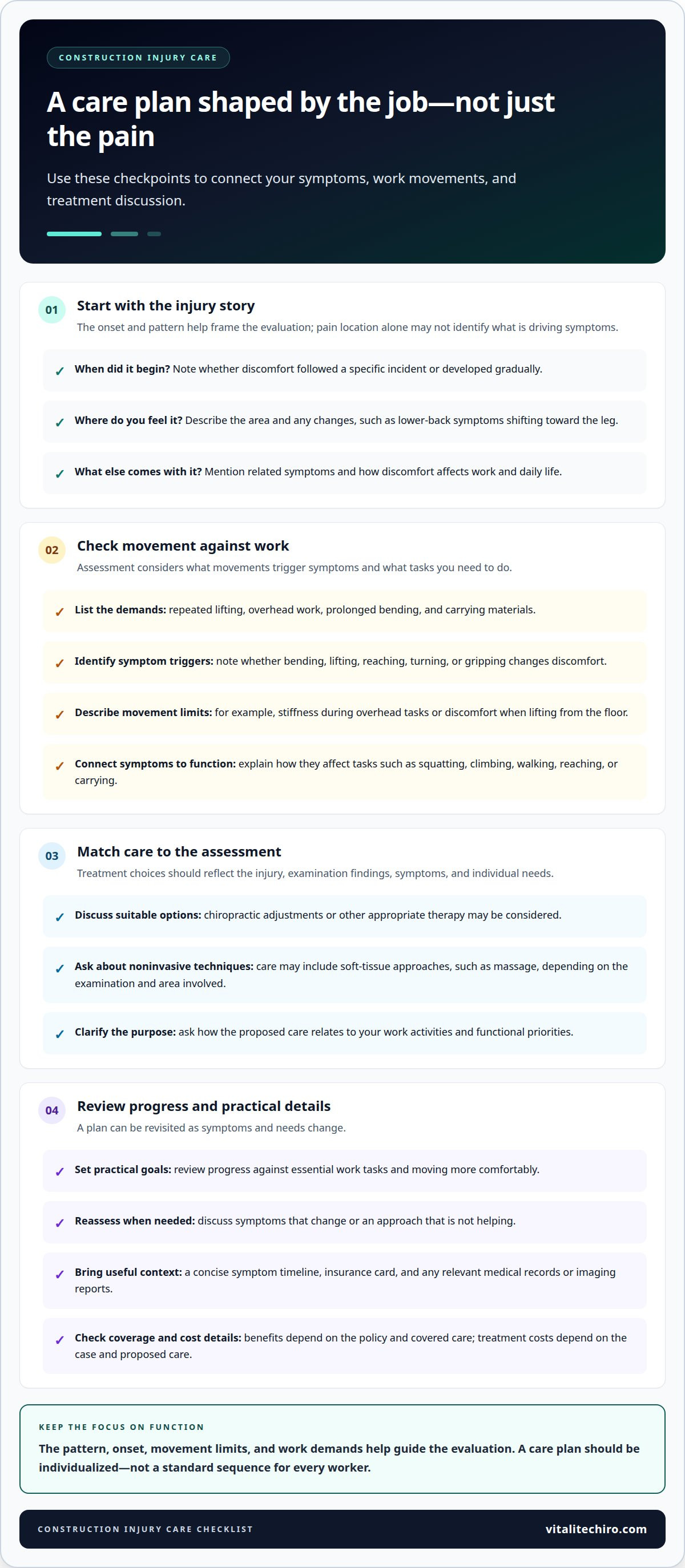
A useful evaluation connects the injury with the movements your job requires. At an appointment, the clinician reviews when symptoms began, which tasks affect them, and how they have changed. A worker with pain after repeated overhead tasks, for example, can describe when discomfort appears and whether it limits reaching. This history frames the movement assessment around actual work demands.
Next, the clinician assesses relevant motion and mobility, such as bending, turning, reaching, or walking. The aim is to understand which movements feel restricted or bring on symptoms, rather than assuming the painful area explains everything. If turning the neck changes shoulder discomfort, that response provides useful context. The clinician can compare reported limitations with observed movement and discuss what they may mean for daily function.
The assessment also considers how symptoms affect specific tasks. Difficulty lifting material from floor level, for example, calls for a different discussion than discomfort while using tools overhead. These examples help identify practical goals, such as improving comfortable range of motion or completing necessary tasks with less limitation. Relief matters, alongside mobility and the ability to manage work-related activities.
Evaluation continues beyond the first appointment. Changes in symptoms, movement, or task tolerance can inform later care discussions. If a previously restricted movement becomes easier, that matters; so does the development of a new symptom. Sharing these changes helps keep the plan connected to the injury and your functional needs. It also gives you a concrete way to discuss whether care remains aligned with progress and work demands.
For an assessment focused on injury history and work-related movement, schedule an injury and movement assessment.
Vitalité Chiropractic
Vitalité Chiropractic helps construction workers in Arlington address work-related back, neck, and movement concerns. When discomfort affects lifting, reaching, or other job tasks, Chiropractic Adjustments, Decompression Therapy, or Sports Injury Care may be considered as part of an individualized plan. The appropriate approach depends on your symptoms and needs, not a standard plan for every worker.
If recurring pain is interfering with work, an appointment can help you discuss your concerns and possible treatment options. Contact Vitalité Chiropractic to talk about care for a construction-related injury.
Choose a next step that fits your work
Think about what you want daily work to feel like, not just which movements cause discomfort now. Is your priority reaching overhead more easily, carrying materials more comfortably, or getting through a shift with fewer interruptions? Naming that practical goal can make a care conversation more focused. A chiropractor for construction workers in Arlington can discuss how your work demands relate to your concerns and which approach may support your goals.
Vitalité Chiropractic offers Chiropractic Adjustments, Decompression Therapy, and Sports Injury Care. These services can inform a discussion about your needs without assuming one approach suits every worker. Bring your priorities to the conversation and explore a considered path forward.
Contact Vitalité Chiropractic to discuss your construction-related concerns and possible next steps. Taking time to address how you want to move and work can be a constructive step toward feeling more confident in your daily routine.
Frequently Asked Questions
What is the Repetitive Injury Cycle, and how does it affect my health?
The Repetitive Injury Cycle describes how recurring work strain can lead to symptoms, protective changes in movement, and added stress elsewhere. A worker may, for example, change how they bend after back discomfort and then notice tension during another task. If the same demands continue, symptoms may return or affect function. Recognizing this pattern helps identify work movements to discuss during an injury evaluation.
Which chiropractors in Arlington treat construction workers and work-related injuries?
Vitalité Chiropractic provides care in Arlington, Virginia, for people with work-related pain and injury concerns. A chiropractor for construction workers in Arlington can consider the demands of physical work when discussing care. Vitalité Chiropractic offers Sports Injury Care, Chiropractic Adjustments, and Decompression Therapy. The right option depends on your symptoms and clinical assessment.
Which Arlington chiropractors specialize in back, neck, shoulder, and joint injuries common in construction?
Vitalité Chiropractic offers Sports Injury Care in Arlington for work-related musculoskeletal concerns. Construction tasks can involve different areas, from the back and shoulders to joints used for lifting or tool work. An assessment connects the affected area with the activity that brings on symptoms. Care options include Chiropractic Adjustments and Decompression Therapy, chosen in relation to individual needs.
Do Arlington chiropractors accept workers’ compensation claims?
Workers’ compensation claims are separate from standard health insurance benefits. Vitalité Chiropractic accepts most major insurance plans, but this does not establish whether a specific workers’ compensation claim can be billed. For an active workplace claim, the claim administrator determines applicable coverage and billing requirements. Keep claim details and insurer instructions available when arranging care.
What is the cost of a chiropractic visit in Arlington without insurance?
This offer covers the initial special, not the cost of every later visit. Fees for other care depend on the case; relevant factors include the assessment and recommended treatment.
Which Arlington chiropractors accept workers’ compensation, health insurance, or offer payment plans?
Vitalité Chiropractic accepts most major insurance plans and offers flexible payment options. Workers’ compensation claims follow a separate process, so acceptance of standard health insurance does not establish claim billing. Coverage and out-of-pocket responsibility depend on the policy and care involved.


